
Checking C/O and preferential rates for imports

An enterprise importing goods from China or an ASEAN country usually receives a C/O Form E or a C/O Form D from the seller and wants to declare a lower tax rate on the customs declaration (in everyday speech, "submitting the C/O to customs"). This page answers four questions: when the customs declarant must submit the proof of origin of goods and at what time, how the document is declared and submitted on the customs declaration, how the customs authority checks a C/O Form E against the data of the issuing authority in China, and how the customs authority handles a C/O whose commodity code differs from the code on the customs declaration. The rules of origin of each agreement, the procedure for issuing a C/O in the exporting country and the cases in which a C/O is rejected are outside the scope of this page.

Summary

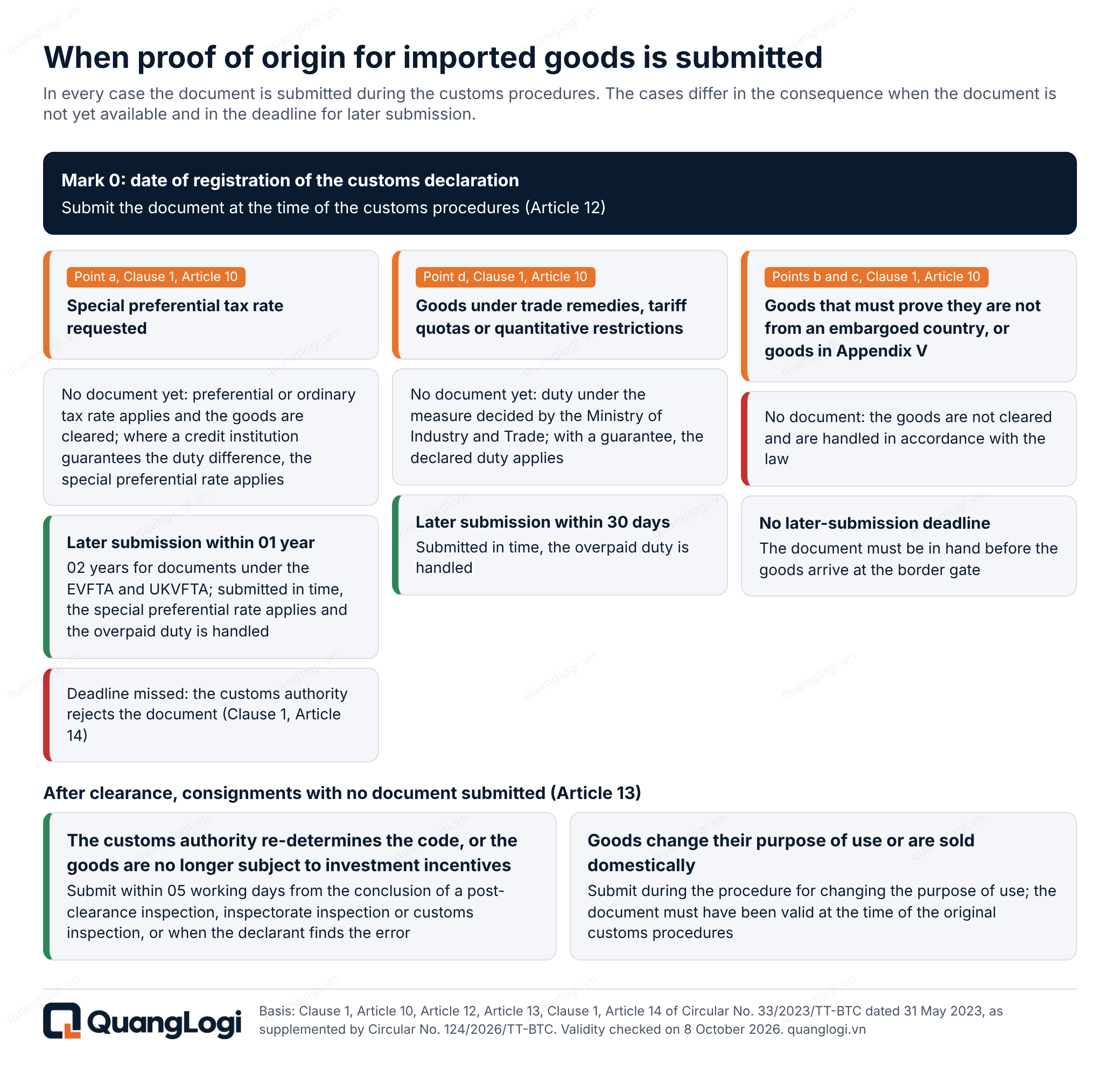
  • Goods for which the special preferential tax rate is requested but whose proof of origin is not yet available are still cleared at the preferential or ordinary tax rate; the document may be submitted later within 01 year from the date of registration of the declaration, or 02 years under the EVFTA and the UKVFTA.
  • Goods that must be proven not to be imported from an embargoed country, or not to originate from a country under control, are not cleared without the document.
  • The lookup result for a C/O Form E does not show the origin criterion; the China Customs site does not show the signatory or the quantity, while the CCPIT site shows both. The missing items can only be checked against the copy of the C/O and the documents of the consignment.
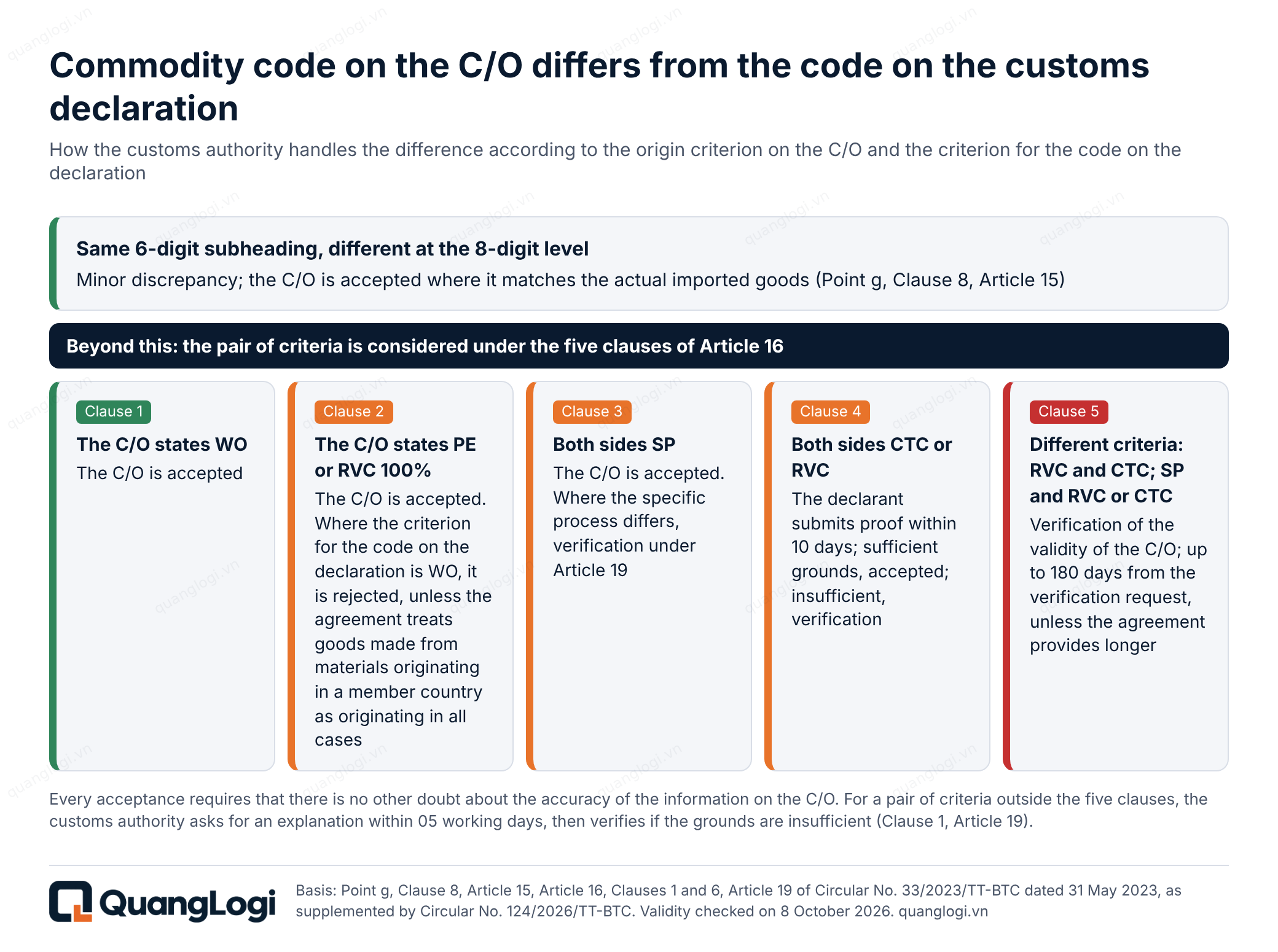
  • A commodity code on the C/O that matches at the 6-digit subheading and differs at the 8-digit level is accepted where it matches the actual goods; other differences are handled by the pair of origin criteria on the C/O and on the declaration.
  • A consignment for which no C/O was submitted during the procedures, and whose code is later re-determined in a way that changes the import duty, may have the C/O submitted later within 05 working days from the date of the conclusion.

Four cases in which proof of origin must be submitted, and the consequence where the document is not yet available

The customs declarant must submit the proof of origin of goods when it wants the special preferential tax rate, and when the goods must prove their origin for reasons of embargo, safety control or trade remedies (Clause 1, Article 10 of Circular No. 33/2023/TT-BTC dated 31 May 2023 of the Minister of Finance on the determination of origin of exported and imported goods, as supplemented by Circular No. 124/2026/TT-BTC, hereinafter referred to as Circular No. 33/2023/TT-BTC). The document is a certificate of origin (C/O) or an origin self-certification document under the relevant agreement (Point a, Clause 4, Article 10). In all four cases the document is submitted at the time of the customs procedures. Article 12 divides the consequences into three regimes.

Case in which the document must be submitted Consequence where the document is not available at the time of the procedures What the importer must do
a) The customs declarant wants the special preferential tax rate for goods originating from a country, group of countries or territory that has a tariff preference arrangement with Vietnam, including goods from a non-tariff zone imported into the domestic market that meet the origin conditions of that country, group of countries or territory The goods are subject to the preferential or ordinary tax rate and are cleared; where the difference in duty is guaranteed by a credit institution, the special preferential tax rate applies. The document is submitted later within 01 year from the date of registration of the customs declaration, or 02 years for documents under the Vietnam - European Union Free Trade Agreement and the Vietnam - United Kingdom of Great Britain and Northern Ireland Free Trade Agreement Record the deadline for the later submission in the consignment file; the document submitted later must still be within its validity period
b) Goods that, under a notice of a competent Vietnamese authority, must have a document proving that they are not imported from a country, group of countries or territory on the embargo list under a Resolution of the United Nations Security Council The goods are not cleared and are handled in accordance with the law Have the document in hand before the goods arrive at the border gate
c) Goods on the List in Appendix V to Circular No. 33/2023/TT-BTC or under a notice of a ministry or sector, which must have a document determining that they do not originate from a country posing a risk to social safety, public health or environmental hygiene The goods are not cleared and are handled in accordance with the law Check the commodity code against Appendix V before signing the purchase contract
d) Goods on a List under a Decision of the Minister of Industry and Trade currently subject to anti-dumping duty, countervailing duty, safeguard measures, tariff quota measures, measures against circumvention of trade remedies or quantitative restrictions The goods are subject to the duty under the measure decided by the Ministry of Industry and Trade; where the duty payable is guaranteed by a credit institution, the declared duty applies. The document is submitted later within 30 days from the date of registration of the customs declaration Check the list of goods under measures in force at the time of registration of the declaration

Where goods are exempt from submitting proof of origin under an international treaty to which Vietnam is a party, the customs authority does not require the document (Clause 2, Article 10). The date of registration of the declaration is the starting mark of both later-submission deadlines, 01 year and 30 days, so this date needs to be recorded together with the declaration number in the consignment file.

Diagram of when proof of origin for imported goods is submitted: later-submission deadlines of 01 year, 30 days and 05 working days, and the cases in which goods are not cleared
When proof of origin for imported goods is submitted and the deadlines for later submission, under Circular No. 33/2023/TT-BTC.

A typical consignment for row a: the goods have arrived at the port, the Chinese seller only has the C/O Form E more than two weeks later, and the importer asks whether the goods must be held at the port to wait for the C/O. Under row a, the consignment is cleared first and the C/O is submitted later.

The ACFTA rate is checked in the tariff schedule before the C/O Form E is considered

Case a only matters where the goods have a special preferential tax rate in the tariff schedule of the agreement. For the ASEAN - China Trade in Goods Agreement, the schedule is issued with Decree No. 118/2022/ND-CP dated 30 December 2022 of the Government and applies until 31 December 2027 (Clause 3, Article 3). Tariff lines marked "*" and goods from a country listed in the column "Countries not eligible for preference" do not receive the ACFTA rate (Clause 4 and Clause 5, Article 3).

Declaring proof of origin on the customs declaration and submitting it through the System

Proof of origin enters the customs dossier through the declaration itself: the information on the document is declared on the declaration first, the document is submitted afterwards, and the original is kept.

  1. Declare in the "Notes" field of the electronic customs declaration: the reference number and date of issue of the C/O, or the code of the exporter eligible to issue origin self-certification documents (REX code under the EVFTA, EORI code under the UKVFTA, CE code under the ATIGA or the RCEP). Where the agreement provides for no reference number or exporter code, declare the name of the document, the document number, the date of issue, and the name of the issuing organisation or exporter, together with the name of the applicable agreement.
  2. Submit the document as electronic data or as a paper document converted into an electronic document (a scan confirmed by digital signature) through the customs electronic data processing system. A C/O issued on the National Single Window Portal, the ASEAN Single Window or a website notified by the competent authority of the exporting country does not have to be submitted; the information on the document is still declared under step 1.
  3. Where the consignment has a written notice of an advance origin ruling that is still valid, declare its number and date of issue; where the consignment uses a deduction tracking slip, declare the date of issue and the issuing unit of the slip, also in the "Notes" field.
  4. Keep the original documents to present them during a post-clearance inspection, an inspectorate inspection, a customs inspection, or when the customs authority doubts the validity of the document during the procedures; if they cannot be presented, the customs authority conducts a verification.

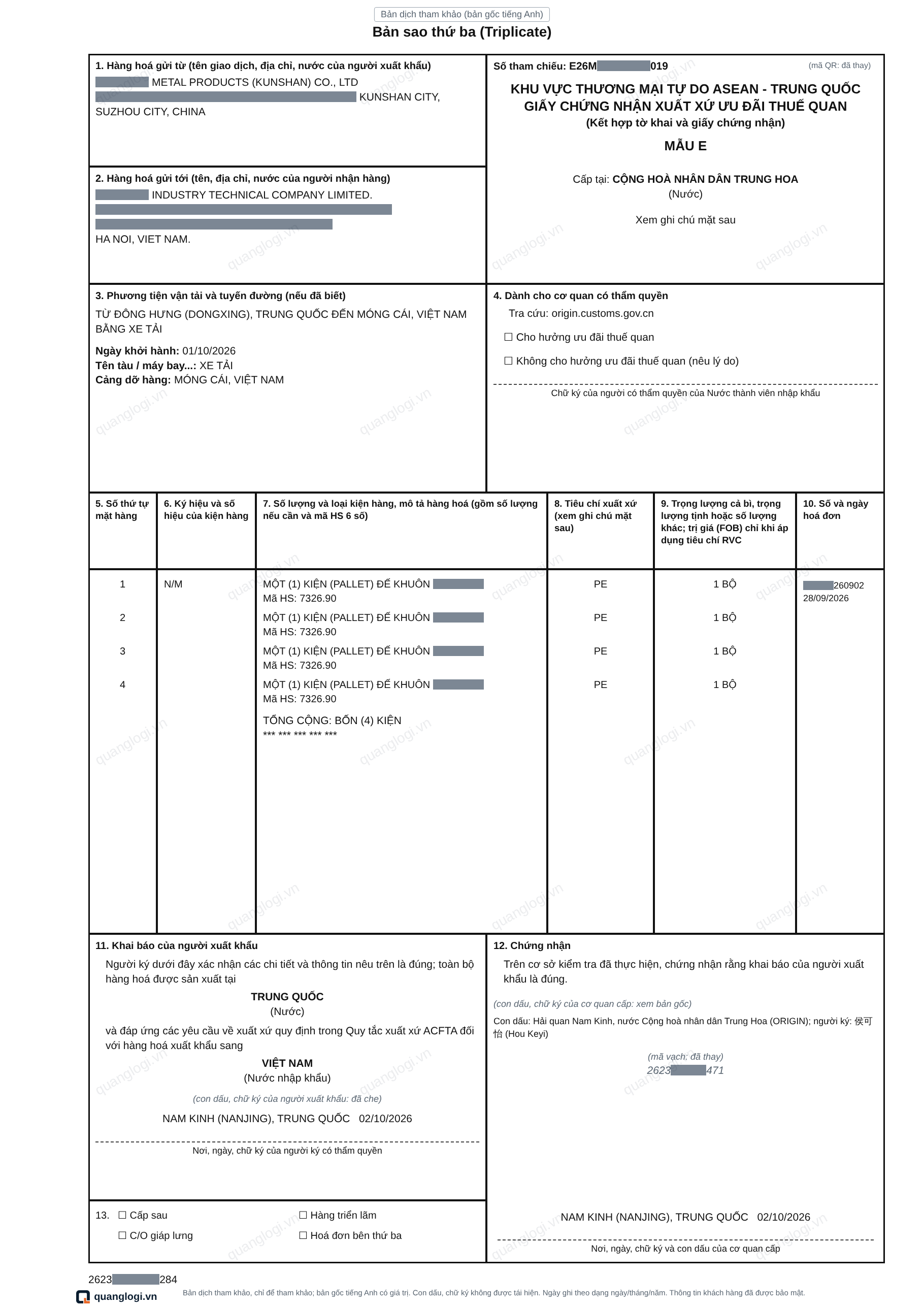
In practice, an enterprise importing machinery from China once received only the Triplicate from the seller and asked whether that C/O Form E was valid. A C/O Form E consists of one original (Original) and two copies (Duplicate and Triplicate); the original is sent by the exporter to the importer, the Duplicate is kept by the issuing authority and the Triplicate is kept by the exporter (Clause 1 and Clause 4, Article 19 of Circular No. 12/2019/TT-BCT dated 30 July 2019 of the Minister of Industry and Trade on the Rules of Origin in the Framework Agreement on Comprehensive Economic Co-operation between the Association of Southeast Asian Nations and the People's Republic of China). The copy to be kept under step 4 is the Original.

Where the information on the document was not declared, or was declared incorrectly, at the time of the procedures, the customs declarant may make a supplementary declaration. The four steps above and the supplementary declaration are governed by Article 11 and Clause 4 and Clause 5, Article 12. The consequence of a supplementary declaration depends on when it is made, under the five cases of supplementary declaration for an import customs declaration.

Consignments imported in several lots, and actual quantities that differ from the C/O

A deduction tracking slip is used when one proof of origin serves several imports. For a consignment brought from a bonded warehouse into the domestic market in several lots, or a consignment under one contract and commercial invoice imported in several lots or shipments, the document may be used to issue a slip for each import. The Customs Sub-department where the first import declaration is registered issues the slip and hands it to the customs declarant to present at each import, until the quantity on the slip and on the document is used up (Article 22). Two other quantity mismatches fall under Article 15.

  • Only part of the consignment is imported: the customs authority accepts the C/O for the part actually imported; the remaining part imported later is accepted where it matches the quantity on the C/O (Clause 5, Article 15).
  • The actual quantity exceeds the quantity on the C/O: the part matching the quantity on the C/O receives the preference if the difference does not affect the validity of the C/O; the excess receives the preference when the customs declarant submits an additional document within the validity period of that document and matching the quantity stated on it (Clause 6, Article 15).

The deduction tracking slip in Article 22 is different from the material deduction ledger in the C/O application file for exported goods. The material deduction ledger I prepare for clients tracks the quantity of materials against each line of the import customs declaration or the value-added tax invoice. The slip in Article 22 is issued by the customs authority. It tracks the quantity of goods of one proof of origin across several imports. The two documents belong to two different procedures and are prepared by two different parties, so the person preparing the file needs to use the full name when dealing with the customs authority.

The China lookup sites for a C/O Form E confirm only the basic data

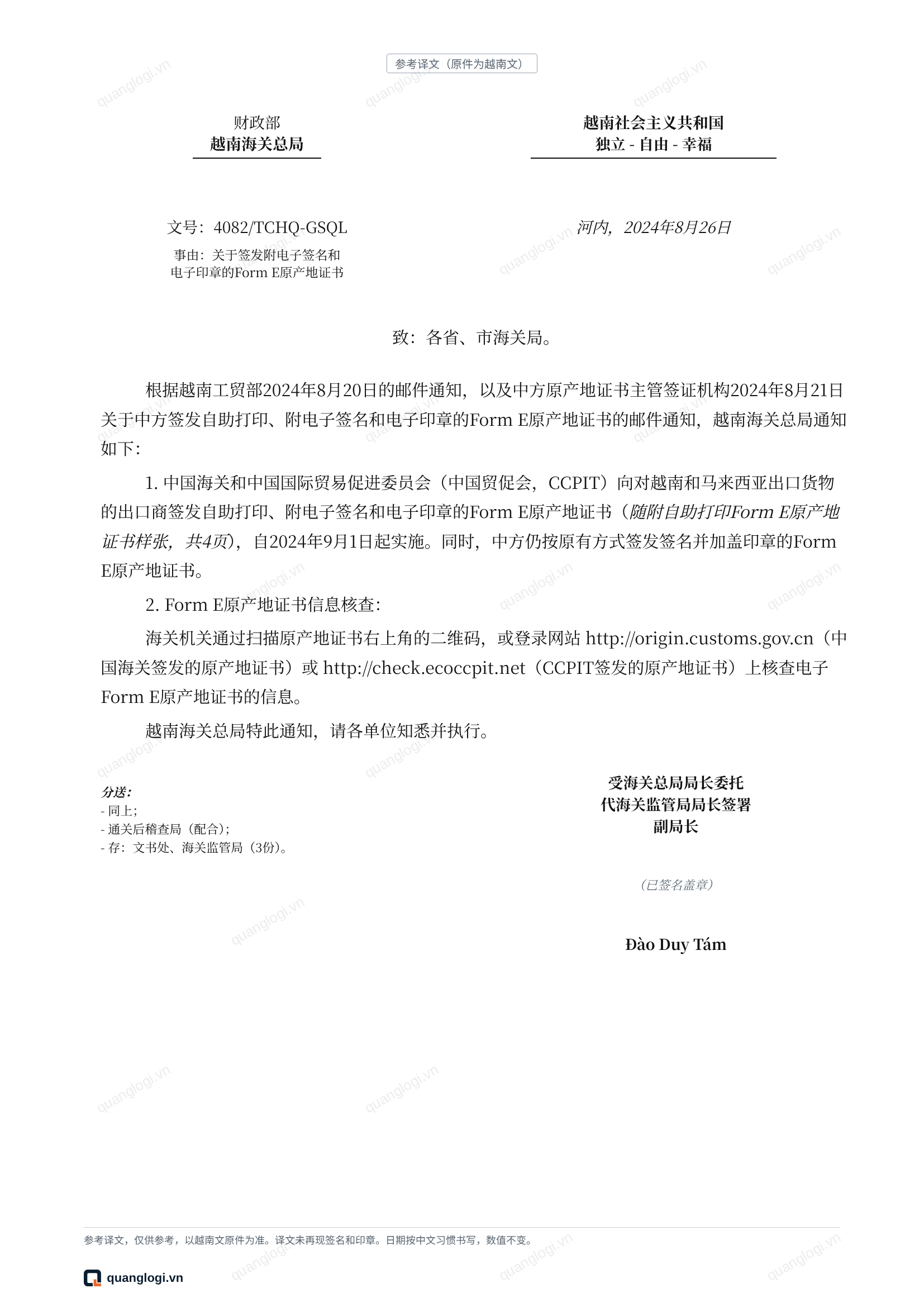
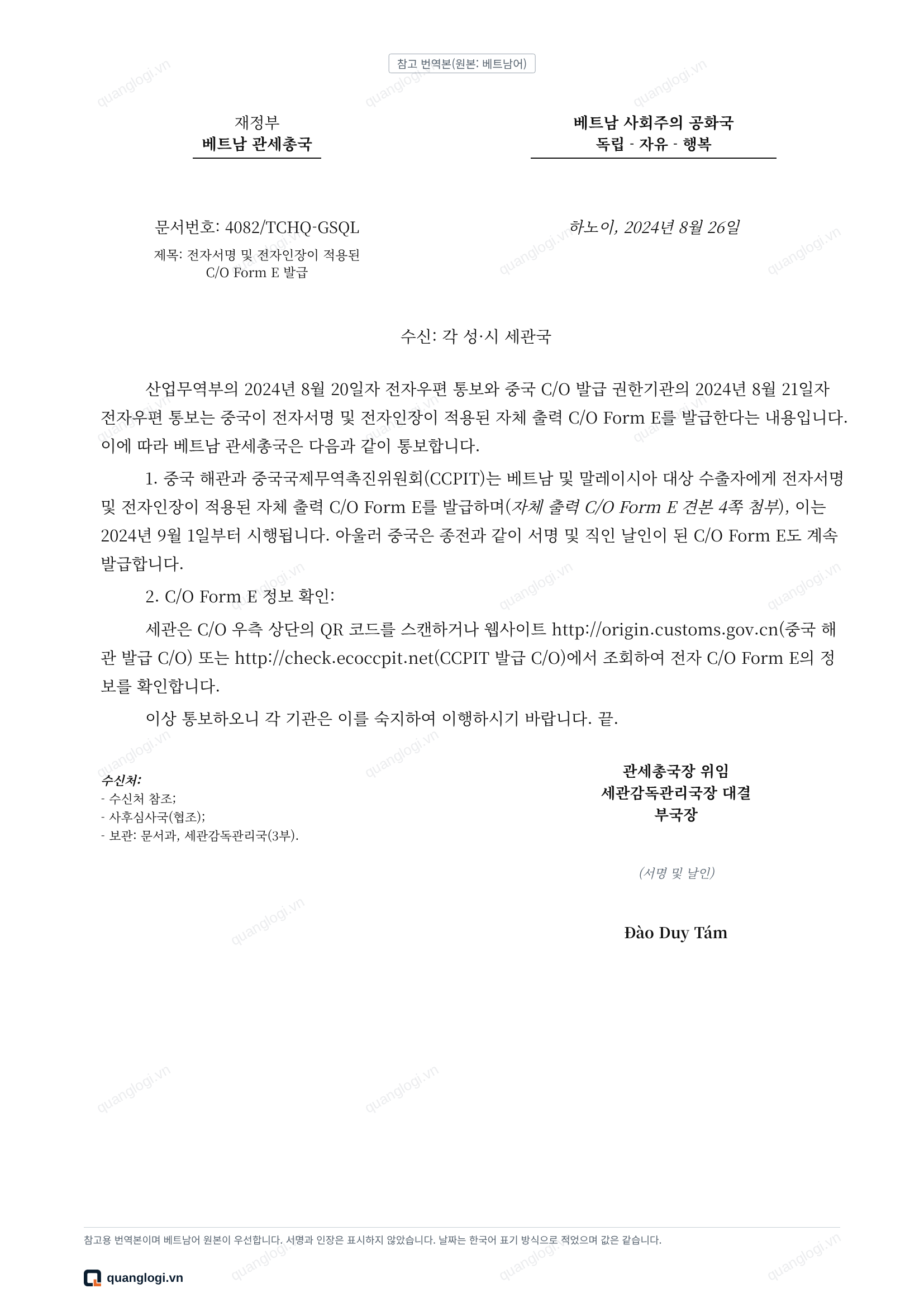
The General Administration of Customs of China and the China Council for the Promotion of International Trade (CCPIT) issue the C/O Form E in two forms. The first is the version with an ink signature and ink seal, as before; the second is the self-printed version with an electronic signature and electronic seal, issued to exporters to Vietnam and Malaysia from 1 September 2024. The self-printed version has no ink seal. The Vietnamese customs authority checks this version through the QR code in the top right corner of the C/O, or on the site origin.customs.gov.cn for a C/O issued by China Customs and the site check.ecoccpit.net for a C/O issued by the CCPIT. The General Department of Vietnam Customs gave notice of these two forms and the two lookup sites in Official Letter 4082/TCHQ-GSQL dated 26 August 2024. Every C/O Form E in the consignments I clear is the self-printed version with an electronic signature and electronic seal; across the market, as of October 2026, almost all C/O Form E certificates in circulation are self-printed.

Official Letter 4082/TCHQ-GSQL of 26 August 2024 of the General Department of Vietnam Customs on C/O Form E with electronic signature and seal.
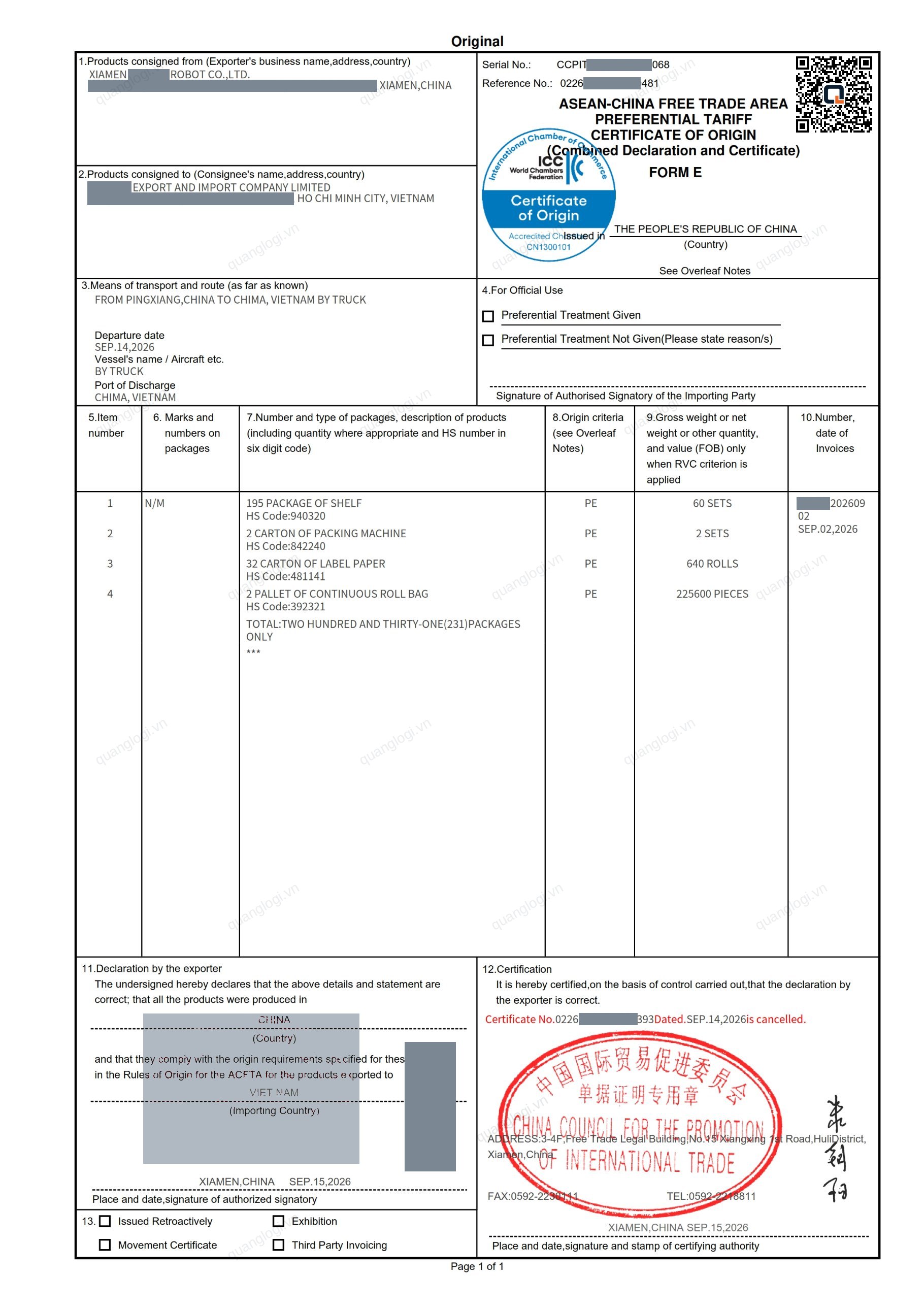
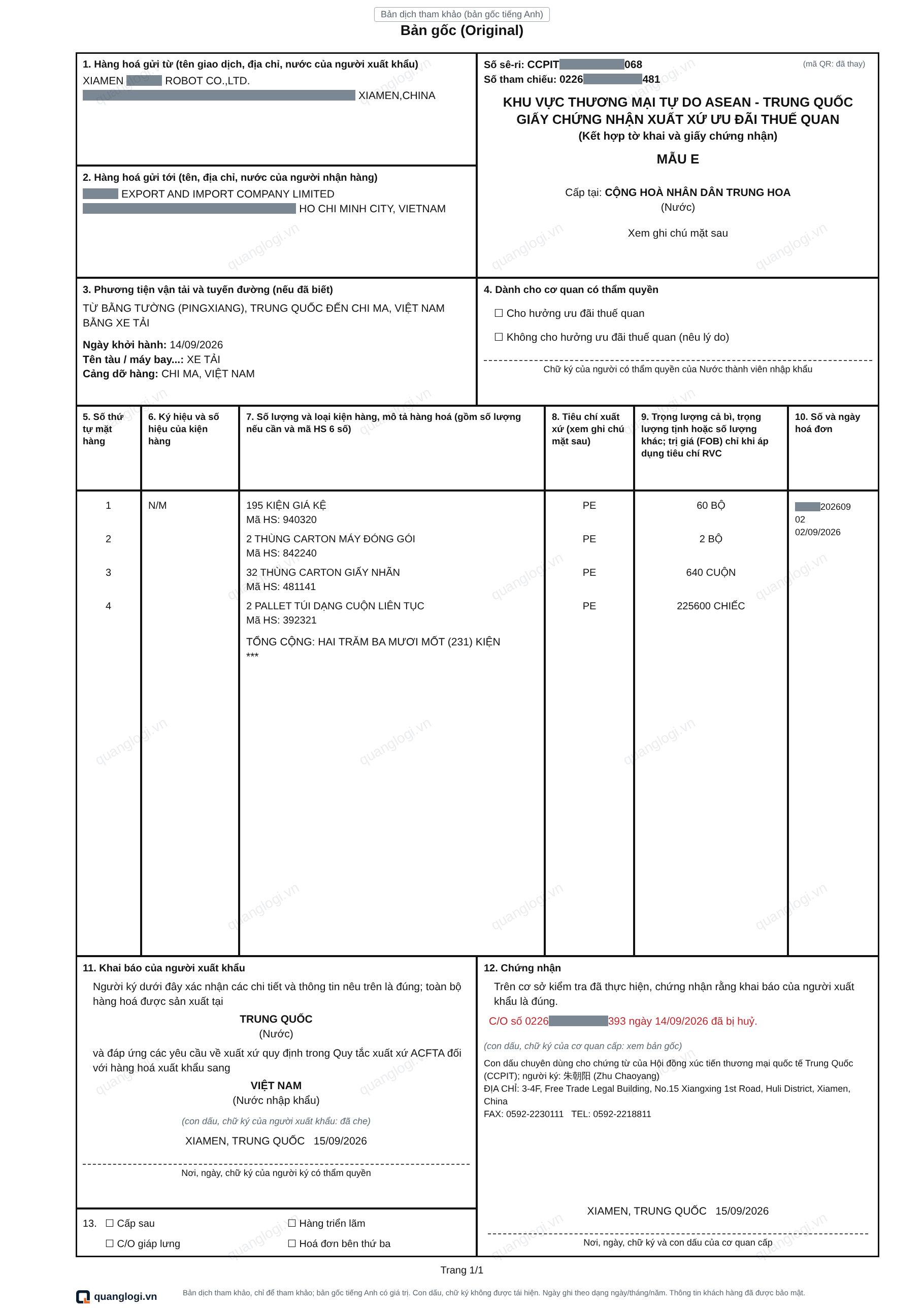
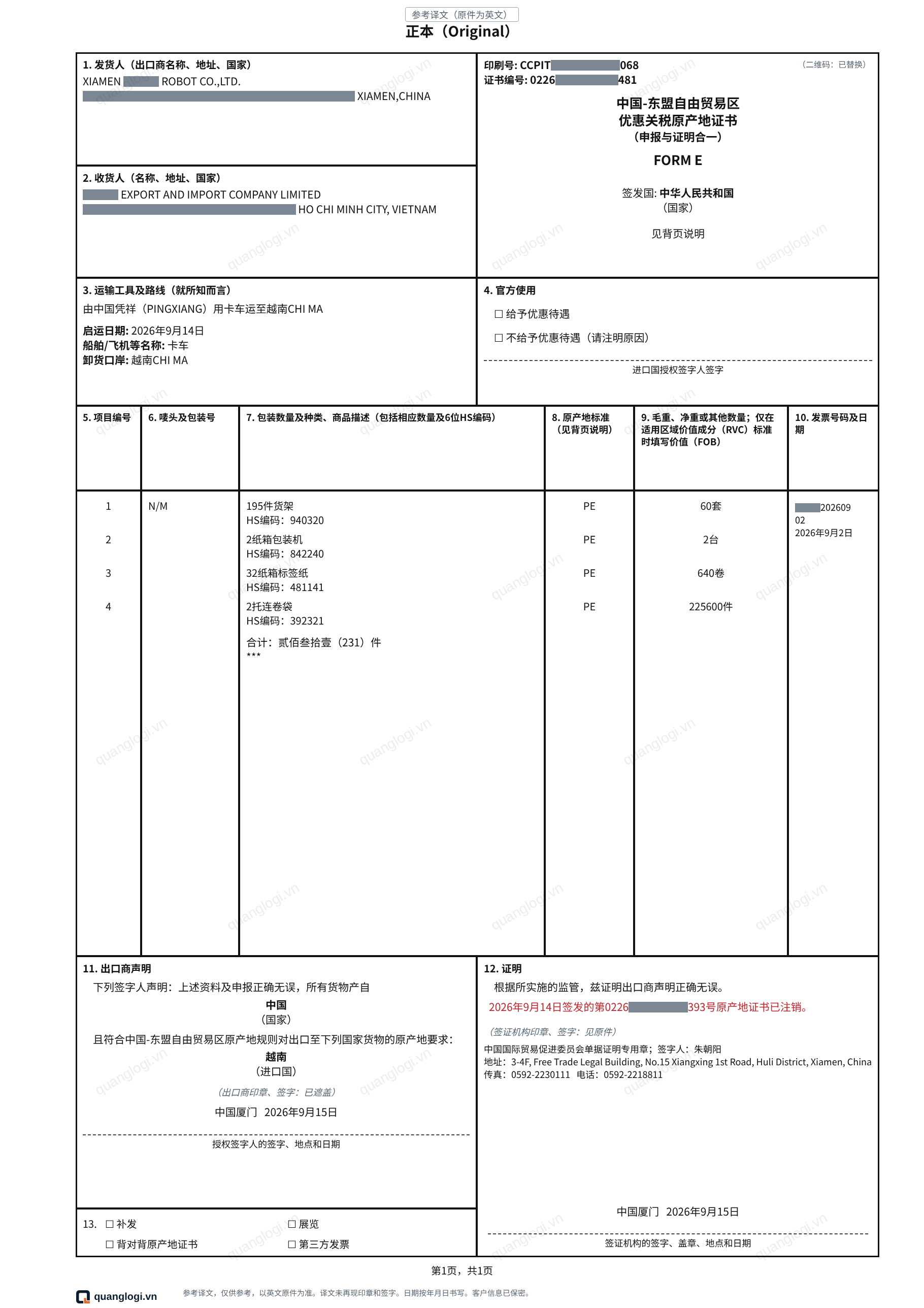
C/O Form E issued by the China Council for the Promotion of International Trade (CCPIT) Xiamen, with the Serial No. and Reference No. at the top

C/O Form E issued by the CCPIT, self-printed with electronic signature and seal, checked on check.ecoccpit.net

View full size

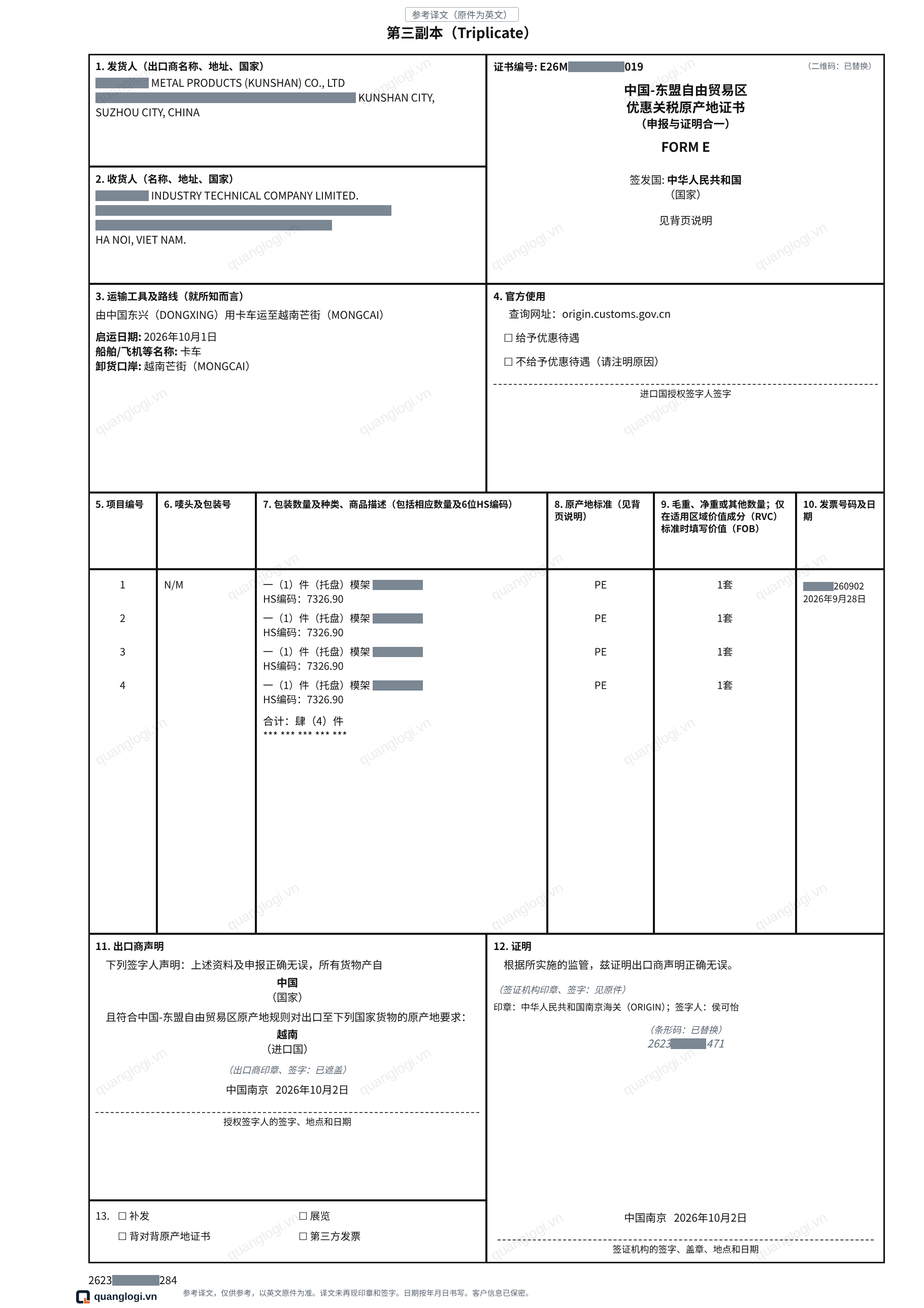
C/O Form E issued by Nanjing Customs, box 4 reading Verification: origin.customs.gov.cn

C/O Form E issued by China Customs, self-printed with electronic signature and seal, box 4 printed with origin.customs.gov.cn

View full size

Sample documents. Customer information protected; QR codes replaced.

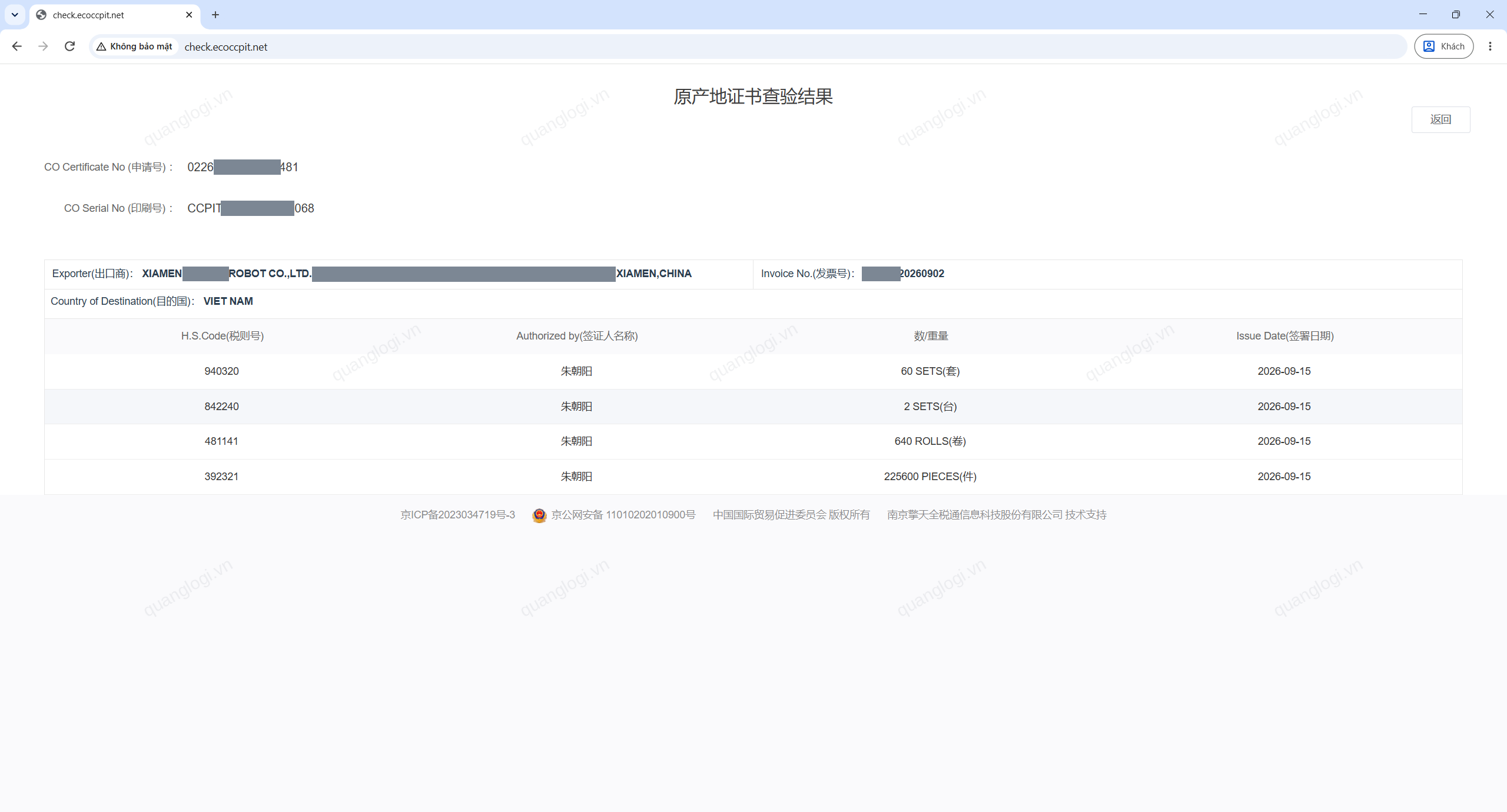
The lookup results on the two sites are not the same. origin.customs.gov.cn returns the C/O number, the exporter, the invoice number, the 6-digit HS code, the importing country, the place of issue and the date of issue; it does not show the signatory's name or the quantity. check.ecoccpit.net returns the exporter, the invoice number and the importing country and, for each 6-digit HS code line, the signatory's name, the quantity or weight and the date of issue; it does not show the place of issue. For a C/O issued by the CCPIT, the signatory's name shown on the lookup site gives one more point to check against the signature on the C/O. The operational handbook cited at the end of this paragraph states that the lookup result lacks the quantity; when I checked on 13 October 2026, the site check.ecoccpit.net did display the quantity. Neither site displays the origin criterion, so the customs officer also checks the copy of the C/O against the customs documentation, and against the result of the physical inspection where the consignment is physically inspected. This way of checking is described in the Handbook on Checking the Origin of Goods under Free Trade Agreements (in Vietnamese) issued with Decision No. 2088/QD-CHQ dated 25 December 2025 of the Director of the Customs Department; the handbook is an operational document, not a legal normative document.

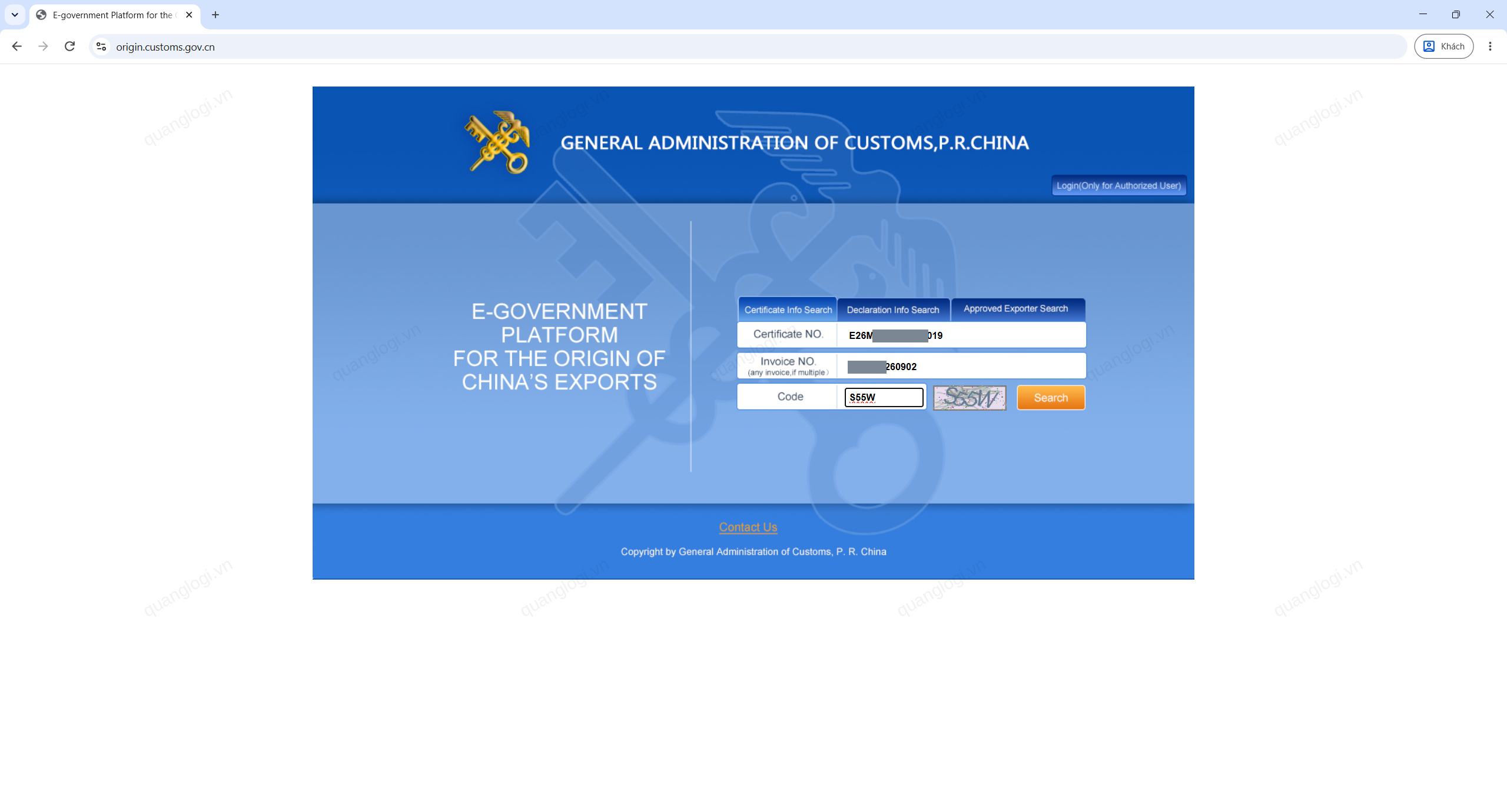
China Customs C/O lookup site origin.customs.gov.cn, Certificate Info Search tab

Input boxes on origin.customs.gov.cn: C/O number, invoice number, verification code

View full size

C/O Form E lookup result on origin.customs.gov.cn showing the C/O number, exporter, invoice number, HS code, place of issue and date of issue

Result on origin.customs.gov.cn: place of issue shown; signatory, quantity and origin criterion not shown

View full size

CCPIT C/O lookup site check.ecoccpit.net with two C/O number boxes and a verification code

Input boxes on check.ecoccpit.net: CO Certificate No (申请号) and CO Serial No (印刷号)

View full size

C/O Form E lookup result on check.ecoccpit.net showing the exporter, invoice number, HS code, signatory, quantity and date of issue

Result on check.ecoccpit.net: signatory and quantity shown; place of issue and origin criterion not shown

View full size

Screenshots taken on 13 October 2026. Customer information protected.

On a C/O issued by the CCPIT, the Serial No. line sits above the Reference No. line; on check.ecoccpit.net, the first box, CO Certificate No (申请号), takes the Reference No., and the second box, CO Serial No (印刷号), takes the Serial No. Entering the two numbers the wrong way round is a mistake I see again and again when looking up C/Os issued by the CCPIT.

Before 1 September 2024, when the C/O Form E existed only with an ink signature and ink seal, the Vietnamese customs authority compared the signature on the C/O with the specimen signatures of the persons authorised to sign C/Os in China, as notified by the General Department of Vietnam Customs, and relied on the lookup result on the issuing authority's site when the signature did not match the list. Official Letter 5022/TCHQ-GSQL dated 30 July 2020 of the General Department of Vietnam Customs sets out three cases based on these two checks.

Signature on the C/O compared with the specimen list Lookup result on the issuing authority's site Action by the customs authority
Minor difference from the specimen signature Exporter, destination, invoice number, issuing authority, HS code and date of issue match the C/O May accept the C/O on the basis of the actual documents of the consignment
Not on the specimen list Matches the C/O Sends the case to the General Department of Vietnam Customs (Customs Supervision and Management Department) for verification
Not on the specimen list No record of the C/O Rejects the C/O

The CCPIT site currently in use is check.ecoccpit.net; Official Letter 5022/TCHQ-GSQL gives the old address check.ccpiteco.net and cites Circular No. 38/2018/TT-BTC, which was replaced by Circular No. 33/2023/TT-BTC from 15 July 2023 (Point a, Clause 1, Article 23). Circular No. 33/2023/TT-BTC treats a minor difference between the signature on the document and the specimen signature as a minor discrepancy, which is accepted where it is consistent with the goods actually imported (Point c, Clause 8, Article 15). For a C/O issued electronically through a website notified by the competent authority of the exporting country, the customs authority checks its validity on that website and records the result in the customs declaration (Clause 1, Article 15).

People still ask for the name of the officer who signed a C/O Form E issued by Hangzhou Customs or Xiamen Customs, a habit left over from the period of checking specimen signature lists. I look up the C/O on the issuing authority's site before searching for the specimen signature list. For a C/O with an ink signature, the lookup result is the deciding factor in all three cases in the table above.

The importer can run the same check on receiving the copy of the C/O from the seller, before the goods arrive at the border gate. The exporter, the invoice number and the HS code on the lookup site are compared with the commercial invoice and the customs declaration to be registered. Third-party invoicing is an exception. In that case the invoice number in Box 10 of the C/O may be the number of the first invoice or of the third-party invoice, and the third-party invoice must be attached to the C/O when it is presented to the customs authority (Article 33 of Circular No. 12/2019/TT-BCT).

The date of issue of the C/O is the second item to check. An enterprise has asked whether a C/O Form E issued before the vessel departs is accepted, where the seller requested early issue because of a one-week public holiday in China. A C/O Form E is issued before or at the time of shipment, so a date of issue earlier than the departure date is not a discrepancy. A C/O issued more than 3 days after shipment must be ticked in Box 13 at "ISSUED RETROACTIVELY", and may only be issued within 12 months from the date of shipment (Clause 1, Article 21). A missing tick in Box 13 is a reason for the seller to ask the issuing authority to correct the C/O before the customs declaration is registered.

Commodity code on the C/O differs from the code on the declaration: the name of the goods is considered first

From 22 August 2026, the checking of the proof of origin of imported goods is carried out on the basis of risk management; Circular No. 124/2026/TT-BTC adds this as Clause 10, Article 15 and does not amend Clauses 1 to 9. Where the document is selected for checking, a difference between the code on the C/O and the code on the declaration is handled under separate provisions. A different code is not enough to reject a C/O. A code that matches at the 6-digit subheading but differs at the 8-digit level is a minor discrepancy, accepted where it matches the actual imported goods (Point g, Clause 8, Article 15). In the consignments I handle, a C/O Form E code that differs from the declaration at the 8-digit level is mostly due to the Chinese seller writing the 8-digit code under China's tariff schedule rather than the AHTN. The two schedules share the Harmonized System at the 6-digit level and split into their own lines at the 8-digit level. Differences beyond this are handled by Article 16 on the basis of the pair formed by the origin criterion on the C/O and the criterion applying to the code on the declaration, in the cases listed in the five clauses of that article.

Criterion on the C/O and criterion for the code on the declaration How the customs authority handles it What the customs declarant prepares
The C/O states wholly obtained (WO) The C/O is accepted where there is no other doubt about the accuracy of the declared information (Clause 1) No further document needs to be submitted
The C/O states produced entirely from originating materials (PE or RVC 100%), and the criterion for the code on the declaration is not WO The C/O is accepted where there is no other doubt (Clause 2) Check the criterion for the code to be declared before registering the declaration
The C/O states PE or RVC 100%, and the criterion for the code on the declaration is WO The goods do not meet the origin criterion and the customs authority rejects the C/O, unless the agreement treats goods produced in a member country from materials originating in another member country as originating goods in all cases (Clause 2) Check the provisions of the applicable agreement before registering the declaration
Both sides use the specific process criterion (SP) The C/O is accepted where there is no other doubt; where the specific process differs, the C/O is verified under Article 19 (Clause 3) Ask the seller to confirm the production process stated on the C/O
Both sides use the change in tariff classification criterion (CTC) or the regional value content criterion (RVC) The C/O is accepted where the customs declarant proves that the goods under the code on the declaration still meet the criterion, or the customs authority has enough information to determine that the goods still meet the CTC criterion, and there is no other doubt; where no document is provided after 10 days or the grounds are insufficient, the C/O is verified under Clause 4, Article 19 (Clause 4) Within 10 days from the request, submit a copy of the production process, a detailed list of the codes of input materials and output products (for CTC) or a production cost statement (for RVC)
Different criteria: the C/O states RVC and the code on the declaration is CTC, or the reverse; the C/O states SP and the code on the declaration is RVC or CTC The validity of the C/O is verified under Article 19 (Clause 5) Allow for a verification period of up to 180 days from the date the customs authority sends the verification request, unless the agreement provides for a longer period; while waiting, pay duty at the preferential or ordinary tax rate, or use the guarantee mechanism in row a of the table of four cases (Clause 6 and Clause 7, Article 19)

A pair of criteria not in the table is not directly governed by Article 16. Where the information on the C/O does not match the declared content and the customs dossier, the customs authority asks the customs declarant for an explanation within 05 working days, and then verifies if the grounds are still insufficient (Clause 1, Article 19).

Diagram of how a commodity code difference between the C/O and the customs declaration is handled by origin criterion WO, PE, SP, CTC, RVC
How a commodity code on the C/O that differs from the customs declaration is handled, under Article 16 of Circular No. 33/2023/TT-BTC.

The order in which the customs authority considers the matter is set out in Official Letter No. 2011/TCHQ-GSQL dated 9 May 2024 of the General Department of Customs, addressed to the provincial and municipal Customs Departments. The Customs Department cited this letter again in Official Letter No. 22395/CHQ-GSQL dated 30 September 2026, replying to Customs Sub-department of Region II about a C/O Form E whose description of goods and code differed from the customs declaration. The guidance divides the matter into two cases according to the name of the goods. Where the customs authority has sufficient grounds to determine that the name of the goods on the proof of origin is not the name declared on the customs declaration, or not the name under the Notice of Analysis and Classification Results or the actual imported goods, it carries out the procedure for rejecting the document. Where there are insufficient grounds for such a conclusion, the customs authority applies Article 16. Official Letter No. 22395/CHQ-GSQL answers one specific case and asks the Sub-department to handle it within its authority.

If you have a consignment whose C/O states a code different from the one you intend to declare on the customs declaration, you may send me the origin criterion and the code on the C/O, the description of goods on the commercial invoice and the code you intend to declare. I will reply which row of the table above the difference falls under and which documents to prepare before registering the declaration.

What I do here is origin-document and customs-procedure work under the certificates I hold, not legal advice on a case.

Contact form

Three cases in which a C/O may be submitted after the goods have been cleared

The code on the declaration may also be re-determined after the goods have been cleared, including for a consignment that did not use a C/O at import. Clause 1, Article 13 allows a customs declarant who did not submit the document at the time of registration of the declaration to submit it later, to be considered for the special preferential tax rate, in this case and in two other cases that change the tax obligation.

Case Time of the later submission (Clause 3, Article 13)
The goods change code, leading to a change in import duty, because the customs authority re-determines the code through a post-clearance inspection, an inspectorate inspection or other operational work, or because the customs declarant finds the error itself. Where the change of code affects the origin criterion on the C/O, it is handled under Article 16 Within 05 working days from the date the customs authority issues its conclusion, or when the customs declarant finds the error itself; the document must have been valid at the time of the import procedures, unless the agreement provides otherwise
The goods change from being subject to investment incentives to not being subject to them, leading to a change in the import duty obligation As for a change of code
The goods change their purpose of use: goods not subject to duty, exempt from duty, considered for exemption or subject to the in-quota tax rate that later change their subject or purpose; materials and supplies imported for processing or for producing exports, and goods temporarily imported for re-export, that later change their purpose of use or are sold domestically At the time of the procedure for changing the purpose of use; the document must have been valid at the time of the original customs procedures, unless the agreement provides otherwise

Where goods that change their purpose of use are on the list of goods under trade remedies at the time the new declaration is registered, the customs declarant must also declare and pay the additional duty corresponding to that measure (Clause 2, Article 13). The later-submission deadline is only 05 working days, so the C/O of the consignment needs to be in the file before the post-clearance inspection ends.

Agree the description of goods with the seller from the signing of the purchase contract

A name and a code that do not match have one common source. The name and code on the C/O are prepared by the seller in the exporting country, while the name and code on the customs declaration are prepared by the buyer in Vietnam. I recommend agreeing the description of goods and the intended code with the seller when the purchase contract is signed, and using exactly that description on the commercial invoice, the C/O and the customs declaration. The contract is also the place to record the seller's obligation to cooperate when the customs authority verifies the origin, because failure of the exporter or producer to cooperate is one of the grounds for rejecting a C/O. The description of goods is one of the six data fields to cross-check between the documents of the same consignment.

Legal basis

The status of validity in the table was checked on 8 October 2026. The provisions cited on this page have been checked against the full text of the documents. Amending documents are listed in separate rows.

Legal document Date of issue Effect and status Content used on this page
Decree No. 118/2022/ND-CP issuing Vietnam's Special Preferential Import Tariff Schedule to implement the ASEAN - China Trade in Goods Agreement for the period 2022 - 2027 30 December 2022 From 30 December 2022; in force Clauses 3, 4 and 5, Article 3
Circular No. 12/2019/TT-BCT on the Rules of Origin in the Framework Agreement on Comprehensive Economic Co-operation between the Association of Southeast Asian Nations and the People's Republic of China 30 July 2019 From 12 September 2019; in force Clause 1 and Clause 4, Article 19; Clause 1, Article 21; Article 33
Circular No. 33/2023/TT-BTC on the determination of origin of exported and imported goods 31 May 2023 From 15 July 2023; in force, supplemented by Circular No. 124/2026/TT-BTC Clause 1, Clause 2 and Point a, Clause 4, Article 10; Article 11; Article 12; Article 13; Clause 1, Point a, Clause 4, Clause 5, Clause 6 and Points c and g, Clause 8, Article 15; Article 16; Clauses 1, 4, 6 and 7, Article 19; Point c, Clause 1, Article 21; Article 22; Point a, Clause 1, Article 23
Circular No. 124/2026/TT-BTC supplementing Clause 10, Article 15 of Circular No. 33/2023/TT-BTC 22 August 2026 From 22 August 2026; in force Article 1 (Clause 10, Article 15 of Circular No. 33/2023/TT-BTC)

Read next

Author

Hoàng Ngọc Quang (QuangLogi) at the ASEAN Law Forum 2026

Hoàng Ngọc Quang (QuangLogi)

Registered customs-broker staff member assigned an identification number by Vietnam Customs under Official Letter No. 249/GSQL-TH dated 20 February 2025.
Customs declaration professional certificate No. 165/2018/KHQ-HN.
Vice Director of GIANG TO VIEN DUONG INTERNATIONAL TRANSPORT Co., Ltd. (Luchi Vietnam).
Member of the Vietnam Association for Logistics Manpower Development (VALOMA) under Admission Decision No. 1003/QD-BCH.
Trained as a lawyer in Course IX of the lawyer training programme for international integration at the Judicial Academy.
More than ten years handling documents and customs procedures on the China-Vietnam-Cambodia corridor, including C/O applications for goods exported from Vietnam and C/O files for goods imported from China.
About the author

I write from the perspective of a practitioner who directly prepares the files. Customer information in all examples is anonymised.

I have been trained as a lawyer under the lawyer training programme for international integration at the Judicial Academy but do not hold a lawyer's practising card. The content is professional information supported by cited legal instruments, not legal advice for a specific matter.
The content on this page is general information and not legal advice. Disclaimer.