There are no articles in this section yet.
Origin verification, C/O record keeping and post-audit
The obligation to prove origin does not end when a C/O is issued. Decree 31/2018/ND-CP provides for checks and verification of origin for exported goods both before and after a C/O is issued (Article 28), imposes a record retention obligation of at least 5 years (Article 30) and sets out the measures applied to traders that do not cooperate (Article 29). The Law on Customs No. 54/2014/QH13 provides for post-clearance inspection within 5 years from the date of registration of the declaration. What is examined is not the C/O itself but all the documents behind it.
Of all the stages in preparing origin documentation, the stage after the goods have been shipped is the one that receives the least preparation. After reading this page, you will know which authority has the power to carry out post-issuance verification, which documents are examined, what you must keep, for how long and by what method, and the sequence of steps to follow when replying to a verification request.
Summary
- The Ministry of Industry and Trade issues guidance on checks and verification of origin for exported goods in five cases under Clause 1, Article 28 of Decree 31/2018/ND-CP, including documentary verification at the request of the customs authority of the importing country and on-site verification at the production facility before and after a C/O is issued. The Ministry of Finance carries out checks and verification during customs procedures under Clause 2, Article 28.
- Under the current provisions, the customs authority may carry out a post-clearance inspection within 5 years from the date of registration of the customs declaration. An inspection at the customs authority's premises lasts no more than 5 working days. An inspection at the customs declarant's premises lasts no more than 10 working days and may be extended once, by no more than 10 working days, if the inspection is wide in scope or its subject matter is complex.
- Note: From 1 March 2027, Clause 24, Article 1 of Law No. 11/2026/QH16 sets the period covered by the inspection at a maximum of 5 years, from the date of registration of the declaration to the date the post-clearance inspection decision is issued. Clause 25, Article 1 provides that the time limit for an inspection is no more than 20 days from the date the decision is announced; where the inspection is wide in scope or its subject matter is complex, the time limit may be extended once, by no more than 20 days. The law uses "days" as the unit, not "working days".
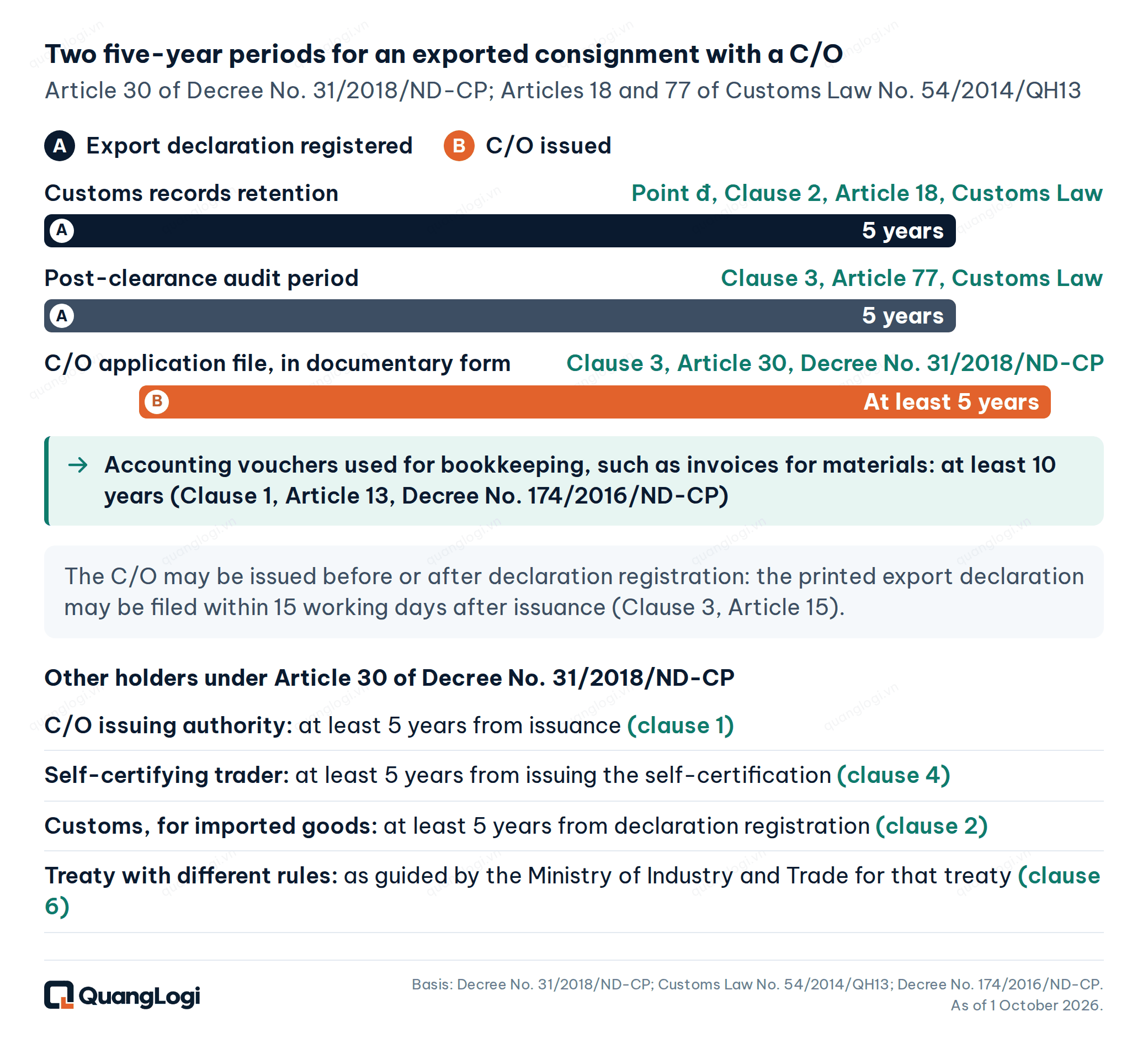
- Clause 3, Article 30 of Decree 31/2018/ND-CP requires a trader applying for a C/O to keep the C/O application and the related documents in written form for at least 5 years from the date the C/O is issued. However, this provision alone is not a sufficient basis for concluding that every method of electronic storage is invalid. As a matter of records management, you should maintain a set of records that can be retrieved, cross-checked and produced in full when a verification request is made.
- Documentation, documents and information used for origin verification are kept confidential. When a competent domestic or international authority asks for them to be disclosed, the trader must report to the Ministry of Industry and Trade before disclosing them (Clause 5, Article 30 of Decree 31/2018/ND-CP).
- A trader that does not cooperate, does not provide the documentation in full or provides incorrect information during post-issuance verification is subject to withdrawal of the C/O issued and suspension of C/O issuance for 6 months (Point c, Clause 1, Article 29). The trader is also assigned to the red channel under risk management for traders, with publication on the Ministry of Industry and Trade's portal at www.moit.gov.vn (Clause 2, Article 29). Its next C/O application will be refused (Clause 7, Article 21).
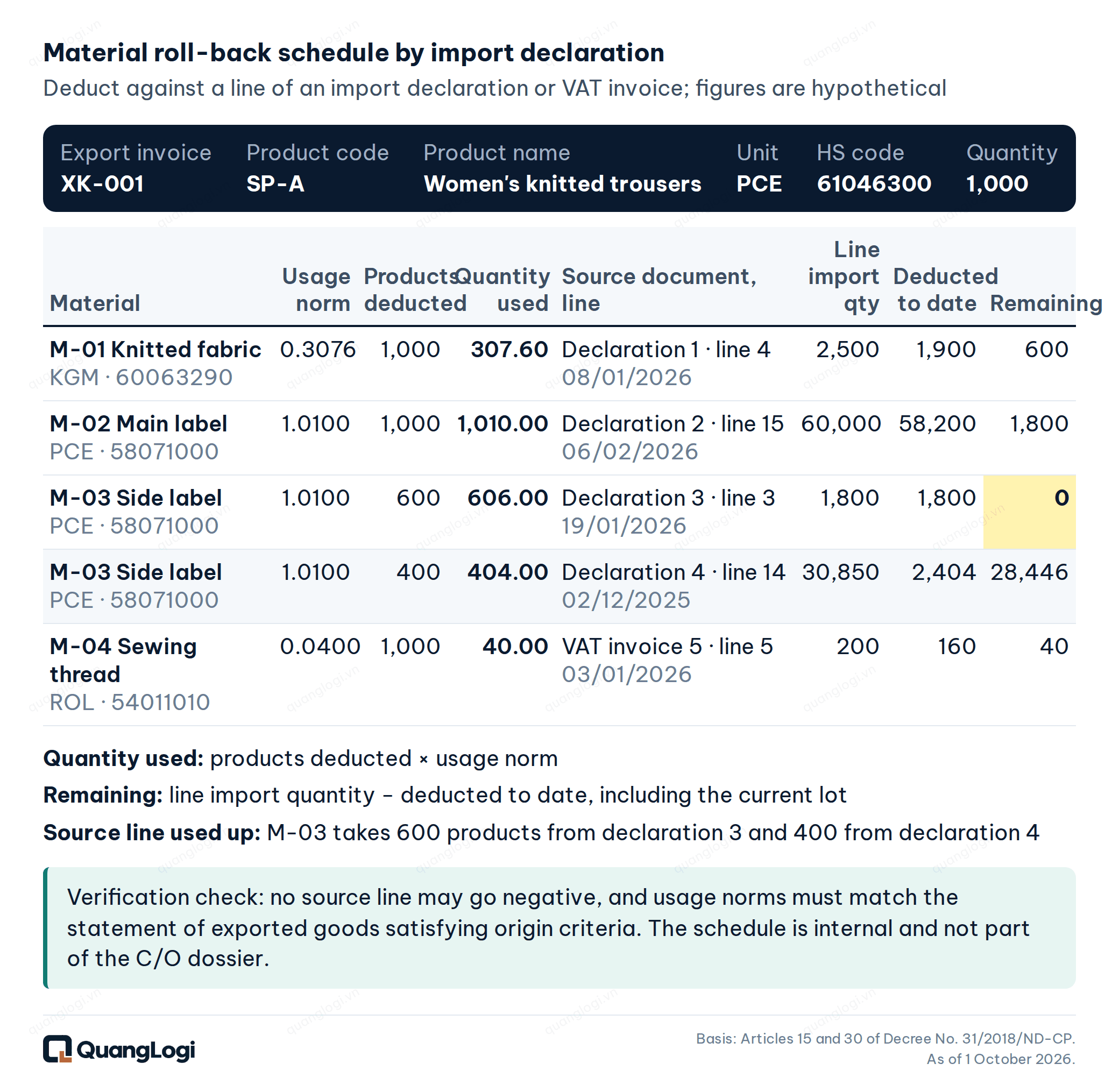
- The material deduction ledger kept for each C/O issued is not part of the application as submitted, but it is the document most often requested during post-issuance verification, because the basic check is the quantity exported multiplied by the material usage per unit, compared with the quantity of input materials that can be shown to have a lawful source.
- In the written explanation, answer exactly what was asked, attach the documents referred to and reply within the time limit stated in the written request. Do not alter figures to make them agree; explain any discrepancy and give the basis for it.
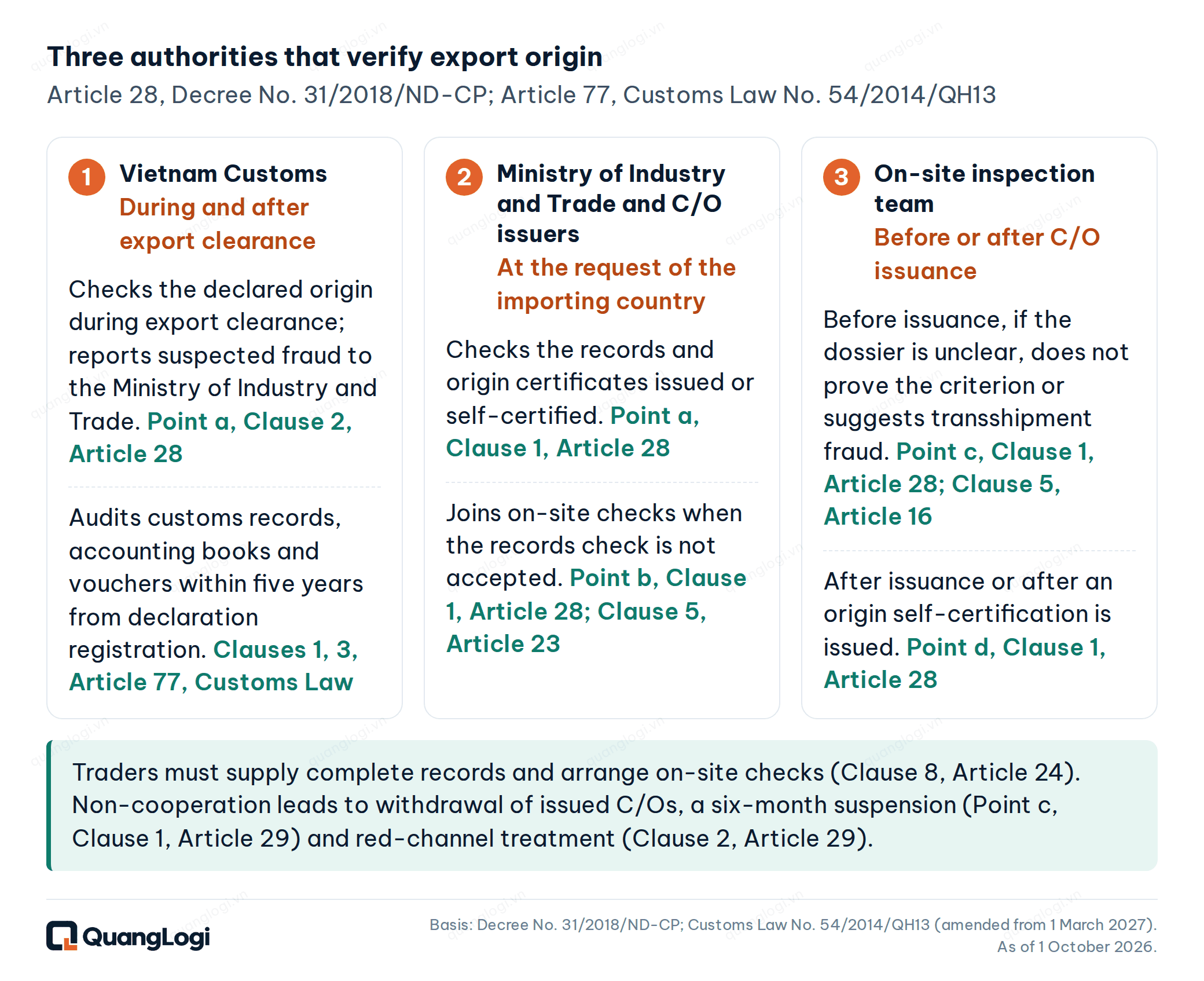
A company faces checks and verification of origin in three types of situation, handled by three different bodies
Article 28 of Decree 31/2018/ND-CP assigns checks and verification of origin to two ministries, and the Law on Customs No. 54/2014/QH13 provides for post-clearance inspection.
| SITUATION | WHO CARRIES IT OUT | LEGAL BASIS | SCOPE |
|---|---|---|---|
| Checks during export procedures | Customs authority | Point a, Clause 2, Article 28 of Decree 31/2018/ND-CP; Decision 467/QD-CHQ of 29 April 2025 | Checks and verification of origin for exported goods on the basis of risk management and the channel assigned to the declaration; where fraud is suspected, the Ministry of Industry and Trade is notified for coordination |
| Documentary verification at the request of the customs authority of the importing country | The Ministry of Industry and Trade issues guidance; the C/O issuing authority carries out the verification | Point a, Clause 1, Article 28 of Decree 31/2018/ND-CP; Circular 33/2023/TT-BTC | Verification of the documentation and of proof of origin that has been issued or made out under self-certification |
| On-site verification at the production facility at the request of the customs authority of the importing country | The Ministry of Industry and Trade works in coordination | Point b, Clause 1, Article 28 | Where the result of the documentary verification is not accepted by the importing country |
| On-site verification at the production facility before a C/O is issued or before the written approval for self-certification is granted | Verification team as prescribed by the Ministry of Industry and Trade | Point c, Clause 1, Article 28; Clause 5, Article 16 | Where the application is unclear, does not demonstrate that the criterion is met, or shows signs of fraudulent transhipment |
| On-site verification at the production facility after a C/O is issued or after an origin self-certification document is made out | Verification team as prescribed by the Ministry of Industry and Trade | Point d, Clause 1, Article 28 | Post-issuance verification by the issuing authority |
| Post-clearance inspection | Customs authority | Law on Customs No. 54/2014/QH13 | Inspection of the customs documentation, books of account, accounting source documents and related records within 5 years from the date of registration of the declaration; three cases: signs of a violation, risk management, and compliance assessment |
Under the current provisions, the customs authority may carry out a post-clearance inspection within 5 years from the date of registration of the customs declaration. An inspection at the customs authority's premises lasts no more than 5 working days. An inspection at the customs declarant's premises lasts no more than 10 working days and may be extended once, by no more than 10 working days, if the inspection is wide in scope or its subject matter is complex. From 1 March 2027, Clause 24, Article 1 of Law No. 11/2026/QH16 sets the period covered by the inspection at a maximum of 5 years, from the date of registration of the declaration to the date the post-clearance inspection decision is issued. Clause 25, Article 1 provides that the time limit for the inspection is no more than 20 days from the date the decision is announced; if the inspection is wide in scope or its subject matter is complex, the person who issued the inspection decision may extend the time limit once, but by no more than 20 days. The unit here is "days", not "working days". Under Clause 4, Article 4, the powers, sequence and procedures for an inspection in progress under a decision issued before 1 March 2027 continue to be governed by the Law on Customs No. 54/2014/QH13.
What this means for the documentation: all six situations above can arise for a consignment for which a C/O has been issued, and they can arise up to 5 years after the date of issuance. The route for receiving the request and replying to it needs to be determined from the written request itself and from the guidance of the competent authority in each case.
What is examined is the set of documents behind the C/O
| DOCUMENT | WHAT IS CHECKED | LEGAL BASIS IN THE C/O APPLICATION |
|---|---|---|
| Import declaration for the materials | HS code, quantity and value of the non-originating materials actually imported | Point i, Clause 1, Article 15 of Decree 31/2018/ND-CP |
| VAT invoice for materials purchased domestically | The portion of the materials not imported directly | Point i, Clause 1, Article 15 |
| Declaration of origin by the domestic manufacturer or supplier under Appendix X to Circular 05/2018/TT-BCT, with supporting evidence | The basis for counting the domestic portion of the materials as originating | Point g, Clause 1, Article 15 |
| Stock records, accounting books and records | Whether the quantities of materials received into stock and taken out of stock agree with the application as submitted | Law on Customs No. 54/2014/QH13, post-clearance inspection |
| Statement of exported goods meeting the origin criteria | Whether the figures in the application as submitted agree with the actual material usage per unit | Point e, Clause 1, Article 15 |
| Production-process description | Whether the operations in Vietnam are as described and whether they fall outside the scope of Article 9 of Decree 31/2018/ND-CP | Point h, Clause 1, Article 15 |
| Material deduction ledger for each C/O issued | Whether the same quantity of materials has been used for more than one consignment for which a C/O was issued | Not part of the application as submitted; an internal document used when giving explanations |
What this means for the documentation: the check used most often remains a multiplication, namely the quantity exported multiplied by the material usage per unit, compared with the quantity of materials that can be evidenced. A company that exports many consignments without keeping a deduction ledger usually cannot say which consignment used which portion of the materials.
The trader keeps its records in written form for at least 5 years from the date the C/O is issued
Article 30 of Decree 31/2018/ND-CP sets the period and the method of record retention for each party.
| CLAUSE | PARTY | RECORDS TO BE KEPT | MINIMUM PERIOD | PERIOD RUNS FROM | METHOD |
|---|---|---|---|---|---|
| 1 | C/O issuing authority or organisation | C/O application and documents relating to the issuance | 5 years | Date of issuance | Written or electronic |
| 2 | Customs authority | Documentation relating to the determination of the origin of imported goods | 5 years | Date of registration of the customs declaration | Written or electronic |
| 3 | Trader applying for a C/O | C/O application and documents relating to the application | 5 years | Date the C/O is issued | Written |
| 4 | Self-certifying trader | Documentation, reports and records showing that the goods meet the origin criterion, and related documents | 5 years | Date the origin self-certification document is made out | Written; to be provided to the competent authority on request |
Clause 6, Article 30 provides that, where an international treaty contains different provisions on retention, the Ministry of Industry and Trade's implementing provisions for that treaty apply. Some agreements set a retention period other than 5 years.
Clause 3, Article 30 of Decree 31/2018/ND-CP requires a trader applying for a C/O to keep the C/O application and the related documents in written form for at least 5 years from the date the C/O is issued. However, this provision alone is not a sufficient basis for concluding that every method of electronic storage is invalid. As a matter of records management, you should maintain a set of records that can be retrieved, cross-checked and produced in full when a verification request is made. In parallel, the customs declarant keeps the customs documentation for 5 years from the date of registration of the declaration under Point đ, Clause 2, Article 18 of the Law on Customs No. 54/2014/QH13. Books and records, together with accounting source documents, are kept in accordance with accounting legislation, under which accounting source documents used directly for entries in the books, such as invoices for purchased materials, are kept for at least 10 years (Clause 1, Article 13 of Decree 174/2016/ND-CP). The two 5-year periods, one for the customs documentation and one for the C/O application, start on different dates; the minimum retention period for the set of records for a consignment is determined by whichever period ends later.
Origin verification documentation must be kept confidential, with a duty to report to the Ministry of Industry and Trade before disclosing it
Clause 5, Article 30 of Decree 31/2018/ND-CP provides that documentation, documents, information and related records used for the verification of the origin of goods are kept confidential. Where competent domestic and international authorities ask for them to be disclosed, the trader and the C/O issuing authority must report to the Ministry of Industry and Trade before disclosing them.
Clause 5, Article 30 of Decree 31/2018/ND-CP provides that documentation, documents, information and records used for origin verification are kept confidential. When a competent domestic or international authority asks for them to be disclosed, the trader and the C/O issuing authority or organisation must report to the Ministry of Industry and Trade before disclosing them. This provision does not provide that every verification request or every reply must pass through the C/O issuing authority.
A trader that does not cooperate with verification is subject to withdrawal of the C/O, suspension of issuance for 6 months and assignment to the red channel
Clause 8, Article 24 of Decree 31/2018/ND-CP provides that a trader applying for a C/O is responsible for providing in full the documentation, documents, information and records used for verification, and for arranging for verification at the production facility at the request of the C/O issuing authority or the competent authority of the importing country. The consequences of failing to do so are set out in Article 29 and Article 21.
| CONDUCT | MEASURE | LEGAL BASIS |
|---|---|---|
| Failure to cooperate, failure to provide the documentation and documents in full, or provision of incorrect information when the issuing authority carries out post-issuance verification | Withdrawal of the C/O issued and suspension of C/O issuance for 6 months from the date of the violation | Point c, Clause 1, Article 29 of Decree 31/2018/ND-CP |
| Use of forged documents or a fraudulent declaration when applying for a C/O | Suspension of C/O issuance for 6 months from the date of detection | Point b, Clause 1, Article 29 |
| The two acts above | Assignment to the red channel in the risk management system and publication on the Ministry of Industry and Trade's electronic portal www.moit.gov.vn | Clause 2, Article 29 |
| Failure to fulfil the responsibilities in Clauses 4, 5, 6 and 8 of Article 24 and in Article 30 | Public posting of the trader's name at the place of issuance for 6 months; extension of the time limit for issuing a C/O to 3 working days | Clause 3, Article 29 |
| Failure to provide the documentation in full or failure to cooperate with checks and verification | Refusal to issue a C/O on the next application | Clause 7, Article 21 |
| Origin fraud relating to a previously issued C/O, where the case has not yet been resolved | Refusal to issue a C/O | Clause 6, Article 21 |
What this means for the documentation: the consequences of staying silent or missing the deadline for replying to a verification request are not limited to that consignment being refused preferential tariff treatment in the importing country. They also lead to suspension of C/O issuance for 6 months for all of the company's later consignments and to their assignment to the red channel under risk management for traders. The cost of staying silent and not replying is far higher than the cost of a reply saying that the application contains a discrepancy but that there is a basis for explaining it.
What must be done immediately after the C/O is issued, while the documents are still to hand
| TASK | HOW | REASON |
|---|---|---|
| Assemble a set of records for each consignment | One complete paper set for each consignment, comprising the copy submitted and the original documents behind it | Clause 3, Article 30 requires retention in written form; gathering the documents three years later is harder than assembling the set at the time |
| Update the deduction ledger | Record the quantity of materials used for the consignment for which a C/O has just been issued, together with the number of the corresponding import declaration | The basic check in post-issuance verification, section 2 |
| Record the basis used | The origin criterion applied, the circular and the appendix it was taken from, the HS code it was checked under, and the text consulted, with the year of that text | Three years later, the person who prepared the application may have left and the circular may have changed |
| Keep evidence of the production process as it was when the consignment was produced | Photographs, job tickets and works orders, each bearing a date | The records relate to the time the consignment was produced; the process may change later |
What this means for the documentation: the four tasks above take little time per consignment if they are done straight away. The deduction ledger can be updated as early as the stage at which the statement of exported goods meeting the origin criteria is prepared when applying for a C/O, but it can take many days if it has to be rebuilt several years later. The second and third tasks are the two where gaps occur most often, because they involve detailed information that needs to be recorded carefully at the time it arises.
A written explanation that answers exactly what was asked, with documents attached, within the time limit stated in the written request
The general principle on receiving a request for an explanation: answer exactly the question asked, attach the documents referred to, reply within the time limit stated in the written request, and identify the correct route for sending the reply from the written request itself and the guidance of the competent authority.
Three things must be avoided. Do not send additional documents that were not asked for without first reviewing them, because every document sent is a possible source of new inconsistencies. Do not alter figures in the written explanation to make them agree with the application instead of explaining the discrepancy, because altering figures is a fraudulent declaration under Point b, Clause 1, Article 29. Do not stay silent or miss the deadline, because of the consequences set out in section 5.
A written explanation that is fit for purpose has three parts: a restatement of exactly what was asked; an answer with figures and references to documents, using the exact names of the documents in the application as submitted; and an explanation of any discrepancy, with the basis for it.
Legal basis
| INSTRUMENT | DATE OF ISSUANCE | EFFECTIVE DATE, STATUS | RELEVANT PROVISIONS |
|---|---|---|---|
| Decree 31/2018/ND-CP, "Detailing the Law on Foreign Trade Management as regards the origin of goods" | 8 March 2018 | 8 March 2018, in force | Clause 1, Article 15 (C/O application); Clause 5, Article 16 (verification at the production facility); Article 21 (refusal to issue); Clause 8, Article 24 (responsibility to cooperate with verification); Article 28 (checks and verification of origin); Article 29 (anti-fraud measures); Article 30 (record retention) |
| Law on Customs No. 54/2014/QH13 | 23 June 2014 | 1 January 2015, in force, amended several times | Post-clearance inspection: definition, 5-year time limit, the three cases in which an inspection takes place, time limit for the inspection at the customs authority's premises and at the customs declarant's premises; obligation to keep records for 5 years |
| Law No. 11/2026/QH16, "Law amending and supplementing a number of articles of the Law on Customs" | 23 August 2026 | 1 March 2027 | Clause 24 and Clause 25 of Article 1 amend Article 77 and Article 79 on the scope of post-clearance inspection, the period covered by the inspection and the time limit for the inspection; Clause 4, Article 4 contains transitional provisions for inspection decisions issued before the date the law enters into force |
| Decree 174/2016/ND-CP, "Detailing a number of articles of the Law on Accounting" | 30 December 2016 | 1 January 2017, in force | Clause 1, Article 13: accounting source documents used directly for making entries in the books of account and preparing financial statements are retained for at least 10 years |
| Circular 05/2018/TT-BCT, "Providing for origin of goods". Text to consult: Consolidated Text 21/VBHN-BCT of 2025 | 3 April 2018 | 3 April 2018, in force | Appendices II to IX (statement template for each origin criterion); Appendix X (declaration of origin by the domestic manufacturer or materials supplier) |
| Circular 33/2023/TT-BTC | 31 May 2023 | 15 July 2023, in force | Determination of the origin of exported and imported goods; verification with the authority issuing the proof of origin, verification at the production facility, handling of results |
| Circular 124/2026/TT-BTC | 22 August 2026 | 22 August 2026, in force | Adds to Circular 33/2023/TT-BTC provisions on checking the proof of origin of imported goods on the basis of risk management; applies only to imported goods |
| Decision 467/QD-CHQ | 29 April 2025 | 29 April 2025 | Procedure for checking and determining the origin of exported and imported goods, applying risk management; an administrative instrument, for reference only |
Contact
If you have just received a written request to substantiate origin, or are preparing for a post-clearance inspection, you can send me what was asked, the application as submitted when applying for the C/O and the corresponding import declarations for the materials. I will review each of the cross-checks, point out where further questions are likely, and draft an outline of the written explanation for you to complete.
What I do here is origin documentation and customs procedures work, within the scope of the professional certificates I hold; it is not legal advice on a specific matter.
Read next
- Common errors when applying for a C/O and how to deal with them. The errors repeated most often in real applications and the line between an error and a violation.
- Input materials, material usage per unit and production process when applying for a C/O. The three groups of documents evidencing the origin criterion, and the four-way cross-check.
- Customs documentation and procedures for exports. The export declaration and where it connects with the C/O application.
- Origin of goods and the certificate of origin (C/O) for goods produced in Vietnam. The overview page for this whole topic.
Author

Hoàng Ngọc Quang (QuangLogi)
Registered customs-broker staff member assigned an identification number by Vietnam Customs under Official Letter No. 249/GSQL-TH dated 20 February 2025.
Customs declaration professional certificate No. 165/2018/KHQ-HN.
Vice Director of GIANG TO VIEN DUONG INTERNATIONAL TRANSPORT Co., Ltd. (Luchi Vietnam).
Member of the Vietnam Association for Logistics Manpower Development (VALOMA) under Admission Decision No. 1003/QD-BCH.
Trained as a lawyer in Course IX of the lawyer training programme for international integration at the Judicial Academy.
More than ten years handling documents and customs procedures on the China-Vietnam-Cambodia corridor, including C/O applications for goods exported from Vietnam and C/O files for goods imported from China.
About the author
I write as someone who prepares these applications myself. Any case and client details in the examples have been anonymised.
I have been trained as a lawyer under the lawyer training programme for international integration at the Judicial Academy but do not hold a lawyer's practising card. The content is professional information supported by cited legal instruments, not legal advice for a specific matter.
The content on this page is general information and not legal advice. Disclaimer.