There are no articles in this section yet.
Inputs, consumption norms and production process for C/O applications
Whether goods can qualify as originating is decided when the type of materials and the materials supplier are chosen and when the production line is set up, not when the C/O application is being prepared. Once the goods have been produced, there is almost nothing left that can be put right. In essence, applying for a C/O means using documents to prove that the goods meet the origin criterion prescribed for those goods, and that proof rests on three main types of document.
This page covers those three main types: evidence of the source of the input materials; the statement demonstrating compliance with the origin criterion, which sets out the material usage per unit of product; and the production-process description. These three types of document take the most time when the application is prepared, and they are also what is checked most closely at post-issuance verification.
Summary
- Whether goods can qualify as originating is decided when the materials and the supplier are chosen and the production line is set up; once the goods have been produced, there is almost nothing left that can be put right.
- The proof in the application rests on three types of document: evidence of the source of the input materials; the statement demonstrating compliance with the origin criterion, which sets out the material usage per unit of product; and the production-process description.
- Materials purchased domestically do not automatically have Vietnamese origin; to be counted as originating, they need the declaration of origin by the domestic manufacturer or materials supplier under Appendix X to Circular 05/2018/TT-BCT, accompanied by supporting evidence.
- The statement is prepared using the templates in Appendices II to IX to Circular 05/2018/TT-BCT, with the template chosen according to the origin criterion being applied.
- The statement must reconcile on four points at once: the quantity of materials brought in, the quantity of finished goods exported, the production process and the origin criterion of the product (the four-way cross-check).
- The table of material usage per unit is an internal document and is not part of the application as submitted; the figures for material usage per unit in that application are compared with the company's books and records during a verification.
- The requirement that a domestic supplier provide the Appendix X declaration should be written into the materials purchase contract.
The first type of document: evidence of the source of the input materials
For each type of material, it must be possible to say where it came from and what its origin is. Three situations are common.
Materials imported by the factory itself. The evidence is the import declaration for that same consignment of materials. The declaration shows both the source and the value, so it is the strongest type of document in the application.
Materials purchased domestically. The evidence is the seller's VAT invoice. The point to remember: a domestic purchase does not mean that the materials have Vietnamese origin. Materials that another company imported and then resold are still non-originating materials. If no document proves otherwise, the C/O issuing authority treats that portion as non-originating.
Materials purchased domestically that themselves qualify as originating in Vietnam. In this situation, Appendix X to Circular 05/2018/TT-BCT of 3 April 2018 is used; its full name is the declaration of origin by the domestic manufacturer or materials supplier. The supplier signs this declaration and attaches its own supporting evidence of origin. As a result, that portion of the materials is counted as having Vietnamese origin when the value content is calculated or the change in tariff classification is assessed.
The consequence for the buyer: the clause requiring the domestic supplier to provide the Appendix X declaration should be in the materials purchase contract itself, not something to be requested after an export order has already been received.
The second type of document: the statement demonstrating compliance with the origin criterion, which sets out the material usage per unit of product
This statement is the most important type of document, because it is the company's declaration that its goods meet the Vietnamese origin criterion.
The statement needs to show four things in full: the types of materials used to make the product; the quantity of each type per unit of product; the value of each input material; and how those materials meet the origin criterion applicable to the HS code of the finished product.
Circular 05/2018/TT-BCT provides ready-made statement templates for each origin criterion, in Appendices II to IX. The statement templates cover the wholly obtained criterion in two cases (with and without a VAT invoice); the change in tariff classification criterion; the de minimis criterion; the value percentage criterion; the regional value content criterion; and the criterion of goods produced entirely in one member country. Choosing the right template for the criterion being applied is the first step; choosing the wrong template means that the whole statement has to be redone.
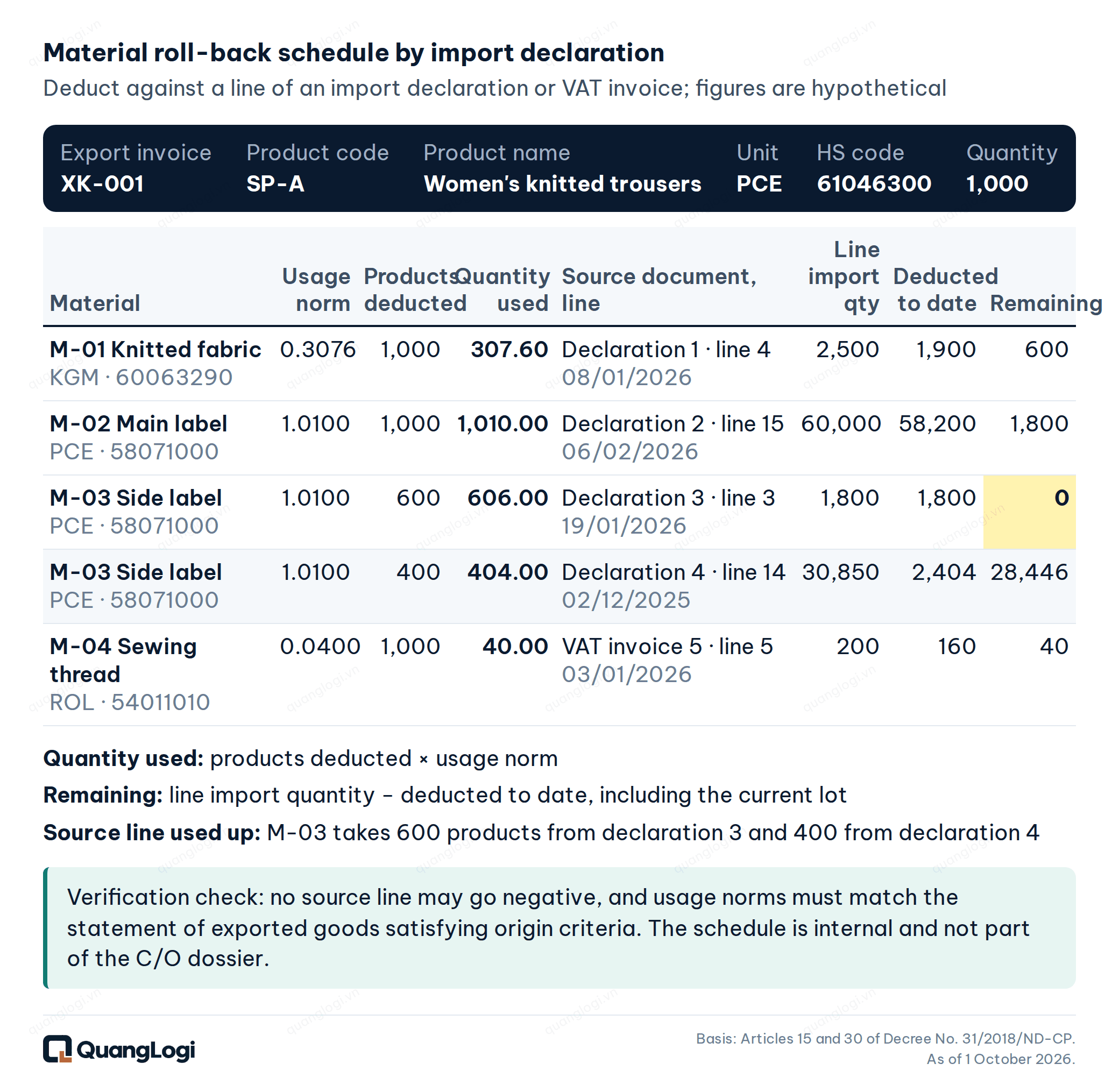
The four-way cross-check. The statement submitted to apply for a C/O must reconcile on four points at once:
- The quantity of materials brought in, as shown on the import declarations and the VAT purchase invoices.
- The quantity of finished goods exported.
- The production process described in the application.
- The origin criterion prescribed for the exported product.
If just one point does not reconcile and the discrepancy cannot be explained, the application is returned. The simplest check that the C/O issuing authority commonly uses is to multiply the quantity of products exported by the material usage per unit in the statement and to compare the result with the quantity of materials on the import declarations and the purchase invoices. If the result exceeds the quantity of materials declared, the company is declaring that it used more materials than it can show evidence for.
The deduction ledger. Materials already used for a consignment covered by an earlier C/O cannot be used again for a later consignment. A company that exports several consignments from the same quantity of materials brought in needs to track the portion already deducted with each C/O application. The deduction ledger is not part of the application as submitted, but it is asked for at post-issuance verification.

The third type of document: the production-process description
The production-process description answers one question: whether the operations carried out in Vietnam go beyond the threshold for simple working or processing operations. That threshold is laid down in Article 9 of Decree 31/2018/ND-CP.
A usable description meets three requirements. First, it describes what actually happens at the factory and is not a translation of the machinery's technical documentation. Second, it is detailed enough for the reader to see at which operation each material enters the process and what it becomes at each operation. Third, it is consistent with the statement: any material named in the statement must appear in the process, and vice versa.
For goods whose origin criterion is a specific working or processing operation, which is common for textiles and clothing and for chemicals, the production-process description is also direct evidence that the criterion is met, not just a supporting document.
The table of material usage per unit is an internal document and is not part of the application as submitted
This point is often misunderstood. The company itself draws up and keeps the table of material usage per unit, for production management and to support its explanations during a verification. The table is not part of the application submitted when a C/O is applied for. What is submitted is the statement demonstrating compliance with the origin criterion, which sets out the material usage per unit of product.
This distinction matters at post-issuance verification: when the relevant authority carries out a verification, the figure for material usage per unit in the application as submitted will be compared with the actual material usage per unit in the company's books and records.
Three things you should do before signing a materials purchase contract
- Find the HS code of the materials you intend to purchase and the HS code of the finished product, and check them against the origin criterion applicable to the finished product. If the criterion is a change in chapter and the materials are classified in the same chapter as the finished product, that choice of materials does not meet the criterion, however much processing is carried out.
- Determine whether the supplier is located in a party to the agreement you intend to use or outside, so that you know whether cumulation is allowed.
- Put the requirement to provide supporting evidence of origin, including the Appendix X declaration if the supplier is domestic, into the terms of the purchase contract.
Legal basis
| INSTRUMENT | DATE, STATUS | RELEVANT PROVISIONS |
|---|---|---|
| Decree 31/2018/ND-CP | 8 March 2018, in force | Article 8 (goods not wholly obtained); Article 9 (simple working or processing operations); Article 11 (de minimis) |
| Circular 05/2018/TT-BCT | 3 April 2018, in force | How the origin criteria are determined. Appendices II to IX are the statement templates for each origin criterion. Appendix X is the declaration of origin by the domestic manufacturer or materials supplier |
| Circular 44/2023/TT-BCT | 29 December 2023, in force from 15 February 2024 | Replaces Appendix I and Appendix II to Circular 05/2018/TT-BCT |
The product-specific rules of each agreement are in that agreement's own circular; see the page "Origin criteria by FTA and C/O form".
If you are preparing the statement and are not yet sure that the figures reconcile, you can send me the import declarations for the materials, the purchase invoices, the quantity of finished goods exported and the HS code of the finished product. I will rerun the four-way cross-check and show which point does not reconcile.
What I do here is origin documentation and customs procedures work, within the scope of the professional certificates I hold; it is not legal advice on a specific matter.
Read next
- C/O application for goods produced in Vietnam. From first-time trader-profile registration to the application for each consignment.
- Substantiating origin, C/O record retention and post-issuance verification. What to keep and how to respond to later queries.
- Conditions for goods to be of Vietnamese origin. Wholly obtained, substantial transformation, and the operations that do not count.
Author

Hoàng Ngọc Quang (QuangLogi)
Registered customs-broker staff member assigned an identification number by Vietnam Customs under Official Letter No. 249/GSQL-TH dated 20 February 2025.
Customs declaration professional certificate No. 165/2018/KHQ-HN.
Vice Director of GIANG TO VIEN DUONG INTERNATIONAL TRANSPORT Co., Ltd. (Luchi Vietnam).
Member of the Vietnam Association for Logistics Manpower Development (VALOMA) under Admission Decision No. 1003/QD-BCH.
Trained as a lawyer in Course IX of the lawyer training programme for international integration at the Judicial Academy.
More than ten years handling documents and customs procedures on the China-Vietnam-Cambodia corridor, including C/O applications for goods exported from Vietnam and C/O files for goods imported from China.
About the author
I write as someone who prepares these applications myself. Client details in the examples have been anonymised.
I have been trained as a lawyer under the lawyer training programme for international integration at the Judicial Academy but do not hold a lawyer's practising card. The content is professional information supported by cited legal instruments, not legal advice for a specific matter.
The content on this page is general information and not legal advice. Disclaimer.