There are no articles in this section yet.
Common mistakes in C/O applications and how to fix them
A C/O application is rarely refused for an unfamiliar reason. Article 21 of Decree 31/2018/ND-CP sets out seven cases in which the issuing authority refuses to issue a C/O and must state the reasons clearly. In practice, the errors found in applications tend to fall into a few recurring groups. Most of them stem from a decision taken much earlier: the choice of HS code, the choice of materials supplier, or the preparation of the statement of goods meeting the origin criteria by copying it from an earlier consignment. Errors in an application and violations relating to origin are two different groups: Decree 169/2026/ND-CP on administrative penalties for customs violations separates them into two articles with very different levels of fine.
After reading this page, you will know the seven most common errors in applying for a C/O and how to spot each one before you submit; which errors can be put right in the application and which cannot; how to respond when issuance of a C/O is refused in Vietnam and when a C/O is rejected in the importing country; and where the line falls between an error and a violation relating to origin that carries a penalty.
Summary
- The seven most common errors in a C/O application are: using the wrong HS code for the finished product; submitting a statement that does not match the HS code; declaring more materials as used under the material usage per unit of product than can be evidenced; assuming that materials purchased domestically are of Vietnamese origin; showing details on the C/O that differ from the commercial invoice or the bill of lading; applying the criterion of one C/O form to another form; and not yet having completed trader-profile registration with the authority that issues the C/O form needed.
- The issuing authority refuses to issue a C/O in the seven cases in Article 21 of Decree 31/2018/ND-CP and must state the reasons clearly. Reading the clause cited in the refusal notice correctly is the first step in establishing whether the error is in the documentation or is one of substance.
- Errors at the long-term decision stage are: choosing materials in the same chapter as the finished product when the criterion is a change in chapter; agreeing to a C/O clause before checking whether the rules of origin can be met; and carrying out in Vietnam only operations covered by Article 9 of Decree 31/2018/ND-CP. These errors cannot be put right by redoing the paperwork.
- Where the customs authority of the importing country requests verification of a C/O already issued, the trader is responsible for providing the documentation and making arrangements for verification under Clause 8, Article 24 of Decree 31/2018/ND-CP. Clause 5, Article 30 provides that the documentation, documents, information and records used for verification are kept confidential; when a competent domestic or international authority requests them, the trader and the C/O issuing authority or organisation must report to the Ministry of Industry and Trade before disclosing them. This provision does not say that every verification request or every reply must pass through the C/O issuing authority. Failure to cooperate leads to withdrawal of the C/O and a 6-month suspension of C/O issuance under Point c, Clause 1, Article 29.
- From 1 July 2026, misdeclaration of origin of exported or imported goods is penalised under Clause 3, Article 9 of Decree 169/2026/ND-CP with a fine of VND 3,000,000 to VND 5,000,000 for organisations. Goods falsely presented as being of Vietnamese origin are penalised under Article 18 in five bands from VND 10 million to VND 100 million according to the value of the offending goods, together with confiscation of the offending goods.
- Decree 169/2026/ND-CP does not remove the penalty for misdeclaration of origin; what has been removed is the provision of the old decree that grouped together misdeclarations not affecting the amount of tax. As a result, misdeclaring the commodity code of imported goods is no longer penalised where it does not affect the amount of tax, while misdeclaration of origin is still penalised and the scope is wider than under the old decree.
The seven most common errors and how to spot them before submission
| ERROR | EARLY SIGN | PROVISION BREACHED |
|---|---|---|
| 1. Misdeclared HS code for the finished product, so that the wrong origin criterion is identified | The HS codes on the export declaration, the commercial invoice and the statement are not the same | Clause 1, Article 16 of Decree 31/2018/ND-CP: the HS code declared on the C/O is the HS code of the exporting country; the criterion is found under this HS code |
| 2. The statement of goods meeting the origin criteria does not match the HS code or the material usage per unit of the consignment covered by the application | The statement was copied from an earlier consignment, and its date of preparation is earlier than the date of the export declaration | Point e, Clause 1, Article 15 of Decree 31/2018/ND-CP; Clause 3, Article 21: the application is internally inconsistent |
| 3. The quantity of materials that can be evidenced is smaller than the quantity declared as used | The quantity of goods exported multiplied by the material usage per unit exceeds the quantity of materials on the import declarations and the purchase invoices | Point i, Clause 1, Article 15; Clause 3, Article 21 |
| 4. Treating materials purchased domestically as materials of Vietnamese origin | There is no declaration of origin under Appendix X to Circular 05/2018/TT-BCT for that material | Point g, Clause 1, Article 15 of Decree 31/2018/ND-CP; Clause 3, Article 7 of Circular 05/2018/TT-BCT |
| 5. Details on the C/O differ from the commercial invoice or the bill of lading | The exporter's name, the importer's name, the description of the goods, the unit of measurement and the quantity differ between the documents | Clause 3, Article 21; this error may be missed at the issuance stage, because checks at that stage focus on whether the origin criterion is met, but it is a common reason for rejection in the importing country |
| 6. Applying the origin criterion of one C/O form to another C/O form | The company is used to one form and moves to another market but keeps the old calculation method; the formulas and the denominators differ between agreements | Article 4 of Decree 31/2018/ND-CP: each agreement is governed by its own implementing circular |
| 7. Trader-profile registration not yet completed with the authority that issues the C/O form needed | A consignment comes up that needs a C/O form issued only by Provincial People's Committees (E, B, S, X), while the company has registered only with the Agency of Foreign Trade | Clause 1, Article 13 and Clause 1, Article 21 of Decree 31/2018/ND-CP; Form No. 17 and No. 18 of Circular 26/2026/TT-BCT |
What this means for the documentation: error 1 is the root error, because the origin criterion is found by HS code; if the HS code is wrong, the whole application is built on a criterion that does not belong to the product. Error 3 is the error detected most often, because the issuing authority's check is a single multiplication.
Three errors at the decision stage that cannot be put right by redoing the paperwork
Choosing materials in the same chapter as the finished product when the criterion is a change in chapter is an error made at the purchasing and production-design stage. Point a, Clause 2, Article 6 of Circular 05/2018/TT-BCT defines change in tariff classification as a change in the HS code of the goods at the two-, four- or six-digit level compared with the HS code of the non-originating input materials. Where the materials are in the same chapter, no amount of processing produces a change at the two-digit level. The place to put this right is the choice of supplier.
Agreeing to a clause in the contract to provide a C/O before checking whether the goods can qualify as originating is an error made at the sales stage. The buyer prices the goods on the basis of the preferential rate of duty in its own country; if there is no C/O or the C/O is rejected, the contract will usually require the seller to compensate for the duty difference. Appendix III, Section 1, Point Đ, Clause 5 of Resolution 19/2026/NQ-CP provides that the administrative procedure for retrospective issuance of a C/O under Article 15 and Article 17 of Decree 31/2018/ND-CP is not to be carried out while the resolution is in force. However, as at 15 September 2026, procedure 1.001380 was still published on the Ministry of Industry and Trade Public Service Portal. Because the two sources are not yet consistent on how this works in practice, you should not assume that applications for a retrospectively issued C/O are still accepted or that they have been stopped entirely. You need to check each case directly with the authority receiving the application. Details are on the page "C/O application for goods produced in Vietnam".
Carrying out only simple working or processing operations in Vietnam is an error made at the production-design stage. Article 9 of Decree 31/2018/ND-CP lists these operations in eight clauses, including packing, labelling, sorting, simple mixing and simple assembly. Even when combined with one another, these operations are not taken into account in determining origin.
What this means for the documentation: applications in the three cases above are refused under Clause 5, Article 21 of Decree 31/2018/ND-CP (the goods are not originating or do not satisfy the rules of origin), and no amount of redoing the paperwork will change that outcome.
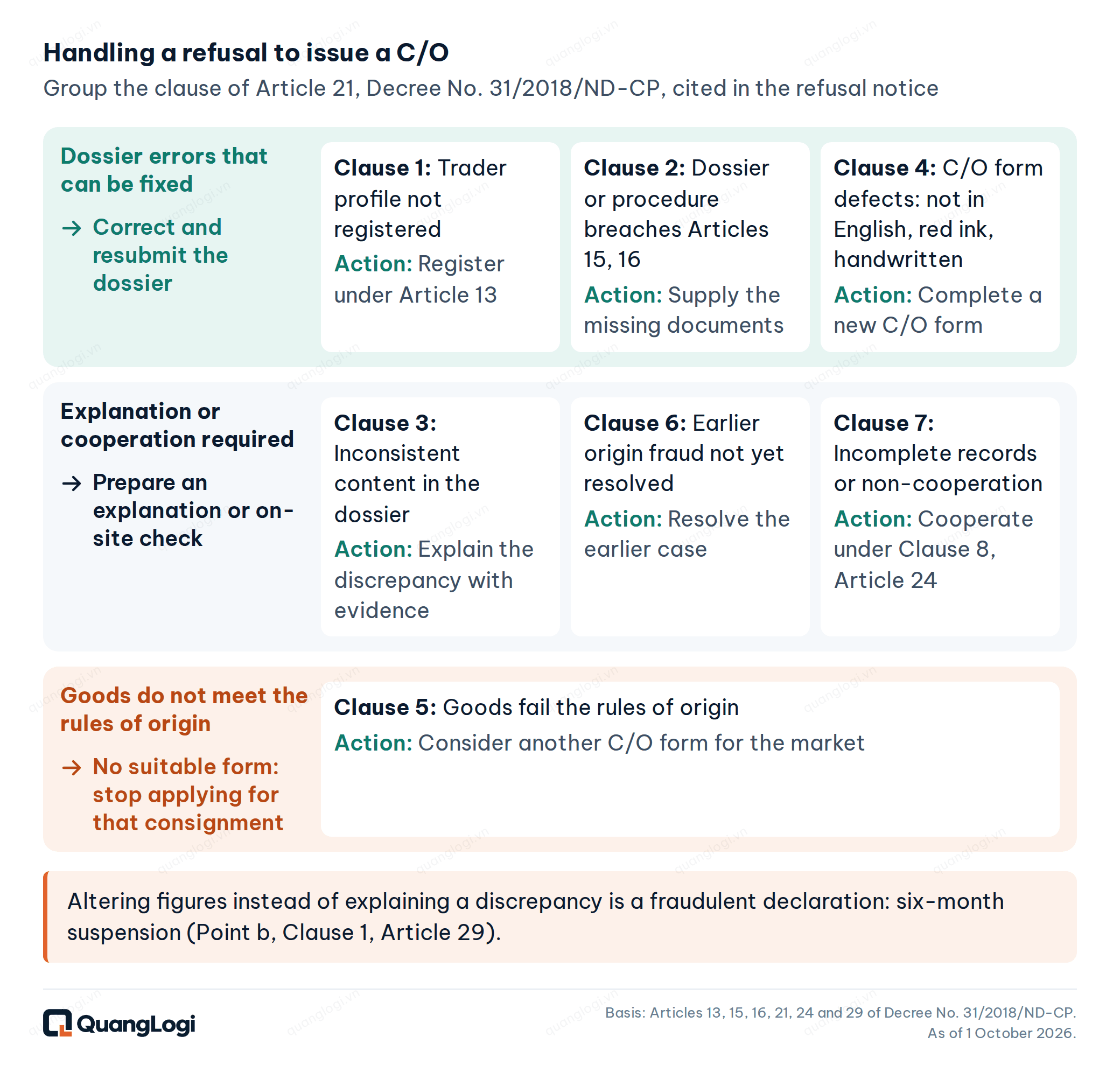
When issuance of a C/O is refused, the first step is to read the clause of Article 21 cited in the notice correctly
Article 21 of Decree 31/2018/ND-CP provides that, in seven cases, the issuing authority refuses to issue a C/O, giving the refusal in writing or by notice on the electronic system and stating the reasons clearly. Each case calls for a different response.
| CLAUSE OF ARTICLE 21 | REASON FOR REFUSAL | RESPONSE |
|---|---|---|
| 1 | Trader-profile registration not yet completed under Article 13 | Complete trader-profile registration with that issuing authority, then resubmit |
| 2 | The application or the procedure does not comply with Article 15 and Article 16 | Check against each point of Clause 1, Article 15 and add the missing documents; the time limit for issuance restarts when the application is complete |
| 3 | The application is internally inconsistent | Identify which side of the four-way cross-check does not reconcile (import declarations and purchase invoices, quantity of goods exported, production process, criterion for the HS code); where the discrepancy is in the figures, explain the difference and give the basis for it; do not alter the figures to make them match |
| 4 | The C/O is not completed in English, is completed in red ink or by hand, contains erasures, is faint, or is printed in several ink colours | Complete the C/O form again |
| 5 | The goods are not originating or do not satisfy the rules of origin | Reconsider whether another C/O form can be used for the same market (section 2 of the page "Origin criteria by FTA"); if there is none, the error cannot be put right in the application |
| 6 | Origin fraud occurred in connection with a previous C/O issuance and the case has not yet been resolved | Resolve the earlier case before submitting a new application |
| 7 | Failure to provide the documentation in full or failure to cooperate with checks and verification | Provide what is requested and make arrangements for verification at the production facility under Clause 8, Article 24 |
What this means for the C/O application: six of the seven cases can be put right in the application or by cooperating; Clause 5 alone is an error of substance, which cannot be put right in the documentation.
When a C/O has been issued but is rejected in the importing country, the trader is obliged to cooperate in verification
The customs authority of the importing country has the right to request origin verification after clearance of the consignment, under Point a and Point b, Clause 1, Article 28 of Decree 31/2018/ND-CP. While the result is pending, preferential treatment of the goods is usually suspended in the importing country.
| TASK | HOW | LEGAL BASIS |
|---|---|---|
| Find out exactly what is being queried | Ask the buyer to provide the document issued by the customs authority of the importing country, because only what it says shows which documents have to be prepared | Clause 7, Article 24: the trader promptly notifies the issuing authority that the C/O has been rejected |
| Assemble the correct documentation for that consignment | The documentation comprises the application as submitted and the original documents behind it, as recorded in the deduction ledger | Clause 3, Article 30: records are kept in written form for 5 years |
| Identify the correct route for the reply, following the written request and the guidance of the competent authority | Keep the documentation, documents, information and records used for verification confidential; report to the Ministry of Industry and Trade before disclosing them, under Clause 5, Article 30. This provision does not say that every verification request or every reply must pass through the C/O issuing authority | Clause 5, Article 30; Clause 8, Article 24 |
| Make arrangements for verification at the production facility when requested | Have the production process and the stock records ready and consistent with the application as submitted | Point b, Clause 1, Article 28; Clause 8, Article 24 |
If the error is one of form, for example a difference in the description of the goods or the unit of measurement between the C/O and the invoice, the response is an explanation with documents, or a request for reissuance under Point d, Clause 1, Article 18 of Decree 31/2018/ND-CP, which covers unintentional errors or mistakes on the original of the issued C/O, within 1 year from the date of issuance. If the error is one of substance, meaning that the goods do not meet the criterion, it cannot be put right through paperwork.
What this means for the documentation: failing to cooperate or refusing to allow verification leads to the goods being denied preferential tariff treatment in the importing country. In Vietnam, it leads to withdrawal of the C/O issued, a 6-month suspension of C/O issuance and the trader being assigned to the red channel under risk management, under Point c, Clause 1 and Clause 2, Article 29 of Decree 31/2018/ND-CP.
Errors in an application and violations that carry penalties are two different groups
An application whose figures do not yet reconcile but can be explained contains an error. Declaring Vietnamese origin for goods that do not qualify, or forging documents in order to meet the criterion, is a violation.
From 1 July 2026, administrative penalties for customs violations are governed by Decree 169/2026/ND-CP of 15 May 2026, which replaces Decree 128/2020/ND-CP and Article 2 of Decree 102/2021/ND-CP. This decree separates the two acts into two different articles.
Misdeclaration of origin is dealt with in Article 9 of Decree 169/2026/ND-CP, on violations of the rules on customs declaration. The general provision on declaring an origin of exported or imported goods that differs from the facts is Clause 3, with a fine of VND 3,000,000 to VND 5,000,000 for organisations. Article 9 has three further levels for specific situations: humanitarian aid goods and goods supplied as non-refundable aid; goods in transit, in merchanting trade or in transhipment, and goods used or destroyed in a non-tariff zone; and goods brought into a bonded warehouse and goods sent abroad from a bonded warehouse.
Goods falsely presented as being of Vietnamese origin are dealt with in Article 18 of Decree 169/2026/ND-CP, on the export, import, temporary import for re-export business, transit or merchanting trade of goods falsely presented as being of Vietnamese origin, in five bands according to the value of the offending goods.
| VALUE OF THE OFFENDING GOODS | FINE FOR ORGANISATIONS |
|---|---|
| Under VND 30 million | VND 10 million to VND 20 million |
| From VND 30 million to under VND 50 million | VND 20 million to VND 30 million |
| From VND 50 million to under VND 70 million | VND 30 million to VND 50 million |
| From VND 70 million to under VND 100 million | VND 50 million to VND 70 million |
| VND 100 million or more | VND 70 million to VND 100 million |
These fines come with the additional penalty of confiscation of the offending goods. The remedial measure is compulsory destruction of offending goods that are harmful to human health, livestock, crops and the environment, or compulsory payment of a sum equal to the value of offending goods that have been sold, dispersed or destroyed in breach of the rules.
The figures above need to be read together with three rules in Article 6 of Decree 169/2026/ND-CP. The levels stated above are those for organisations; the level for individuals is half of that, and household businesses, households and residential communities are subject to the level for individuals. The level actually applied to an act is the midpoint of the range, reduced where there are mitigating circumstances and increased where there are aggravating circumstances. Where misdeclaration of origin leads to a shortfall in the amount of tax payable, to tax evasion, or to a violation of the rules on the management of exported and imported goods, the act does not stop at Article 9; it moves to the heavier articles, including Article 18.
An incorrect account of the new decree is in circulation: that Decree 169/2026/ND-CP has removed the penalty for misdeclaration of origin. What has been removed is the provision of the old decree that grouped together misdeclaration of the quantity, description, type, quality, customs value, origin or commodity code of imported goods subject to tax, where the misdeclaration does not affect the amount of tax payable. The practical consequence is that misdeclaring the commodity code of imported goods is no longer penalised where it does not affect the amount of tax, while misdeclaration of origin is still penalised under Article 9. The new provision carries no condition about an effect on the amount of tax, so its scope is wider than under the old decree.
Outside the customs field, labelling goods with the wrong origin may also be considered under counterfeit goods and goods labelling legislation. As far as the C/O issuing authority is concerned, using forged documents or making fraudulent declarations leads to a 6-month suspension of C/O issuance under Point b, Clause 1, Article 29 of Decree 31/2018/ND-CP.
Pre-submission self-check
| ITEM TO CHECK | PASSES WHEN | CORRESPONDING ERROR |
|---|---|---|
| HS code of the finished product | The same on the export declaration, the commercial invoice and the statement | Error 1, error 2 |
| Origin criterion being applied | It is the criterion of the C/O form about to be applied for, looked up in the circular for the relevant agreement, using the text to consult together with its year | Error 6 |
| The multiplication check | The quantity of goods exported multiplied by the material usage per unit does not exceed the quantity of materials that can be evidenced | Error 3 |
| Materials purchased domestically counted as originating | Originating domestic materials need to be accompanied by the Appendix X declaration, together with the supplier's supporting evidence | Error 4 |
| Consignment details | The exporter's name, the importer's name, the description of the goods, the unit of measurement and the quantity match across the C/O, the commercial invoice, the bill of lading and the export declaration | Error 5 |
| Deduction ledger | Up to date as of the most recent consignment | Error 3 |
| Trader profile | Registered with every issuing authority for the C/O forms to be applied for, and updated within the last two years under Clause 3, Article 13 | Error 7 |
| Fixed-product status | No change in the material usage per unit, HS code, value or source of supply over two years compared with the application as submitted; if there is a change, submit the full application under Clause 1, Article 15 | Error 2 |
What this means for the documentation: the eight items above take about half an hour per consignment when they are checked carefully and reviewed in detail from the time the application is planned or prepared. If problems are found late, at the time of submission or after the application has been refused, resolving them and updating and supplementing the documents can take several days or more.
Legal basis
| INSTRUMENT | DATE OF ISSUANCE | EFFECTIVE DATE, STATUS | RELEVANT PROVISIONS |
|---|---|---|---|
| Decree 31/2018/ND-CP, "Detailing the Law on Foreign Trade Management as regards the origin of goods" | 8 March 2018 | 8 March 2018, in force | Article 9 (simple working or processing operations); Article 13 (trader profile); Article 15 (C/O application); Article 16 (HS code declared on the C/O); Article 18 (reissuance); Article 21 (refusal to issue); Article 22 (withdrawal); Article 24 (responsibilities of the trader); Article 28 (checks and verification); Article 29 (anti-fraud measures); Article 30 (retention and confidentiality of records) |
| Resolution 19/2026/NQ-CP | 29 April 2026 | 29 April 2026, ceases to have effect on 1 March 2027 | Appendix III, Section 1, Point Đ, Clause 5: the administrative procedure for retrospective issuance of a C/O provided for in Article 15 and Article 17 of Decree 31/2018/ND-CP is not to be carried out |
| Circular 05/2018/TT-BCT, "Providing for origin of goods". Text to consult: Consolidated Text 21/VBHN-BCT of 2025 | 3 April 2018 | 3 April 2018, in force | Point a, Clause 2, Article 6 (definition of change in tariff classification); Article 7 (declaration and undertaking of origin); Appendix X (declaration of origin by the domestic materials supplier) |
| Circular 26/2026/TT-BCT | 20 May 2026 | 29 May 2026; Clause 3, Article 19 from 1 August 2026 | Form No. 17 and Form No. 18: lists of C/O forms issued by the Agency of Foreign Trade and by Provincial People's Committees |
| Circular 33/2023/TT-BTC | 31 May 2023 | 15 July 2023, in force | Checking, determination and verification of the origin of exported and imported goods |
| Decision 467/QD-CHQ | 29 April 2025 | 29 April 2025 | Procedure for checking and determining origin, applying risk management; an administrative document, for reference only |
| Decree 169/2026/ND-CP | 15 May 2026 | 1 July 2026, in force | Administrative penalties for customs violations, replacing Decree 128/2020/ND-CP and Article 2 of Decree 102/2021/ND-CP; Article 6 (principles for applying the levels of fine); Article 9 (violations of the rules on customs declaration); Article 18 (goods falsely presented as being of Vietnamese origin) |
Note on status: the status of the instruments was checked on 12 September 2026 against the register for tracking instruments; Decree 169/2026/ND-CP was checked against the full text on 10 September 2026; the articles of Decree 31/2018/ND-CP and Resolution 19/2026/NQ-CP were checked against the full text on 13 September 2026. Resolution 19/2026/NQ-CP is a time-limited instrument; the passage in section 2 on the retrospectively issued C/O will be reviewed before 1 March 2027.
Contact
If your application has just been refused, or the buyer reports that the C/O has been rejected by the customs authority of its country, you can send me the issuing authority's notice or the points raised by the buyer, together with the application as submitted. I will identify which clause of Article 21 the error falls under and whether it is in the documentation or is one of substance, and tell you which cases can still be put right and which cannot.
What I do here is origin documentation and customs procedures work, within the scope of the professional certificates I hold; it is not legal advice on a specific matter.
Read next
- Substantiating origin, C/O record retention and post-issuance verification. The documents that must be kept and how to respond when you are subject to verification.
- Input materials, material usage per unit and production process when applying for a C/O. The three groups of documents evidencing the origin criterion, and the four-way cross-check.
- Conditions for goods to be of Vietnamese origin. Wholly obtained, substantial transformation, and the simple working or processing operations that are not taken into account.
- Origin of goods and the certificate of origin (C/O) for goods produced in Vietnam. The overview page for this whole topic.
Author

Hoàng Ngọc Quang (QuangLogi)
Registered customs-broker staff member assigned an identification number by Vietnam Customs under Official Letter No. 249/GSQL-TH dated 20 February 2025.
Customs declaration professional certificate No. 165/2018/KHQ-HN.
Vice Director of GIANG TO VIEN DUONG INTERNATIONAL TRANSPORT Co., Ltd. (Luchi Vietnam).
Member of the Vietnam Association for Logistics Manpower Development (VALOMA) under Admission Decision No. 1003/QD-BCH.
Trained as a lawyer in Course IX of the lawyer training programme for international integration at the Judicial Academy.
More than ten years handling documents and customs procedures on the China-Vietnam-Cambodia corridor, including C/O applications for goods exported from Vietnam and C/O files for goods imported from China.
About the author
I write as someone who prepares these applications myself. Any case and client details in the examples have been anonymised.
I have been trained as a lawyer under the lawyer training programme for international integration at the Judicial Academy but do not hold a lawyer's practising card. The content is professional information supported by cited legal instruments, not legal advice for a specific matter.
The content on this page is general information and not legal advice. Disclaimer.