There are no articles in this section yet.
Conditions for Vietnamese origin
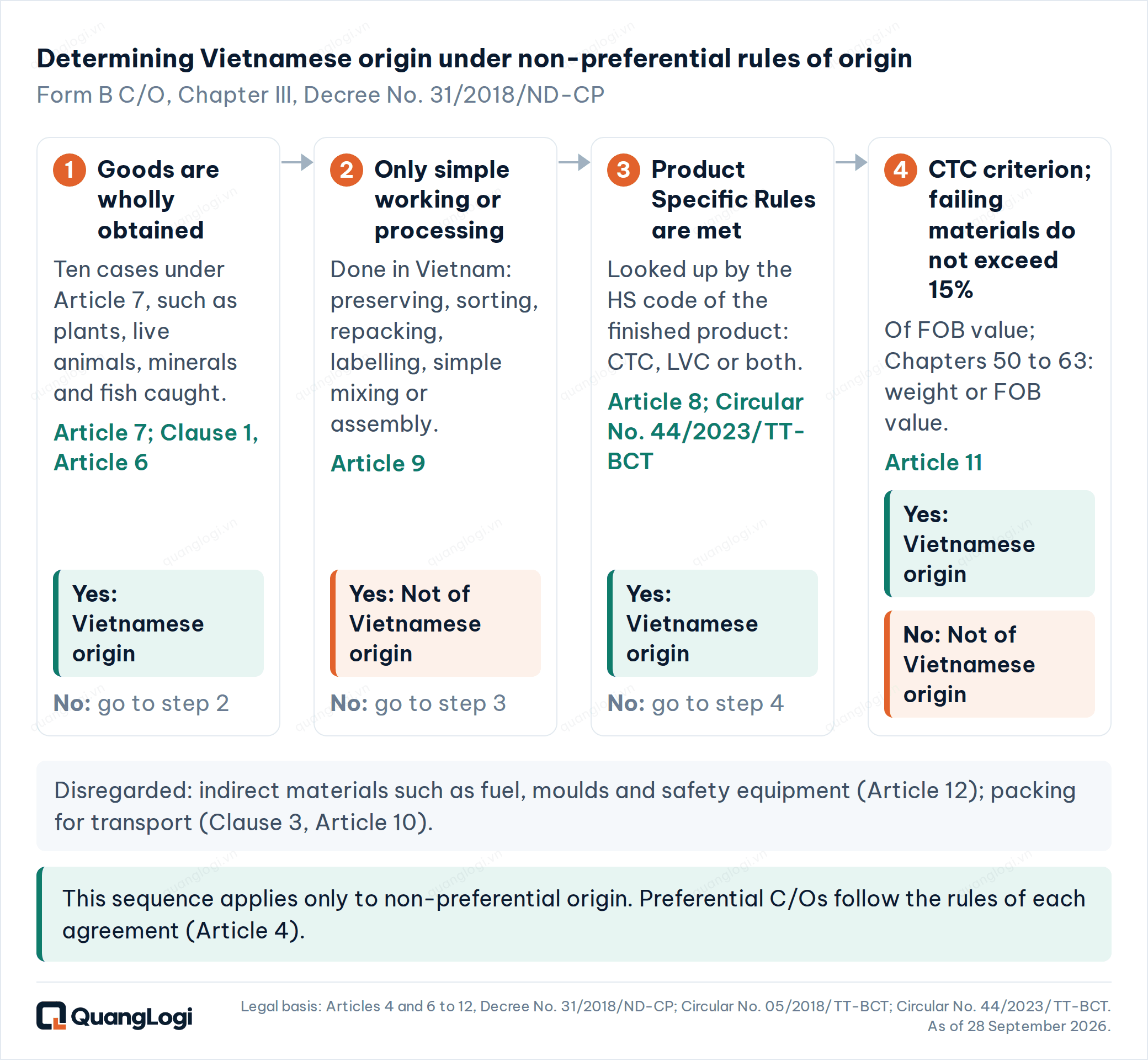
The fact that goods are produced in Vietnam does not mean that they have Vietnamese origin. Decree 31/2018/ND-CP divides goods of Vietnamese origin into two categories:
1. Wholly obtained goods: typically goods such as plants, plant products, live animals, marine products and minerals that are produced and obtained entirely in one country.
- Goods not wholly obtained: typically goods that are produced from imported materials but have undergone substantial transformation that meets the criteria laid down in the regulations on origin of goods.
The Decree also contains a list of simple working or processing operations that are excluded and are not taken into account when the origin of goods is determined. Whether carried out separately or in combination, and however many times they are repeated, these operations do not confer Vietnamese origin on the goods.
This page sets out the most important groundwork on origin of goods. After reading this page, you will have a clear understanding of the conditions that goods must meet to have Vietnamese origin. You will also be able to answer for yourself why, when two factories both import materials from China and both produce the same type of product, one is issued with a C/O for its goods and the other is not.
Summary
-
Decree 31/2018/ND-CP is the foundational decree governing the origin of exported goods and the origin of imported goods (Article 1).
-
Goods have Vietnamese origin when they fall into one of the two categories laid down in Article 6: they are wholly obtained under Article 7, or they are not wholly obtained but meet the origin criterion in the List of Product-Specific Rules under Article 8.
-
Substantial transformation (Clause 12, Article 3 of Decree 31/2018/ND-CP) is determined by one of three types of criterion under Clause 4, Article 3 of Circular 05/2018/TT-BCT: change in tariff classification (CTC); value percentage or value content (LVC: Local Value Content, RVC: Regional Value Content); and specific working or processing operation (SP). The criterion that applies to each product is found under the product's HS code in the List of Product-Specific Rules. That List is laid down in the implementing circulars.
-
The simple working or processing operations set out in Article 9, such as preservation, sifting, sorting, change of packaging, labelling, simple mixing, simple assembly and slaughter of animals, are not taken into account when origin is determined, even when they are carried out in Vietnam.
-
Vietnamese law does not prescribe how many operations must be carried out in Vietnam. Two conditions must both be met: the operations carried out in Vietnam are not on the list of simple working or processing operations in Article 9, and the goods meet the origin criteria.
-
The de minimis rule under Article 11 allows the portion of materials that does not meet the change in tariff classification criterion to be disregarded if that portion does not exceed 15% of the FOB value or, for yarn, textiles and clothing classified in HS Chapters 50 to 63, does not exceed 15% of the total weight. This rule applies only to the change in tariff classification criterion.
-
The origin of packaging, accessories, spare parts and unassembled or disassembled goods is determined in accordance with Article 10.
-
Indirect materials under Article 12, such as fuel, energy, tools, moulds, lubricating oils, lubricants, safety equipment and inspection equipment, are not taken into account when origin is determined.
-
Non-preferential origin, which is used for C/O Form B, and preferential origin under each free trade agreement are governed by two different sets of rules. The origin of goods must be assessed under the set of rules and the origin criteria that correspond to the C/O form and the export market.
1. Two categories under which a consignment has Vietnamese origin
Article 6 of Decree 31/2018/ND-CP of 8 March 2018 provides that goods are considered originating when they fall into one of two categories: they are wholly obtained under Article 7, or they are not wholly obtained and meet the origin criterion under Article 8.
The first category: wholly obtained goods. Article 7 lists ten cases in which goods are considered wholly obtained. These cases have one feature in common: the goods are produced or obtained entirely in the territory of one country, without using materials sourced from the territory of another country.
| GROUP | EXAMPLES UNDER ARTICLE 7 |
|---|---|
| Plants and plant products | Grown and harvested in Vietnam |
| Animals and animal products | Born and raised in Vietnam |
| Hunting, fishing, farming and gathering | Carried out in Vietnam |
| Minerals and naturally occurring substances | Extracted or taken from the soil, waters, seabed or subsoil beneath the seabed of Vietnam (Clause 5) |
| Products taken from the waters or seabed outside the territorial sea | Vietnam has the right to exploit those waters or that seabed under international law (Clause 6) |
| Marine products caught on the high seas | Caught by vessels registered in Vietnam and entitled to fly the Vietnamese flag; products processed on board those vessels (Clause 7, Clause 8) |
| Waste and scrap | Obtained from production or consumption in Vietnam |
| Goods produced from the products above | All materials belong to the groups above |
The second category: goods not wholly obtained. Article 8 provides that goods not produced entirely in Vietnam are still considered to have Vietnamese origin if they meet the origin criterion in the List of Product-Specific Rules prescribed by the Ministry of Industry and Trade. These criteria measure whether imported materials have undergone substantial transformation in Vietnam. Clause 12, Article 3 of Decree 31/2018/ND-CP defines substantial transformation as the transformation of goods through a production process to form a new article of commerce that differs from the original goods in shape, function, basic characteristics or intended use. Article 4 of Circular 05/2018/TT-BCT provides that goods originate in the country where the last production process that substantially transforms those goods is carried out. At present, most manufacturing companies in Vietnam produce goods that fall into this category.
Substantial transformation is determined by specific criteria, and the criterion that applies to each product is found under the HS code of the finished product.
2. Criteria for determining substantial transformation
Clause 4, Article 3 of Circular 05/2018/TT-BCT provides that product-specific rules are rules requiring materials to undergo a change in tariff classification, or to undergo a specific working or processing operation, or to meet a value percentage, or to meet a combination of these criteria. Substantial transformation is therefore measured by one of the following three types of criterion, or by a combination of those types.
| TYPE OF CRITERION | ABBREVIATION | WHAT IS MEASURED |
|---|---|---|
| Change in tariff classification | CTC | The HS code of the finished product must differ from the HS code of the non-originating materials, at the two-digit chapter level, the four-digit heading level or the six-digit subheading level |
| Value content | LVC, RVC | The value created in Vietnam must reach the prescribed minimum percentage, calculated using the formula specific to each set of rules |
| Specific working or processing operation | SP | A particular operation must be carried out in Vietnam; this criterion is common for textiles and clothing, and for chemicals |
These types of criterion may be applied on their own, combined as alternatives so that meeting one of the two is enough, or combined cumulatively so that they must be met at the same time. The specific criterion for each HS code is laid down in the List of Product-Specific Rules. The abbreviations CTC and LVC are the terms used in Point a and Point b, Clause 2, Article 6 of Circular 05/2018/TT-BCT. RVC and SP are the terms used in free trade agreements and do not appear in Decree 31/2018/ND-CP.
For non-preferential origin, this List is Appendix I to Circular 05/2018/TT-BCT of 3 April 2018, which has been replaced by the appendix issued with Circular 44/2023/TT-BCT of 29 December 2023. The current text to consult for Circular 05/2018/TT-BCT is Consolidated Text 21/VBHN-BCT of 2025. For preferential origin under free trade agreements, each agreement has its own list, issued with the implementing circular for that agreement. That topic is covered on the page "Origin criteria by FTA and C/O form".
3. Simple working or processing operations are not taken into account when origin is determined
Article 9 of Decree 31/2018/ND-CP lists the simple working or processing operations. When these operations are carried out in Vietnam, they are not taken into account when the origin of goods is determined, even where several operations on the list are carried out in combination.
| GROUP OF OPERATIONS | EXAMPLES GIVEN IN ARTICLE 9 |
|---|---|
| Preservation of goods during transport and storage | Ventilation, spreading out, drying, chilling, salting |
| Cleaning, sorting, painting, cutting up | Removal of dust, sifting, selecting, sorting, wiping, painting, cutting up |
| Change of packaging, handling of consignments | Change of packaging, breaking-up and assembly of consignments, bottling, packing |
| Labelling | Affixing marks, labels or distinguishing signs to products or their packaging |
| Simple mixing | Simple mixing of products |
| Simple assembly | Simple assembly of parts into a complete product |
| Combination of operations | Two or more of the operations above |
| Slaughter | Slaughter of animals |
The direct consequence of Article 9 is that goods that are imported into Vietnam and then only preserved, sorted, repackaged and given Vietnamese-language labels before being exported to a third country do not have Vietnamese origin. This provision is also the dividing line between production activity and an act of origin fraud.
The question I receive most often from companies is what percentage of the operations must be carried out in Vietnam for the goods to qualify as originating. Vietnamese law does not set a required percentage of operations. The determination rests on two independent conditions, both of which must be met: the operations carried out in Vietnam are not on the list of simple working or processing operations in Article 9, and the finished product meets the substantial transformation criteria set out in section 2.
4. The de minimis rule
Article 11 of Decree 31/2018/ND-CP allows goods that do not meet the change in tariff classification criterion still to be considered originating if the portion of materials that does not meet the criterion is below a certain threshold. This threshold is laid down for two cases, depending on the HS code of the finished product.
| GROUP OF GOODS | THRESHOLD | BASIS OF CALCULATION |
|---|---|---|
| Goods not classified in HS Chapters 50 to 63 | 15% | The value of all non-originating materials that do not meet the change in tariff classification criterion, relative to the FOB value of the goods |
| Goods classified in HS Chapters 50 to 63 (textiles and clothing) | 15% | The weight of those materials relative to the total weight of the goods, or the value of those materials relative to the FOB value. Meeting the threshold under either of the two methods of calculation is sufficient |
Two conditions attached to Article 11 are often overlooked when that article is applied. Under Point c, Clause 1, Article 11, the goods must still meet all other conditions laid down in the Decree and the relevant implementing circulars. The de minimis rule applies only to the change in tariff classification criterion. In addition, under Clause 2, Article 11, the value of the portion of materials that is disregarded is still counted in the value of non-originating materials when the value percentage is calculated. Relying on the de minimis rule to satisfy the change in tariff classification criterion does not turn that portion of materials into originating materials.
The 15% threshold above belongs to the non-preferential rules of origin. Each free trade agreement has its own threshold and its own basis of calculation, and some agreements do not provide for a de minimis rule.
5. Packaging, accessories, spare parts, and unassembled or disassembled goods
Article 10 of Decree 31/2018/ND-CP provides for five cases. The point that needs the most attention is that the same type of packaging material is treated differently depending on the origin criterion being applied.
| CASE | TREATMENT |
|---|---|
| Goods to which the change in tariff classification criterion applies | Packaging materials and containers for retail sale, when classified together with the goods, are excluded from the non-originating materials used to produce the goods |
| Goods to which the value percentage criterion applies | The value of packaging materials and containers for retail sale is regarded as a constituent part of the goods and is taken into account when origin is determined |
| Packing materials for transportation and shipment | Not taken into account when origin is determined |
| Product literature and instructions for use; accompanying accessories, spare parts and tools of an appropriate type and quantity | Considered to have the same origin as the goods |
| Unassembled or disassembled goods imported in several consignments because of transport or production conditions | If the importer so requests, the origin of the goods in each consignment is considered to be the same as the origin of those unassembled or disassembled goods |
The first two rows of the table are commonly overlooked when value content is calculated: retail packaging is left out of the calculation when the change in tariff classification criterion is applied, but must be included in the calculation when the value percentage criterion is applied.
6. Indirect materials
Article 12 of Decree 31/2018/ND-CP lists eight groups of items that are used in production, inspection or testing but are not incorporated into the goods, or that are used to maintain buildings and operate equipment. These items need not be taken into account when the origin of goods is determined.
| GROUP | DESCRIPTION |
|---|---|
| 1 | Fuel and energy |
| 2 | Tools, dies and moulds |
| 3 | Spare parts and materials used to maintain equipment and buildings |
| 4 | Lubricating oils, lubricants, compounds and other materials used in production or to operate equipment and buildings |
| 5 | Gloves, eyewear, footwear, clothing and safety equipment |
| 6 | Equipment, devices and machines used to test or inspect goods |
| 7 | Catalysts and solvents |
| 8 | Any other materials that are not incorporated into the goods but can be demonstrated to be necessary in the production process |
7. Preferential origin and non-preferential origin are governed by two different sets of rules
The same consignment may qualify as originating in Vietnam under the non-preferential rules of origin and so be issued with a C/O Form B, yet not qualify under the rules of origin of a free trade agreement and therefore not be issued with a C/O on a preferential form. The reverse can also happen, because different C/O forms may have different origin criteria for the same type of goods.
Decree 31/2018/ND-CP deals with these two sets of rules in two separate chapters. Chapter II contains the preferential rules of origin. Article 4 provides that origin for the purpose of tariff and non-tariff preferences is determined in accordance with the international treaty that Vietnam has signed or acceded to, and with the regulations of the Ministry of Industry and Trade implementing that treaty. Article 5 provides that the origin of exported goods for the purpose of the Generalised System of Preferences (GSP) and other unilateral preferences is determined in accordance with the rules of origin that the importing country applies to those preferences, and with the regulations of the Ministry of Industry and Trade implementing those rules of origin. For goods exported under the GSP, the origin criteria are set by the preference-granting country, while the certification procedure follows the guidance of the Ministry of Industry and Trade, for example Circular 38/2018/TT-BCT for the GSP of the European Union, Norway, Switzerland and Turkey.
Chapter III contains the non-preferential rules of origin, which comprise Articles 6 to 12 discussed above and are implemented by Circular 05/2018/TT-BCT. The preferential rules of origin of each agreement are laid down in the separate implementing circular for that agreement, with their own criteria, de minimis threshold and cumulation rule.
The question to ask is therefore not simply whether the goods have Vietnamese origin. The following points need to be made clear. What is the export market? Which C/O form applies? What is the corresponding set of origin criteria? Do the goods meet those origin criteria?
8. Legal basis
| INSTRUMENT | DATE OF ISSUANCE | EFFECTIVE DATE, STATUS | RELEVANT PROVISIONS |
|---|---|---|---|
| Decree 31/2018/ND-CP, "Detailing the Law on Foreign Trade Management with regard to origin of goods" | 8 March 2018 | 8 March 2018, in force; under Resolution 19/2026/NQ-CP, three administrative procedures in Article 15 and Article 17 are not to be carried out | Chapter II, preferential rules of origin: Article 4 (under international treaties); Article 5 (under the GSP and unilateral preferences). Chapter III, non-preferential rules of origin: Article 6 (originating goods); Article 7 (wholly obtained); Article 8 (not wholly obtained); Article 9 (simple working or processing operations); Article 10 (packaging and accessories); Article 11 (de minimis); Article 12 (indirect materials) |
| Resolution 19/2026/NQ-CP | 29 April 2026 | 29 April 2026, ceases to have effect on 1 March 2027 (Clause 3, Article 8) | Does not amend the rules of origin in Chapter II and Chapter III of Decree 31/2018/ND-CP. The provision that affects the Decree is in Appendix III "Reduction and simplification of administrative procedures under the management of the Ministry of Industry and Trade", Section 1 "Administrative procedures abolished", Point Đ "Import and export sector", Clause 5, which reads: "The administrative procedure for the retrospective issuance of a certificate of origin (C/O) laid down in Article 15 and Article 17 of Decree 31/2018/ND-CP is not to be carried out." This provision has attracted little attention. While the Resolution is in force, companies need to apply for a C/O at the time of export to avoid problems arising |
| Circular 05/2018/TT-BCT, "Regulations on origin of goods" | 3 April 2018 | 3 April 2018, in force. Current text to consult: Consolidated Text 21/VBHN-BCT of 2025 | Appendix I: the List of Product-Specific Rules; Appendices II to IX: the statement template for each origin criterion; Appendix X: the declaration of origin by the domestic manufacturer or materials supplier |
| Circular 44/2023/TT-BCT | 29 December 2023 | 15 February 2024, in force | Replaces Appendix I and Appendix II to Circular 05/2018/TT-BCT |
| Circular 23/2025/TT-BCT | 5 May 2025 | 5 May 2025, in force | Amends and supplements Circular 05/2018/TT-BCT and Circular 38/2018/TT-BCT |
Note on status: the status of the instruments above was checked on 12 September 2026. The content of this page was checked against the full texts of Decree 31/2018/ND-CP, Resolution 19/2026/NQ-CP, Circular 44/2023/TT-BCT and Consolidated Text 21/VBHN-BCT of 2025 on 13 September 2026. Resolution 19/2026/NQ-CP is a time-limited instrument. Under Clause 3, Article 8, it ceases to have effect on 1 March 2027 unless another instrument replaces it earlier. The content of this page will be reviewed before that date.
9. Contact
If you have not yet determined which category your goods fall into, you can send me the HS code of the finished product, the list of imported materials with their HS codes, and a short description of the operations carried out at the factory. I will tell you whether the goods are wholly obtained or not wholly obtained, and whether the operations being carried out are on the list of simple working or processing operations in Article 9.
What I do here is origin documentation and customs procedures work, within the scope of the professional certificates I hold; it is not legal advice on a specific matter.
10. Read next
-
Origin criteria by FTA and C/O form. The same product can qualify as originating under one agreement but not under another.
-
Input materials, material usage per unit and production process when applying for a C/O. Three groups of supporting evidence in the C/O application showing that the origin criterion is met.
-
Origin of goods and the certificate of origin (C/O) for goods produced in Vietnam. The overview page for this whole topic.
11. Author

Hoàng Ngọc Quang (QuangLogi)
Registered customs-broker staff member assigned an identification number by Vietnam Customs under Official Letter No. 249/GSQL-TH dated 20 February 2025.
Customs declaration professional certificate No. 165/2018/KHQ-HN.
Vice Director of GIANG TO VIEN DUONG INTERNATIONAL TRANSPORT Co., Ltd. (Luchi Vietnam).
Member of the Vietnam Association for Logistics Manpower Development (VALOMA) under Admission Decision No. 1003/QD-BCH.
Trained as a lawyer in Course IX of the lawyer training programme for international integration at the Judicial Academy.
More than ten years handling documents and customs procedures on the China-Vietnam-Cambodia corridor, including C/O applications for goods exported from Vietnam and C/O files for goods imported from China.
About the author
I write as someone who prepares these applications myself. Any case and client details in the examples have been anonymised.
I have been trained as a lawyer under the lawyer training programme for international integration at the Judicial Academy but do not hold a lawyer's practising card. The content is professional information supported by cited legal instruments, not legal advice for a specific matter.
The content on this page is general information and not legal advice. Disclaimer.