
There are no articles in this section yet.
C/O application file for goods manufactured in Vietnam
By this stage the goods have been produced, the origin criterion has either been met or not been met, and what remains is to put together an application whose format and content comply with the regulations and which can stand up to scrutiny by the officer reviewing it. This page follows the order in which the work has to be done: completing first-time trader-profile registration, choosing the issuing authority and the filing system, preparing the set of documents for each consignment, and then the situations that arise, such as applying for a retrospectively issued C/O or for reissuance of a C/O.
This page is limited to goods produced in Vietnam. Goods imported from abroad and then exported from Vietnam without undergoing working or processing operations in Vietnam are not eligible for a Vietnamese C/O.
Summary
- A company applying for a C/O for the first time must complete trader-profile registration with the issuing authority, and must register with every authority to which it will submit applications.
- The Vietnam Chamber of Commerce and Industry has not issued C/Os since 5 May 2025, under Decision 1103/QD-BCT of 21 April 2025.
- Since 1 August 2026, the power to issue C/Os has been divided between the Agency of Foreign Trade and Provincial People's Committees under Article 19 of Circular 26/2026/TT-BCT: 12 forms are on both lists, and 19 types are on the Provincial People's Committees' list only, including Form E and Form B.
- Forms D, AK and VK are filed on ecosys.gov.vn; the remaining forms are filed on co.moit.gov.vn.
- The application for each consignment consists of three groups of documents: input (import declarations for the materials, invoices for materials purchased domestically, the Appendix X declaration), production (the statement demonstrating compliance with the origin criterion, the production-process description) and output (contract, commercial invoice, packing list, bill of lading, cleared export declaration).
- Retrospectively issued C/O: Resolution 19/2026/NQ-CP provides that the procedure for retrospective issuance of a C/O is not to be carried out while the resolution is in force. As at 15 September 2026, however, this procedure was still published on the Ministry of Industry and Trade Public Service Portal. You need to check each case directly with the authority receiving the application.
- You need to check whether the goods can qualify as originating before agreeing to a C/O clause in the contract.
The one-off task: trader-profile registration
A company applying for a C/O for the first time must complete trader-profile registration with the issuing authority before, or at the same time as, it submits the application for its first consignment. This is why the first application always takes the most effort and time, and is also checked most closely.
One point is often overlooked: the company needs to register with every issuing authority to which it will submit applications. If the company has left one out, and starts the additional registration procedure only when a consignment needs a C/O form issued by an authority it has not yet registered with, the result is delay.
After the first time, each consignment needs only its own application, which usually goes through checking and approval more smoothly.
Two issuing authorities since 1 August 2026, and not every form offers a choice
The Vietnam Chamber of Commerce and Industry has not issued any type of C/O since 5 May 2025, under Decision 1103/QD-BCT of 21 April 2025. Many online guides still give instructions for registering an account on the old system.
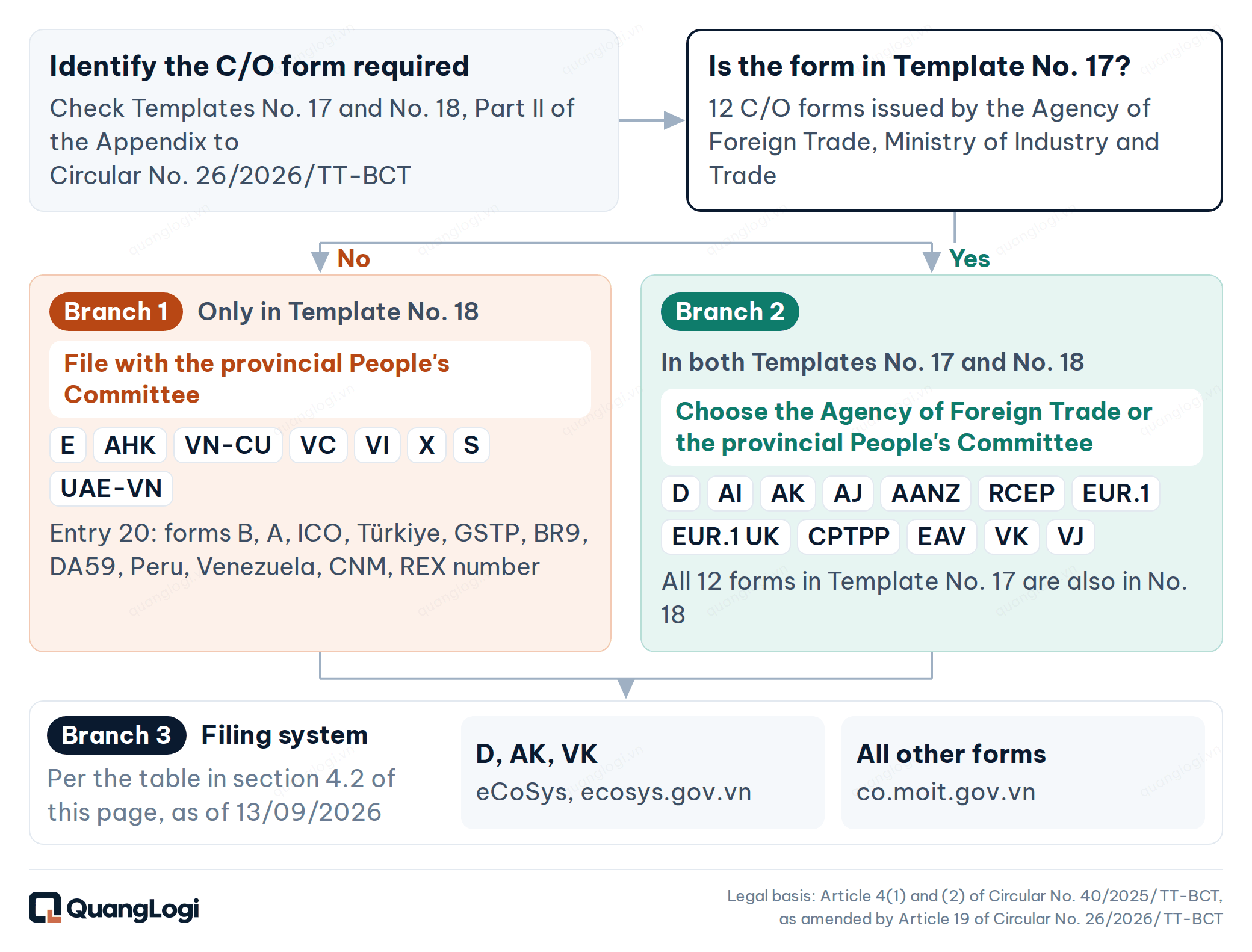
Since 1 August 2026, the power to issue C/Os has been divided between two authorities, under Article 19 of Circular 26/2026/TT-BCT:
| GROUP | C/O FORM | AGENCY OF FOREIGN TRADE | PROVINCIAL PEOPLE'S COMMITTEES |
|---|---|---|---|
| On the lists of both authorities | D, AI, AK, AJ, AANZ, RCEP, EUR.1, EUR.1 UK, CPTPP, EAV, VK, VJ | Yes | Yes |
| Forms under agreements, on the provincial list only | E, AHK, VC, VI, VN-CU, S, X, UAE-VN | No | Yes |
| Non-preferential forms and specialised forms | B, A, ICO, Türkiye, GSTP, BR9, DA59, Peru, Venezuela, CNM, REX number | No | Yes |
Read the table the other way round to see the point that is most easily misunderstood: there is no C/O form that only the Agency of Foreign Trade can issue, whereas there are 19 types that only Provincial People's Committees issue. For the 12 forms on both lists, the company may choose where to submit its application. A Form E application for China can be submitted only at provincial level.
Two filing systems
| SYSTEM | ADDRESS | C/O FORMS |
|---|---|---|
| Electronic Certificate of Origin Management and Issuance System (eCoSys) | ecosys.gov.vn | D, AK, VK |
| Electronic Certificate of Origin Management and Issuance System of the Ministry of Industry and Trade | co.moit.gov.vn | EUR, AANZ, AJ, AI, CPTPP, EAV, RCEP, VJ, EUR1UK, AHK, B, E, S, VC, VI, VN-CU, X, A, CNM, DA59, GSTP, ICO, P, TR, UAEVN |
Three forms, D, AK and VK, are still filed on eCoSys because their data has to be transmitted to the National Single Window. A company whose export markets fall into both groups must maintain accounts on both systems.


The application for each consignment
| GROUP | DOCUMENT | PURPOSE |
|---|---|---|
| Input | Import declarations for all the materials | Shows the source and the value of the non-originating materials |
| Input | Invoices for materials purchased domestically | Applies to the part of the materials that was not imported directly |
| Input | Declaration of origin by the domestic manufacturer or materials supplier, that is, Appendix X to Circular 05/2018/TT-BCT, accompanied by that supplier's supporting evidence of origin | Used where materials are purchased domestically and the supplier has no C/O, but those materials nonetheless meet the Vietnamese origin criterion |
| Production | Statement demonstrating compliance with the origin criterion, which sets out the material usage per unit of product | Shows the types of materials used, the quantity of each type per unit of product, the value of the input materials, and how the origin criterion is met |
| Production | Production-process description | Shows that the operations carried out in Vietnam are not simple working or processing operations |
| Output | Contract, commercial invoice, packing list, export bill of lading | Gives the details of the export consignment |
| Output | Cleared export declaration | Confirms that the consignment has actually been exported |
The statement template is chosen from Appendices II to IX to Circular 05/2018/TT-BCT to match the origin criterion being applied to the HS code of the finished product.
Time needed in practice
When the company provides complete information from the outset, the application is usually put together within one working day. On the next working day the application is filed on the electronic certificate of origin issuance system that corresponds to the C/O form, and it then awaits approval and issuance.
This timing holds only if the input documentation is complete and accurate. If one import declaration for materials or one purchase invoice is missing, the clock restarts from the moment the missing documentation has been supplied in full. If that moment falls at the weekend, the application will normally have to wait until the start of the following week to be approved.
Three situations that commonly arise
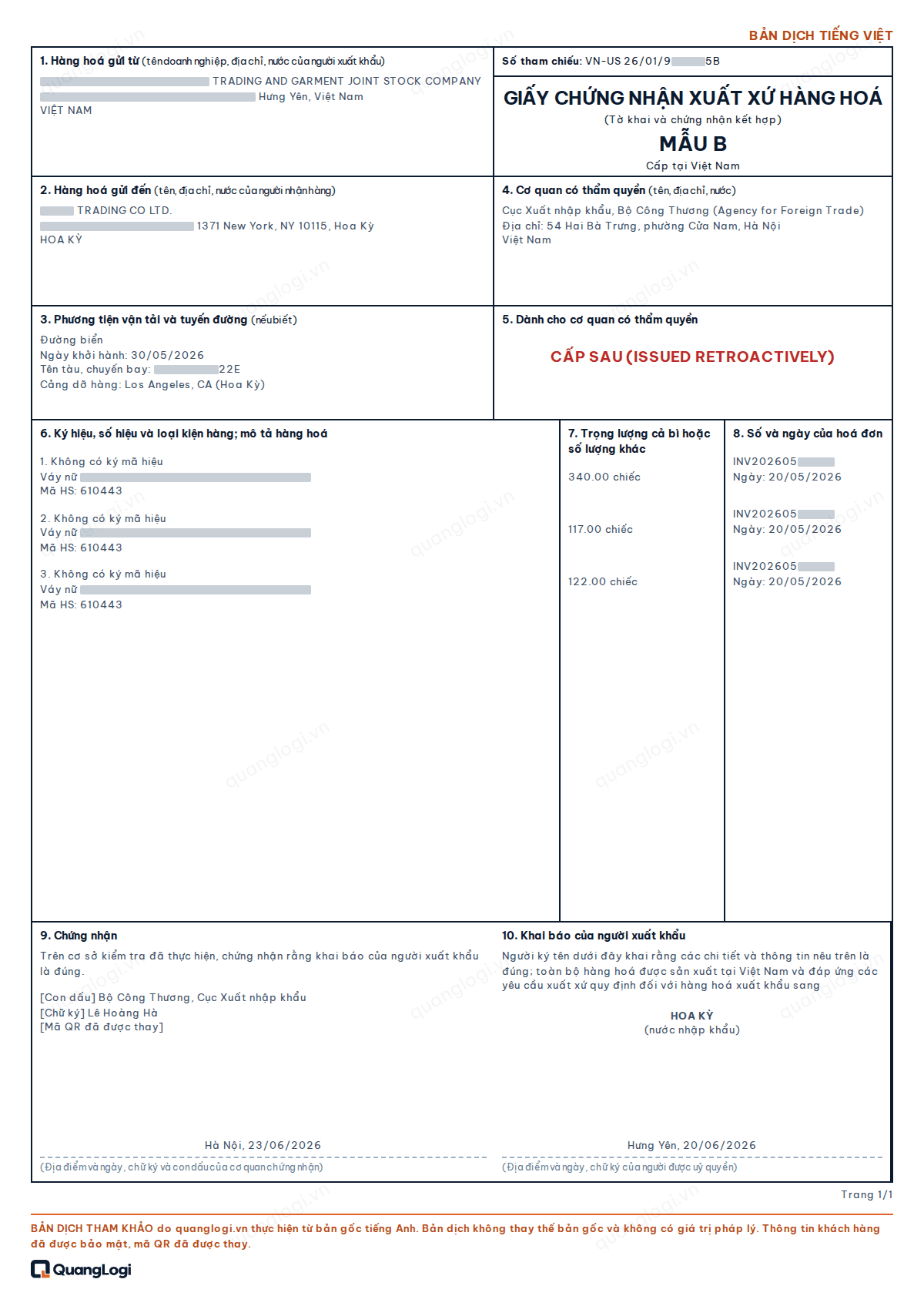
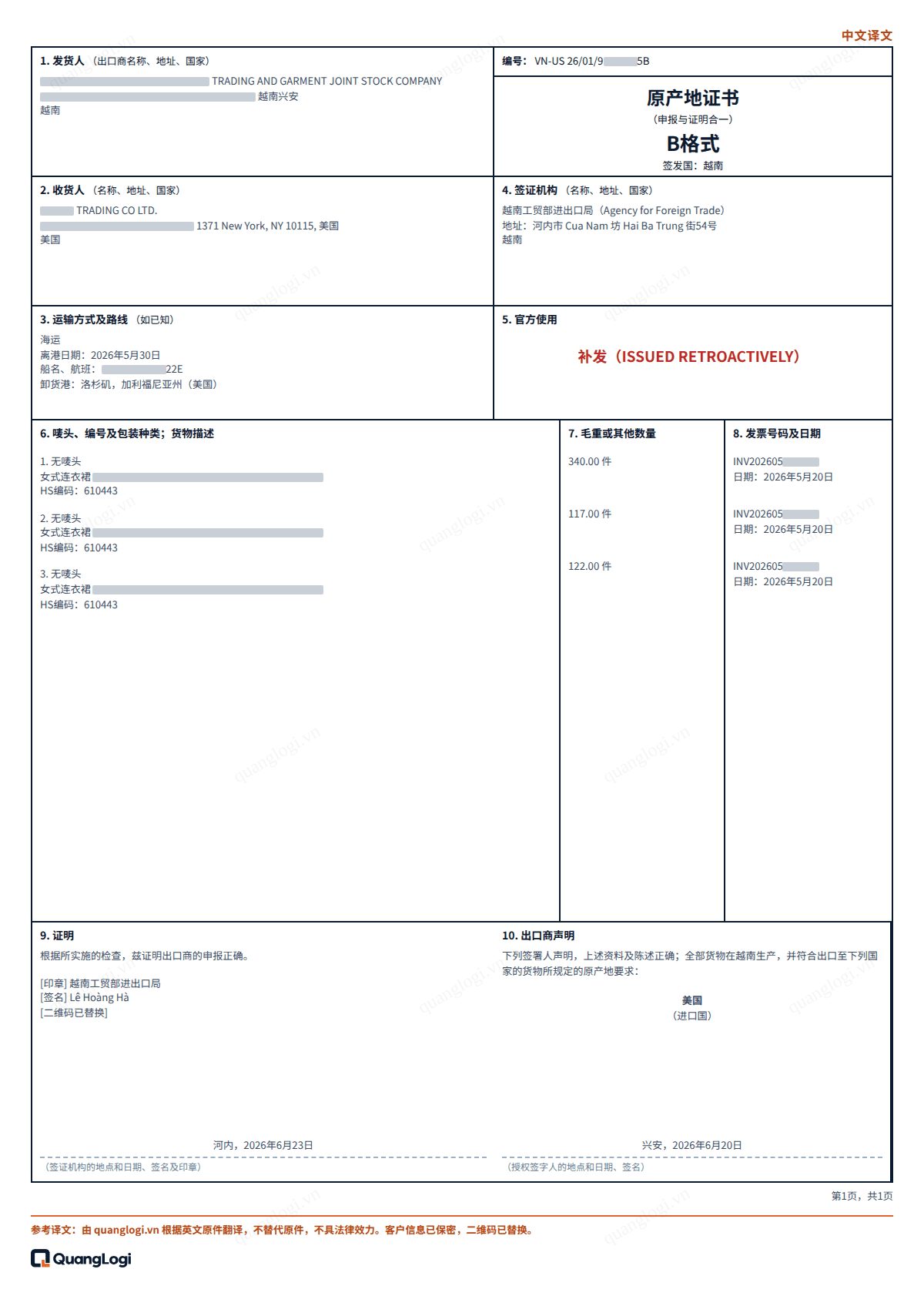
Retrospectively issued C/O. Appendix III, Section 1, Point Đ, Clause 5 of Resolution 19/2026/NQ-CP provides that the administrative procedure for retrospective issuance of a C/O under Article 15 and Article 17 of Decree 31/2018/ND-CP is not to be carried out while the resolution is in force. However, as at 15 September 2026, procedure 1.001380 was still published on the Ministry of Industry and Trade Public Service Portal. The two sources are not yet consistent on how this operates in practice, so you should not assume either that applications for a retrospectively issued C/O are still accepted or that they have been stopped altogether. You need to check each case directly with the authority receiving the application.
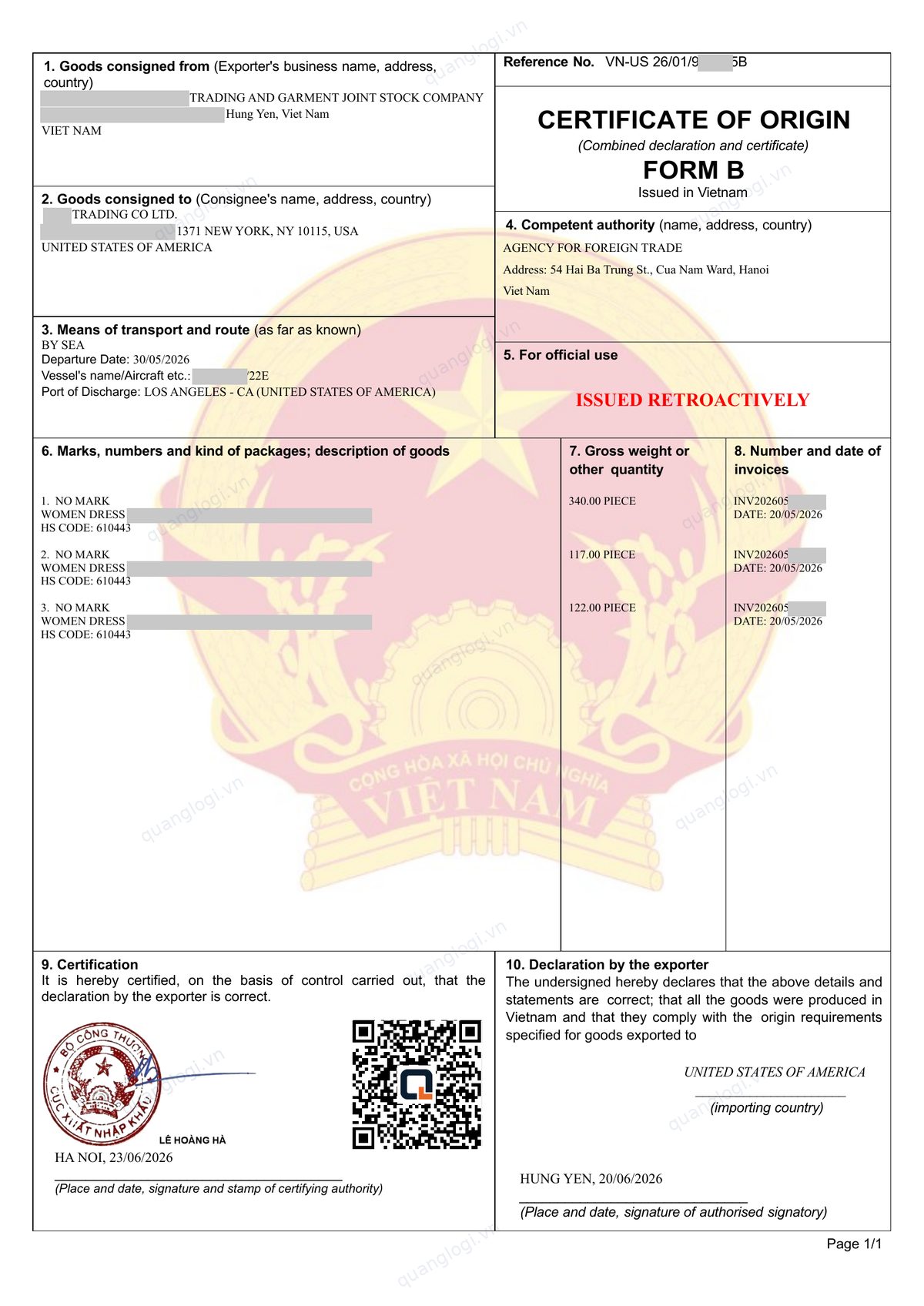
Vietnam Certificate of Origin Form B, issued retroactively, original
Reissuance of a C/O. Clause 1, Article 18 of Decree 31/2018/ND-CP distinguishes four cases:
- Point a: the C/O is lost, misplaced or damaged; the reissued copy is stamped "CERTIFIED TRUE COPY" and is valid for no more than 1 year from the date of shipment.
- Point b: the C/O needs to be split into several C/O sets; reissuance is allowed only within 1 year from the date of issuance of the earlier C/O.
- Point c: the goods are re-imported for reprocessing or are redirected to another importing country; reissuance is allowed only within 1 year from the date of issuance of the earlier C/O.
- Point d: there is an unintentional error or omission on the original; reissuance is allowed only within 1 year from the date of issuance of the earlier C/O.
The time limit for requesting reissuance under Points b, c and d does not extend to the case in Point a. At present, most of the C/O forms that Vietnam issues are electronic, and reissuance of a C/O because of loss or damage under Point a applies only to the C/O forms that are still paper-based.
Self-certification of origin. Under some agreements, an eligible company may make out the proof of origin itself instead of applying for a C/O. The procedure for written approval of self-certifying traders is laid down in Circular 40/2025/TT-BCT. Under the EVFTA, the type of self-certification also depends on the value of the consignment.
The C/O clause in a contract is a commitment with a cost
The buyer agrees to the contract price because it has factored in the preferential rate of import duty in its own country, on condition that the exporter can provide a valid C/O. If there is no C/O at the time of delivery, or there is one but the customs authority of the importing country rejects it, the seller will usually have to bear the difference in duty, because it has breached an obligation set out in the contract.
The right order is therefore to check first whether the goods can qualify as originating and to agree to the C/O clause afterwards, not the other way round.
Legal basis
| INSTRUMENT | DATE, STATUS | RELEVANT PROVISIONS |
|---|---|---|
| Decree 31/2018/ND-CP | 8 March 2018, in force | Certification of origin of goods: trader-profile registration, C/O application, retrospectively issued C/O, reissuance, self-certification of origin. Article 30 sets the record retention period |
| Circular 05/2018/TT-BCT | 3 April 2018, in force | Appendices II to IX set out the statement template for each origin criterion. Appendix X is the declaration of origin by the domestic materials supplier. Appendix XI is the template for C/O Form B |
| Decision 1103/QD-BCT | 21 April 2025 | Withdraws the delegated power to issue C/Os; VCCI ceased issuing C/Os on 5 May 2025 |
| Decree 146/2025/ND-CP | In force from 1 July 2025 | Reallocates the power to issue C/Os |
| Circular 40/2025/TT-BCT | In force from 1 July 2025 | Procedures for C/O issuance and for written approval of self-certifying traders |
| Circular 26/2026/TT-BCT | Issued on 20 May 2026, in force from 29 May 2026; the part on allocation of the power to issue C/Os applies from 1 August 2026 | Article 19 amends Article 4 of Circular 40/2025/TT-BCT and replaces two appendices with Form No. 17 and Form No. 18 in Part II of the Appendix to Circular 26/2026/TT-BCT |
If your company is applying for a C/O for the first time, or is held up at trader-profile registration, you can let me know which C/O form you intend to use and the province where your company is based. I will set out where to submit the application, which system to file on, and what to prepare for the first application.
What I do here is origin documentation and customs procedures work, within the scope of the professional certificates I hold; it is not legal advice on a specific matter.
Read next
- Input materials, material usage per unit and production process when applying for a C/O. The three types of supporting evidence for the origin criterion.
- Customs documentation and procedures for exports. The export declaration and the accompanying documents.
- Common errors when applying for a C/O and how to deal with them. The errors repeated most often in real applications.
Author

Hoàng Ngọc Quang (QuangLogi)
Registered customs-broker staff member assigned an identification number by Vietnam Customs under Official Letter No. 249/GSQL-TH dated 20 February 2025.
Customs declaration professional certificate No. 165/2018/KHQ-HN.
Vice Director of GIANG TO VIEN DUONG INTERNATIONAL TRANSPORT Co., Ltd. (Luchi Vietnam).
Member of the Vietnam Association for Logistics Manpower Development (VALOMA) under Admission Decision No. 1003/QD-BCH.
Trained as a lawyer in Course IX of the lawyer training programme for international integration at the Judicial Academy.
More than ten years handling documents and customs procedures on the China-Vietnam-Cambodia corridor, including C/O applications for goods exported from Vietnam and C/O files for goods imported from China.
About the author
I write as someone who prepares these applications myself. Client details in the examples have been anonymised.
I have been trained as a lawyer under the lawyer training programme for international integration at the Judicial Academy but do not hold a lawyer's practising card. The content is professional information supported by cited legal instruments, not legal advice for a specific matter.
The content on this page is general information and not legal advice. Disclaimer.