Customs value and value consultation in Vietnam
The customs value of imported goods is the actual price payable up to the first border gate of import. When the declared value is doubted, the customs authority conducts a consultation and handles the result within a maximum of 30 days from the date of release of goods.
An importer who receives a customs Notice requiring the value consultation procedure is usually in the same situation: the goods have arrived at the border gate, the customs authority has relied on its database to set an intended price higher than the invoice price the enterprise is declaring, and the time limit for explanation is counted in working days. This article answers three questions: in what sequence the customs value of imported goods is determined, in which cases the customs authority rejects or doubts the declared value, and what the customs declarant must do during the 30 days of consultation. The customs value of imported goods is the actual price payable up to the first border gate of import, under Clause 3, Article 86 of the Law on Customs No. 54/2014/QH13, and is the basis for calculating import duty under Clause 1 of that Article. A discrepancy in value leads to a discrepancy in duty, with a risk of loss of state budget revenue. Consultation (commonly called value consultation) is the procedure through which the customs declarant explains and proves the declared value when the customs authority has doubt, under Clause 4, Article 25 of Circular No. 38/2015/TT-BTC dated 25 March 2015 of the Ministry of Finance, as amended and supplemented by Circular No. 39/2018/TT-BTC and Circular No. 121/2025/TT-BTC (hereinafter referred to as Circular No. 38/2015/TT-BTC). The methods for determining the customs value are set out in Circular No. 39/2015/TT-BTC dated 25 March 2015 of the Ministry of Finance, as amended and supplemented by Circular No. 60/2019/TT-BTC (hereinafter referred to as Circular No. 39/2015/TT-BTC). The legal documents cited in this article are in force as at 3 October 2026.
Summary
- The customs value of imported goods is the actual price payable up to the first border gate of import, under Clause 3, Article 86 of the Law on Customs No. 54/2014/QH13.
- The customs value of imported goods is determined sequentially under the six methods in Clause 2, Article 5 of Circular No. 39/2015/TT-BTC, stopping at the method under which the value can be determined, under Point a, Clause 1, Article 5.
- The customs authority rejects the declared value in four cases under Point a, Clause 3, Article 25 of Circular No. 38/2015/TT-BTC and has doubt about the declared value of imported goods in five cases under Point b.4 of the same Clause.
- The time for consultation and for handling the consultation result is a maximum of 30 days from the date of release of goods or the date of taking the goods into the declarant's storage, under Point c, Clause 4, Article 25 of Circular No. 38/2015/TT-BTC.
- The customs declarant may request that the consultation result be used for subsequent imports. The customs authority accepts the request when the customs declarant is assessed as having a compliance rating of high or above, and the result is valid for 06 months from the date of issue of the Customs Value Notice, under Clause 5, Article 25 of Circular No. 38/2015/TT-BTC.
The amended version of Article 25 cited in this article
Article 25 of Circular No. 38/2015/TT-BTC is cited in this article as amended by Clause 12, Article 1 of Circular No. 121/2025/TT-BTC, effective from 1 February 2026. The Point and Clause numbers are those of this amended version and do not match the 2015 version or the 2018 version.
Customs value of imported goods and the six valuation methods
The amount of duty on a consignment depends on the commodity code, the origin and proof of origin of imported goods and the customs value. Point a, Clause 1, Article 5 of Circular No. 39/2015/TT-BTC requires the methods to be applied sequentially, stopping at the method under which the customs value can be determined. Clause 2, Article 5 lists six methods.
The six methods, in the exact order of Clause 2, Article 5, are summarised in the table below. Each later method may be applied only when the customs value cannot be determined under the preceding methods.
| Order | Method (Article of Circular No. 39/2015/TT-BTC) | Summary of content | What to know when applying |
|---|---|---|---|
| 1 | Transaction value of imported goods (Article 6) | The price actually paid or payable by the buyer to the seller to purchase and import the goods, after the additions and deductions under Article 13, Article 14 and Article 15 | The actual price includes indirect payments, advance payments and deposits not yet shown on the invoice (Clause 3, Article 6); it applies only when all four conditions in Clause 4, Article 6 are met (next section) |
| 2 | Transaction value of identical imported goods (Article 8) | The transaction value, already accepted by the customs authority, of a consignment identical in physical characteristics, quality and brand, from the same country and the same producer | Carried out in the manner of Article 9, replacing "similar imported goods" with "identical imported goods" (Clause 2, Article 8) |
| 3 | Transaction value of similar imported goods (Article 9) | The already accepted transaction value of a similar consignment, under the same conditions of sale and the same condition as to the time of export | The comparison consignment must have been exported to Vietnam on the same day or within 60 days before or after, at the same commercial level and in the same quantity; where the conditions differ, an adjustment to the same conditions is required (Clause 2, Article 9) |
| 4 | Deductive value (Article 10) | The unit selling price of the goods themselves, or of identical or similar goods, on the domestic market of Vietnam, less reasonable costs and the profit after sale | Not applicable when the goods have not yet been sold in Vietnam, when the sale has not been recorded in the accounting books, or when the goods are connected with assists (Clause 1, Article 10) |
| 5 | Computed value (Article 11) | The sum of the direct costs of producing the goods, the general expenses and profit of sales of goods of the same class or kind to Vietnam, and the transport and insurance costs under Point g and Point h, Clause 2, Article 13 | The basis is the figures in the documents and accounting books of the producer in the country of export (Clause 2, Article 11), so this method depends on the seller providing the figures |
| 6 | Fall-back method (Article 12) | The five methods above are applied again sequentially and flexibly, on the basis of available documents and data, stopping immediately at the method under which the value can be determined | The following may not be used: the domestic selling price of goods produced in Vietnam, the domestic price in the country of export, the price of exports to another country, the reference price in the List of goods subject to valuation risk, or the higher of two alternative values (Clause 3, Article 12); the comparison period for identical or similar goods is extended to a maximum of 90 days (Point b, Clause 4, Article 12) |
The customs declarant may reverse the order of the deductive value method and the computed value method only upon a written request (Point b, Clause 1, Article 5 of Circular No. 39/2015/TT-BTC). Applying the methods out of sequence is a ground for rejecting the declared value (Point a.4, Clause 3, Article 25 of Circular No. 38/2015/TT-BTC).
Conditions for applying the transaction value and the special relationship
The transaction value method may be applied only when the transaction satisfies all four conditions in Clause 4, Article 6 of Circular No. 39/2015/TT-BTC:
- The buyer is not restricted in the right to dispose of or use the goods after import, except for restrictions imposed by Vietnamese law, restrictions on the place of resale and restrictions that do not affect the value (Point a).
- The price or the sale is not subject to a condition or payment that makes the value of the goods impossible to determine (Point b).
- After the resale, transfer or use of the goods, the buyer does not have to pay any further amount from the proceeds, except for the amount to be added under Point e, Clause 2, Article 13 (Point c).
- The buyer and the seller have no special relationship, or they have one but the special relationship does not influence the transaction value (Point d).
The condition in Point d is the one that most often has to be proved for goods imported from a parent company or a company in the same group.
Special relationship is a term of Article 7 of Circular No. 39/2015/TT-BTC and differs from the "related-party relationship" used in the law on related-party transactions. Clause 1, Article 7 lists nine cases, from Point a to Point i:
- Both are employees, or one is an employee and the other is a director, in each other's enterprise (Point a).
- Both are general partners contributing capital in a business recognised by law (Point b).
- Employer and employee (Point c).
- The seller has the right to control the buyer, or the reverse (Point d).
- Both are controlled by a third party (Point đ).
- Both jointly control a third party (Point e).
- They have a family relationship: husband and wife, parents and children, grandparents and grandchildren, aunts or uncles and nieces or nephews by blood, siblings by blood, brothers-in-law and sisters-in-law (Point g).
- A third person owns, controls or holds 5% or more of the voting shares of both parties (Point h).
- The parties are associated in business as sole agent, sole distributor or sole concessionaire, when they also fall within one of the cases from Point a to Point h (Point i).
Under Clause 2, Article 7, the special relationship does not influence the transaction value when the transaction is conducted as it would be with a buyer that has no special relationship, or when the transaction value closely approximates a comparison value of a consignment exported to Vietnam on the same day or within 60 days before or after. The customs declarant must declare the special relationship on the import declaration and the customs value declaration (if any) at the time the declaration is registered (Point a.1, Clause 4, Article 7, as amended by Clause 7, Article 1 of Circular No. 60/2019/TT-BTC). An enterprise that imports goods from its parent company should keep on file the price list that the seller applies to buyers with no special relationship.
In practice, an enterprise has shared that its consignment had a unit price lower than the customs authority's price data and that the buyer and the seller had a special relationship. The outcome was an administrative violation record, a decision on tax assessment by the customs authority together with late payment interest, and, according to that enterprise, the assignment of its subsequent declarations to the red channel for about one year. The combination of a low unit price and a special relationship that has not been proved to have no influence on the price falls within Point a.3, Clause 3, Article 25 of Circular No. 38/2015/TT-BTC, which is a case with sufficient grounds for rejection. The proof under Clause 2, Article 7 must be prepared before the declaration is registered and must not wait until a notice arrives.
Additions often omitted when declaring the customs value
Where a transaction meets all four conditions in Clause 4, Article 6, the price actually paid or payable is used as the basis. The transaction value is complete only after the amounts under Article 13 of Circular No. 39/2015/TT-BTC have been added. An undeclared addition is a ground for the customs authority to reject the declared value after consultation (Point e.1.2, Clause 4, Article 25 of Circular No. 38/2015/TT-BTC). An amount is added when it is paid by the buyer and not yet included in the price, relates to the imported goods, and is supported by objective and quantifiable data (Clause 1, Article 13).
| Point (Clause 2, Article 13) | Addition | Documents commonly used |
|---|---|---|
| a | Selling commissions and brokerage | Agency or brokerage contract |
| b | Cost of containers that are treated as one with the goods | Invoice for the purchase of the containers |
| c | Cost of packing the goods | Separate invoice, contract annex |
| d | Assists supplied by the buyer free of charge or at reduced cost, such as materials, moulds and design drawings | Schedule apportioning the value of the assists |
| đ | Royalties and licence fees (Article 14) | Contract on the transfer of the right to use intellectual property rights |
| e | Amounts payable from the proceeds of the resale of the goods | Revenue-sharing agreement |
| g | Cost of transport to the first border gate of import | Contract of carriage, freight invoice |
| h | Cost of insurance to the first border gate of import | Insurance policy |
A consignment that has an addition but no objective and quantifiable data for it must move to the next method (Clause 1, Article 13). Point g and Point h depend on the Incoterms 2020 delivery terms stated in the contract: under a contract with delivery ex works at the seller's premises, freight and insurance are not yet included in the invoice price and must be added.
The General Department of Vietnam Customs (now the Department of Vietnam Customs) replied to a freight forwarding enterprise in Hanoi in Official Letter No. 683/TCHQ-TXNK dated 21 February 2024 along exactly these lines: for goods delivered on EXW terms, the customs value must include the price at the place of delivery and the costs incurred up to the first border gate of import; a failure to include these costs in full is an incorrect declaration of the customs value, and the obligation to determine and declare the value does not depend on whether the goods are subject to duty. In the same Official Letter, for goods delivered on DDU, DDP or DAP terms where the goods amount already includes the costs from the border gate of import to the place of delivery and the customs declarant has no objective and quantifiable documents with which to separate them, that amount stays in the goods amount and the declaration is not regarded as incorrect. The Official Letter responds to one specific case. It was issued before Decree No. 167/2025/ND-CP, and the generally applicable basis remains Article 13 and Article 15 of Circular No. 39/2015/TT-BTC.
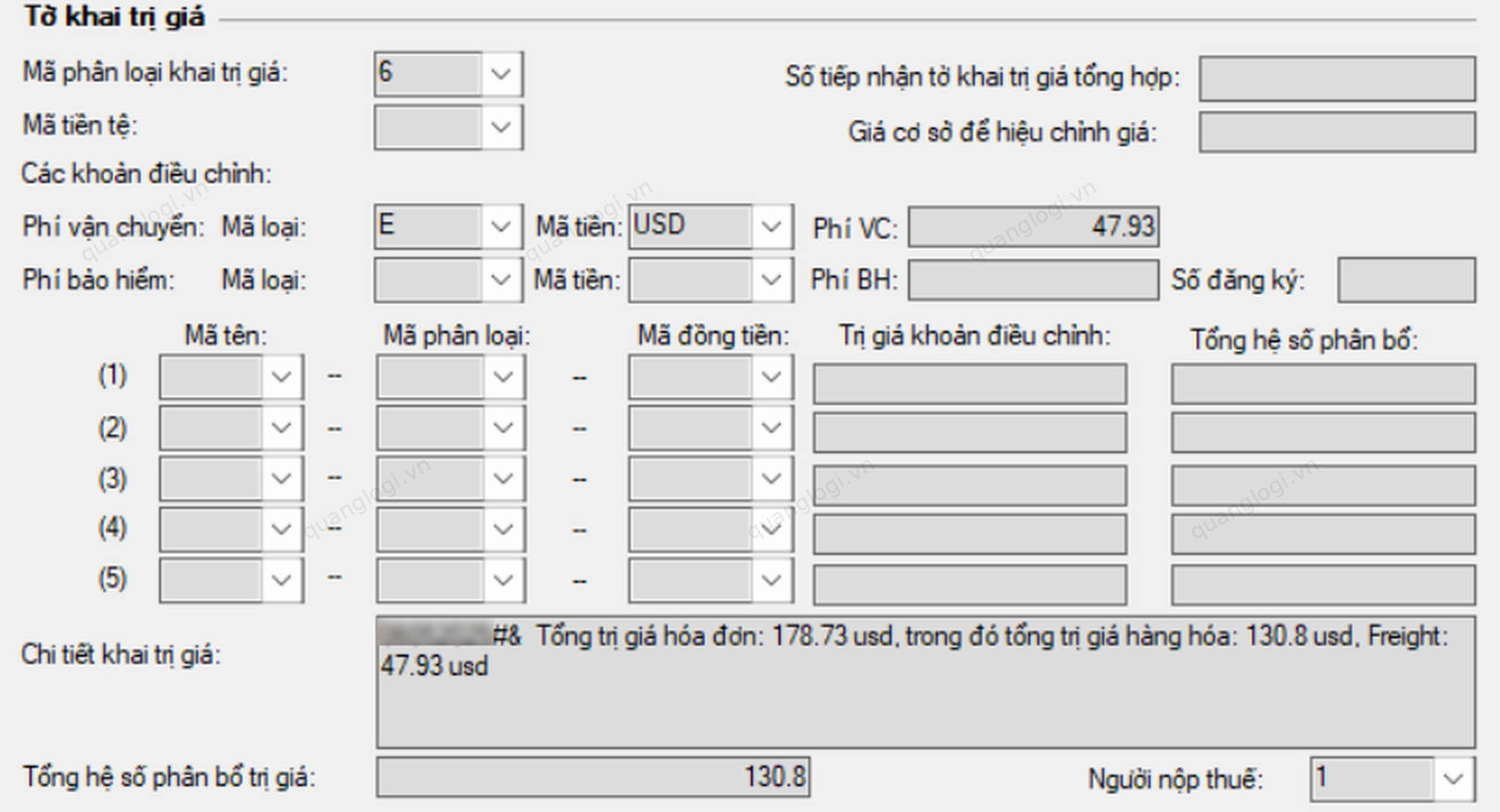
On the declaration, I declare the adjustments in the Value Declaration section of the electronic customs declaration software and do not merge them into the unit price of the goods. The image below shows an actual declaration that I prepared: the invoice states a total of 178.73 USD, of which the goods amount is 130.8 USD and freight is 47.93 USD; value declaration classification code 6 means that the transaction value method is applied; freight is declared separately in the freight field; the value declaration details field states the split clearly so that the officer can check it against the invoice; the total value apportionment coefficient equals the goods amount of 130.8 USD. Freight is not added twice. These fields (freight, code and name of the adjustments, value declaration details, total apportionment coefficient of the dutiable value) are all in the list of data fields under Point a.1, Clause 3, Article 25; an omission or an incorrect entry here is a ground for rejecting the declared value.
Points applicable to goods imported by road from China
For goods imported by road, the first border gate of import is the border gate where the goods enter the territory of Vietnam as stated on the customs declaration; for rail, it is the international railway station stated on the customs declaration (Point b.2 and Point b.3, Clause 2, Article 20 of Decree No. 08/2015/ND-CP dated 21 January 2015 of the Government, as amended and supplemented by Clause 8, Article 1 of Decree No. 167/2025/ND-CP). A contract with delivery ex works in China therefore gives rise to an addition, namely the freight from the works to the border gate. Freight for the domestic leg in Vietnam from the border gate to the warehouse is a deduction under Point b, Clause 2, Article 15 of Circular No. 39/2015/TT-BTC when it is already included in the price, is supported by objective data allowing it to be separated, and is consistent with the law on accounting (Clause 1, Article 15). For my clients, which are importing factories, I split the freight into two parts, the leg before the border gate and the leg after the border gate, on the service fee statement and the invoice themselves, because this is the objective data that allows the domestic freight to be accepted as a deduction. A single combined freight invoice cannot be split.
Four cases of rejection and five cases of doubt about the declared value
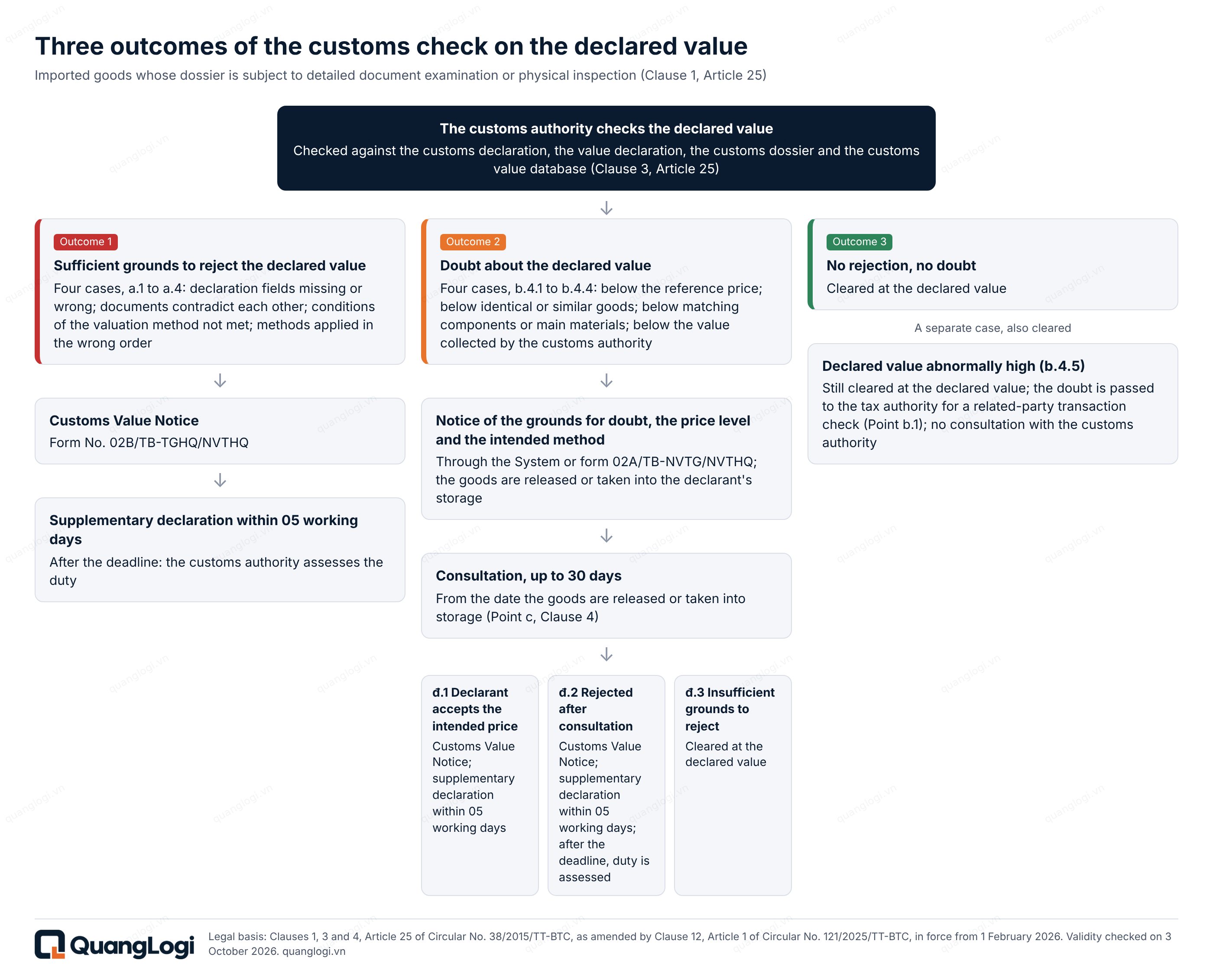
Circular No. 38/2015/TT-BTC does not divide cases into those where consultation is mandatory and those where it is not, although this is how importers usually put the question. The customs authority examines the declared value of customs dossiers that are subject to detailed document examination or physical inspection of goods (Clause 1, Article 25). The result is one of three outcomes under Clause 3, Article 25: rejection, doubt, or customs clearance at the declared value. Consultation arises only under the second outcome.
The conditions for applying a method, the adjustments and the freight discussed in the three sections above all return under the first outcome, as grounds for rejection under Point a.1 and Point a.3.
| Point | Case with sufficient grounds to reject the declared value | Check to perform before registering the declaration |
|---|---|---|
| a.1 | Failure to declare, or incorrect or incomplete declaration of, one of the data fields on the customs declaration or the customs value declaration that affects the customs value (the list of data fields is given below the table) | Review all 16 data fields on the draft declaration, in particular the value declaration classification code and the adjustments |
| a.2 | Contradiction between documents in the customs dossier as to content relating to the customs value | Cross-check the unit price, total value and delivery terms between the contract, the invoice and the transport documents |
| a.3 | Failure to satisfy one of the conditions for applying the customs valuation method | Check the four conditions in Clause 4, Article 6 of Circular No. 39/2015/TT-BTC, in particular the special relationship |
| a.4 | Incorrect application of the sequence or content of the customs valuation method | State the method actually applied on the customs value declaration; do not move to a later method before the earlier method has been ruled out |
The data fields under Point a.1 are: place of unloading, payment method, value declaration classification code, freight, insurance, code and name of the adjustments, value declaration details, total apportionment coefficient of the dutiable value, description of goods, unit of measurement, invoice unit price, dutiable unit price, dutiable value, invoice value, total invoice value, country of origin.
When there are sufficient grounds for rejection, the customs authority issues a Customs Value Notice using form No. 02B/TB-TGHQ/NVTHQ and requests a supplementary declaration within a maximum of 05 working days; after that time limit, the customs authority assesses the duty. Case a.2 arises from the set of documents itself, so cross-checking the six data fields most prone to discrepancy between documents needs to be done before the declaration is registered.
| Point | Case in which there is doubt about the declared value of imported goods | Handling under Clause 3, Article 25 |
|---|---|---|
| b.4.1 | Lower than the reference price in the List of exports and imports subject to valuation risk issued by the Department of Vietnam Customs | Consultation; the goods are released or taken into the declarant's storage (Point b.2) |
| b.4.2 | Lower than the lowest customs value of identical or similar goods determined by the customs authority, or lower than the lowest declared value that has been accepted | Consultation (Point b.2); the comparison data are taken within 90 days, as stated below the table |
| b.4.3 | Lower than or equal to the customs value of the complete set of components, of the main materials, or the transport cost of identical or similar goods | Consultation (Point b.2) |
| b.4.4 | Lower than the customs value collected by the customs authority | Consultation (Point b.2) |
| b.4.5 | Abnormally high compared with the reference price | Customs clearance at the declared value; the doubt is referred to the tax authority (Point b.1); no consultation with the customs authority |
The comparison data under Point b.4.2 are taken within 90 days before or 90 days after the date of export of the consignment under examination; where no identical or similar goods are found within this period, the customs authority extends it to between 6 months and 1 year (Point b.4.2, Clause 3, Article 25).
Point b.4.2 is applied with a narrow margin. In practice, an enterprise has shared that its consignment of components for a new vehicle model, with the same commodity code as the old model but a lower price than earlier consignments, was still referred to consultation although the enterprise had declared a different detailed description of goods and explained that this was the first consignment of a new model. Point b.4.2 applies squarely to this case: the benchmark is the lowest accepted declared value of identical or similar goods. The provision sets no minimum threshold of difference. A different declared description does not by itself take the consignment out of the group of similar goods used for comparison. The lower price of a new model must be proved, from the first consignment, by the documents under Point g, Clause 4.
Consultation sequence, consultation dossier and the 30-day time limit
The time for conducting the consultation and handling the consultation result is a maximum of 30 days from the date of release of goods or the date of taking the goods into the declarant's storage (Point c, Clause 4, Article 25 of Circular No. 38/2015/TT-BTC). The Head of the Regional Customs Sub-department is responsible for organising the consultation and delegates its conduct to the customs office where the declaration is registered (Point a, Clause 4).
The starting point of the 30-day time limit changed with the amendment effective from 1 February 2026: the 2018 version counted from the date of registration of the customs declaration (Point d, Clause 4, Article 25, as amended by Clause 14, Article 1 of Circular No. 39/2018/TT-BTC), while the version in force counts from the date of release of goods or the date of taking the goods into the declarant's storage (Point c, Clause 4, Article 25). Guidance prepared before 1 February 2026 that still states the registration date does not reflect the regulation in force.
When there is doubt, the customs authority notifies the grounds for doubt, the price level and the valuation method the customs authority intends to apply through the customs electronic data processing system (the System) or by a Notice of Doubt about the Declared Value using form No. 02A/TB-NVTG/NVTHQ, and the goods are released or taken into the declarant's storage in accordance with the regulations. The consultation is conducted in person or indirectly through the System; only a customs declarant with a compliance rating of high or above may choose the form of consultation.
Some enterprises have reported that, at the time they were referred to consultation, they had not received a notice stating the price level and the method that the customs authority intended to use as the grounds for doubt. The views exchanged about these cases go in two directions: the price level is not provided for reasons of confidentiality, or it is provided at the consultation meeting. Point b.2, Clause 3, Article 25 and Clause 3, Article 21 of Decree No. 08/2015/ND-CP provide that the content of the notice comprises the grounds for doubt, the price level and the valuation method the customs authority intends to apply. The customs declarant has a basis for requesting the customs authority to state all three items in the Notice of Doubt about the Declared Value before the consultation dossier is prepared, because without the intended price level it is not possible to identify which difference has to be proved.
In practice at the customs offices where I carry out procedures, checked up to 5 October 2026, the customs authority notifies the doubt and the related requests through the System and does not issue the Notice of Doubt about the Declared Value as a paper document. Form 02A serves as the content template of the notice. I contact the officer in charge of value consultation on my own initiative as soon as I receive the notice, or contact the customs authority directly to ask; the offices usually publish a list of officers with their divisions, positions and contact telephone numbers.
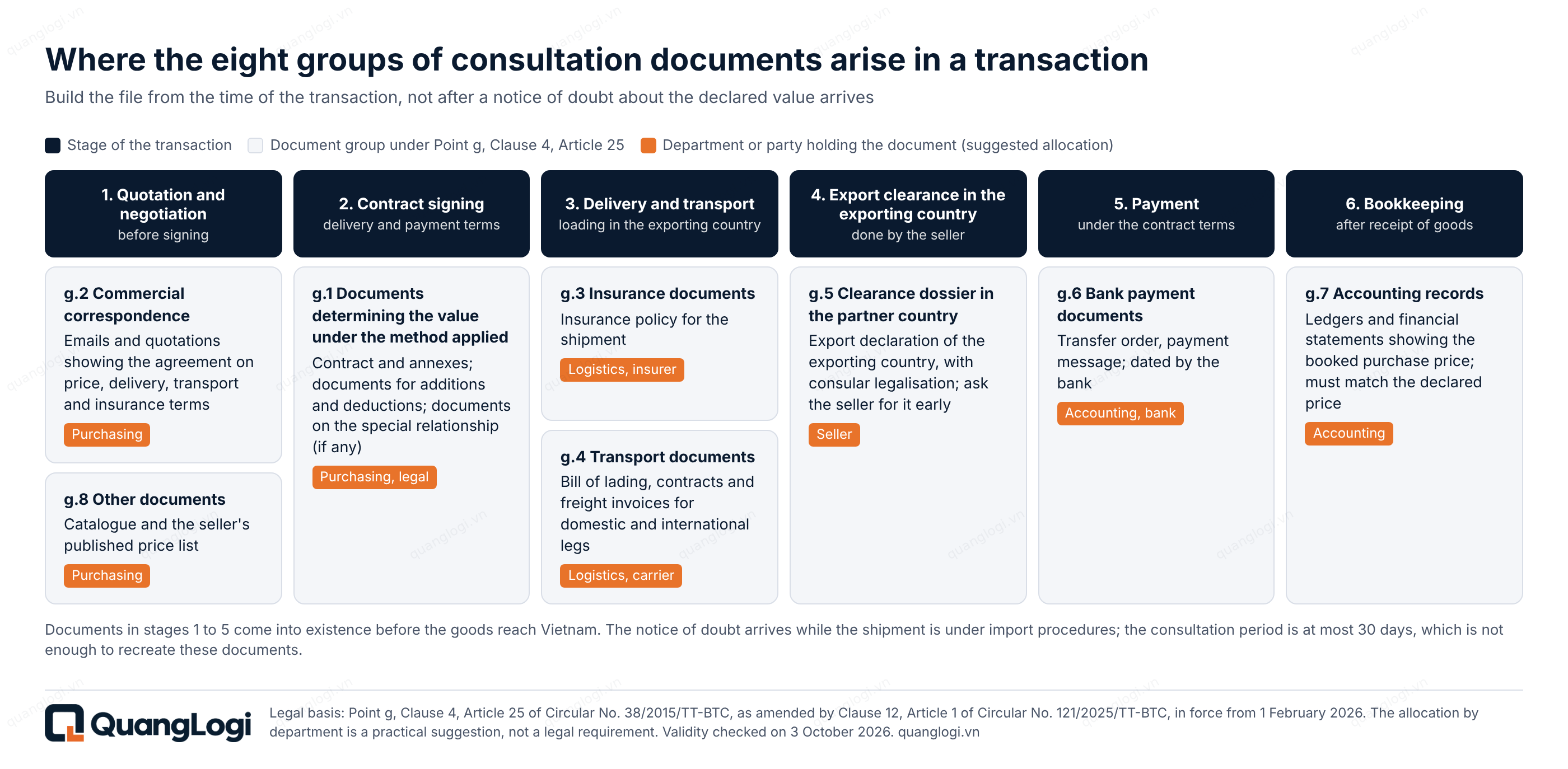
| Point (Point g, Clause 4, Article 25) | Group of documents in the consultation and valuation dossier | When the document comes into existence, to show whether it can be recreated |
|---|---|---|
| g.1 | Documents and materials determining the customs value under the method applied | At the time of customs declaration; can be recreated |
| g.2 | Documents and commercial correspondence showing the agreement on value and on the terms of delivery, transport and insurance | At the time of negotiating and signing the contract; cannot be recreated after the goods arrive |
| g.3 | Insurance documents for the goods | Before the goods are loaded onto the means of transport; cannot be recreated |
| g.4 | Domestic and international transport documents | When the goods are handed over to the carrier; issued by a third party |
| g.5 | Customs clearance dossier in the partner country, with consular legalisation | At the time of export in the partner country; the seller must be asked to provide it early |
| g.6 | Documents of payment through a bank | At the time of payment; recorded by the bank, cannot be recreated |
| g.7 | Documents forming part of the accounting records | At the time of accounting entry; must match the declared price |
| g.8 | Other documents and materials proving the value of the goods | Depends on the type; the seller's published price list is the type commonly used |
Failure to provide documents, failure to attend the consultation without a legitimate reason, or attendance by a person who has no letter of authorisation is a ground for rejecting the declared value (Point e.1.4, Clause 4, Article 25). A person who comes to work with the customs authority and is not the legal representative of the enterprise must bring the original letter of authorisation, signed by the authorising person and the authorised person.
In my experience, the unit in charge of value consultation at the customs office where the declaration is registered usually has a publicly available guidance note on the composition of the dossier for value consultation; the representative of the enterprise should contact the unit on its own initiative to ask for this guidance note as soon as the notice is received. Besides the eight groups of documents listed above, the enterprise may consider preparing the following as well: the export declaration of the country of export, with a translation if it is not in English (under g.5), the most recent annual financial statements showing the purchase price as recorded in the accounts (under g.7), and the seller's catalogue and publicly offered price list (under g.8). For types of documents on which the customs authority has no specific regulation or which do not directly serve the verification of the customs value, the enterprise may consider and decide for itself whether to present them and include them in the value consultation dossier. As to formalities, I make certified true copies of the documents submitted on paper, other than those already submitted electronically, and state the full name and title of the person signing the certification on each type; for a document of several pages, the seal stamped across the page edges is applied to that document separately, not across a whole dossier made up of several different documents.
The consultation ends with one of three conclusions under Point đ, Clause 4, Article 25. Where the customs declarant agrees with the intended price level, or the declared value is rejected, the customs declarant files a supplementary declaration within a maximum of 05 working days from the date of issue of the Customs Value Notice; after that time limit, the customs authority assesses the duty in accordance with the Law on Tax Administration (Point đ, Clause 4, Article 25; Clause 3, Article 21 of Decree No. 08/2015/ND-CP). Where the customs authority does not have sufficient grounds for rejection, the goods are cleared at the declared value.

Goods that have been released while the consultation is pending may be sold and invoiced. The Department of Vietnam Customs replied to an electric vehicle enterprise in Ho Chi Minh City in Official Letter No. 18773/CHQ-NVTHQ dated 13 July 2026: imported goods that meet all the conditions and for which the customs authority has decided on the release of goods may circulate on the market, and the enterprise may sell the goods and issue invoices in accordance with the law. The Official Letter also cites the case in which the customs declarant does not yet have sufficient information and documents to determine the customs value, and the goods are then released if the amount of duty, calculated on the customs value determined by the customs authority, is covered by a guarantee by a credit institution.
If you are receiving a Notice of Doubt about the Declared Value for a consignment imported from China, you may send me the commodity code, the delivery terms stated in the contract and the grounds for doubt stated in the notice. I will reply which case under Point b.4, Clause 3, Article 25 your consignment falls into and which group of documents under Point g, Clause 4 you need to submit first.
Recommendation: build the value evidence file at the time of the transaction
I recommend that importing enterprises have a plan for collecting the records and documents that prove the declared value from the time the transaction is carried out and the import is planned, and that they do not wait until a notice of doubt arrives before approaching the parties concerned to collect them. The enterprise may inform its departments and the parties concerned in advance of the risk that the customs authority will require the value consultation procedure, state clearly which records and documents are needed and which department or party is to cooperate in providing each of them, and prepare document templates in advance so that they can be completed within a short time when needed. Delay in preparing the documents prolongs the value consultation procedure and results in a loss of time and cost for the enterprise itself. With all the documents under Point g.2 and Point g.6, the customs declarant can give explanations in order to obtain the conclusion that there are insufficient grounds for rejection (Point đ.3). Without these documents, the option that avoids tax assessment by the customs authority is to agree with the price level and method intended by the customs authority (Point đ.1) and to file a supplementary declaration within a maximum of 05 working days from the date of issue of the Customs Value Notice and, at the same time, within 30 days from the date of release of goods. The customs value determined by the customs authority is the benchmark for identical or similar goods under Point b.4.2, so the decision to agree with the price level needs to take account of subsequent consignments of the same item.
For the next consignment of the same item, the declared value is in every case the value that the customs declarant determines itself under the method being applied; under the transaction value method, this is the price actually paid or payable (Article 6 of Circular No. 39/2015/TT-BTC). Declaring the later consignment at the invoice price together with the adjustments is the correct performance of the declaration obligation. The consultation result can be reused only when the declared value of the later consignment is equal to or higher than the customs value stated in the consultation result and the factors relating to the goods, the parties and the conditions of the transaction are identical (Point e.2.1, Clause 5, Article 25); outside this frame, the value of the later consignment is examined as for a new consignment, with the customs value determined on the previous occasion as the benchmark. A price for the later consignment that is lower than that level, without documents explaining the reduction, falls under Point b.4.2. The earlier result does not apply automatically to the later consignment.
An enterprise that repeatedly imports the same item from the same seller should request multiple use of the consultation result in the consultation minutes or in the written reply to the questions of the first consultation (Point a, Clause 5, Article 25 of Circular No. 38/2015/TT-BTC). The customs authority accepts the request only when the customs declarant is assessed as having a compliance rating of high or above (Point b).
The result is valid for 06 months from the date of issue of the Customs Value Notice, at one Regional Customs Sub-department where the declaration is registered (Point c and Point d), and applies to a later consignment only when the three conditions under Point e.2.1 are all met: the customs declarant still has a compliance rating of high or above and the legal documents on which the issue of the Notice was based have not changed; the description of goods, HS code, origin, importer, exporter, conditions of sale and delivery terms are identical to the content of the Notice; and the declared value is equal to or higher than the customs value stated in the consultation result, except where the reference price of the identical or similar item in the List of exports and imports subject to valuation risk has been adjusted upwards. The customs authority cancels this result when it finds that the consultation dossier is inaccurate or that there are violations (Point d, Clause 5).
Read next
- Incoterms 2020 reference table covering all 11 rules: the party that pays freight and the party that buys insurance under each rule, used to identify the amounts to be added under Point g and Point h.
- Procedures for goods in transit through Vietnam to Cambodia: goods in transit are not goods imported into Vietnam and so fall outside the scope of customs valuation covered in this article.
- HS codes, customs value and import duty: articles on the commodity code, value and duty of imported goods.
- Importing into Vietnam: the overview page of the import section, covering documents, commodity codes, value and duty.
Legal basis
The status of validity in the table was checked on 3 October 2026.
| Legal document | Date of issue | Effect and status | Content used in this article |
|---|---|---|---|
| Law on Customs No. 54/2014/QH13 | 23 June 2014 | From 1 January 2015; in force, amended and supplemented by Laws No. 71/2014/QH13, 35/2018/QH14, 07/2022/QH15, 90/2025/QH15 and 133/2025/QH15 | Clause 1 and Clause 3, Article 86 |
| Law No. 90/2025/QH15 amending and supplementing a number of articles of eight laws, including the Law on Customs | 25 June 2025 | From 1 July 2025; in force | Article 3 amends Article 42, adds Clause 4 to Article 43 and adds Article 47a to the Law on Customs; it does not amend Article 86 |
| Law No. 11/2026/QH16 amending and supplementing a number of articles of the Law on Customs | 23 August 2026 | From 1 March 2027; not yet in force on the date of checking | Clause 29, Article 1 amends Clause 2, Article 86 (customs value of exported goods); it does not amend Clause 1 or Clause 3, Article 86 |
| Decree No. 08/2015/ND-CP detailing and providing measures for the implementation of the Law on Customs with regard to customs procedures, customs inspection, supervision and control | 21 January 2015 | From 15 March 2015; in force, amended and supplemented by Decree No. 167/2025/ND-CP; Decree No. 59/2018/ND-CP was repealed from 15 August 2025 under Clause 3, Article 4 of Decree No. 167/2025/ND-CP | Clause 2, Article 20; Clause 3, Article 21 (as amended in 2025) |
| Decree No. 167/2025/ND-CP amending and supplementing a number of articles of Decree No. 08/2015/ND-CP | 30 June 2025 | From 15 August 2025; in force | Clause 8 and Clause 9, Article 1 (amending Article 20 and Article 21) |
| Circular No. 38/2015/TT-BTC on customs procedures; customs inspection and supervision; export duty, import duty and tax administration for exported and imported goods | 25 March 2015 | From 1 April 2015; in force, amended and supplemented by Circular No. 39/2018/TT-BTC and Circular No. 121/2025/TT-BTC | Article 25, as amended by Clause 12, Article 1 of Circular No. 121/2025/TT-BTC |
| Circular No. 39/2018/TT-BTC amending and supplementing a number of articles of Circular No. 38/2015/TT-BTC | 20 April 2018 | From 5 June 2018; in force, amended and supplemented | Clause 14, Article 1 (the version of Article 25 applied from 5 June 2018 to 31 January 2026); the Point and Clause numbers of this version differ from the version in force |
| Circular No. 121/2025/TT-BTC amending and supplementing a number of articles of the circulars on customs procedures | 18 December 2025 | From 1 February 2026; in force | Clause 12, Article 1 (amending Article 25 of Circular No. 38/2015/TT-BTC); Point a, Clause 2, Article 2 (repealing Point d.3.2.3, Clause 2, Article 15 of Circular No. 39/2015/TT-BTC) |
| Circular No. 39/2015/TT-BTC on the customs value of exported and imported goods | 25 March 2015 | From 1 April 2015; in force, amended and supplemented by Circular No. 60/2019/TT-BTC and Point a, Clause 2, Article 2 of Circular No. 121/2025/TT-BTC | Articles 5, 6, 7, 8 to 12, 13, 15 |
| Circular No. 60/2019/TT-BTC amending and supplementing a number of articles of Circular No. 39/2015/TT-BTC | 30 August 2019 | From 15 October 2019; in force | Amends Article 5, Article 6, Clause 4 of Article 7 and Article 12 of Circular No. 39/2015/TT-BTC |
| Law on Tax Administration No. 108/2025/QH15 | 10 December 2025 | From 1 July 2026; in force, replacing the Law on Tax Administration No. 38/2019/QH14 | Article 25 (tax assessment by the customs authority for exported and imported goods) |