Origin of goods and the certificate of origin (C/O) for goods produced in Vietnam
This page answers one question: whether the goods you produce in Vietnam from imported materials are eligible for a C/O, and what you need to prepare, starting now, to be sure of obtaining one. Goods imported from abroad and then exported from Vietnam without undergoing a production operation in Vietnam are outside the scope of this page and are not eligible for a Vietnamese C/O.
Goods produced in Vietnam from imported materials do not automatically have Vietnamese origin. Goods have Vietnamese origin only when they meet the origin criterion corresponding to the C/O form that the buyer uses to claim preferential treatment. The exporter must be able to prove this with documentation consisting of the production-process description, the statement of exported goods meeting the origin criteria and the documents on the source of the input materials.
Summary
- Decree 31/2018/ND-CP is the underlying instrument on the origin of goods and remains in force; the rules of origin of each free trade agreement are set out in the Ministry of Industry and Trade's separate implementing circular for that agreement (Article 4 of Decree 31/2018/ND-CP).
- Goods produced from imported materials are goods not wholly obtained and are regarded as having Vietnamese origin when they meet the origin criterion given in the List of Product-Specific Rules under the HS code of the finished product (Article 8 of Decree 31/2018/ND-CP); the simple working or processing operations in Article 9 are not taken into account.
- The Vietnam Chamber of Commerce and Industry ceased issuing C/Os on 5 May 2025 (Decision 1103/QD-BCT). From 1 August 2026, the Agency of Foreign Trade issues the 12 C/O forms listed in Form No. 17, and Provincial People's Committees issue the C/O forms and written approvals in the 21 entries of Form No. 18. Form E, Form B, Form S and Form X are issued, and REX numbers are assigned, at provincial level only (Article 19 of Circular 26/2026/TT-BCT, Form No. 17 and Form No. 18).
- The C/O application is filed on one of two systems, depending on the form: eCoSys at ecosys.gov.vn for Forms D, AK and VK; the Electronic Certificate of Origin Management and Issuance System of the Ministry of Industry and Trade at co.moit.gov.vn for the remaining forms.
- The documents making up the application for each consignment are set out in Clause 1, Article 15 of Decree 31/2018/ND-CP. The document that takes the most time and is checked most closely is the statement of exported goods meeting the origin criteria (Point e), which must reconcile at the same time with the import declarations for the materials, the quantity exported, the production process and the criterion for the HS code.
- Appendix III, Section 1, Point Đ, Clause 5 of Resolution 19/2026/NQ-CP provides that the administrative procedure for retrospective issuance of a C/O under Article 15 and Article 17 of Decree 31/2018/ND-CP is not to be carried out while the resolution is in force. However, as at 15 September 2026, procedure 1.001380 was still published on the Ministry of Industry and Trade Public Service Portal. The two sources are not yet consistent on how this operates in practice, so you should not assume either that applications for a retrospectively issued C/O are still accepted or that they have been stopped altogether. You need to check each case directly with the authority receiving the application.
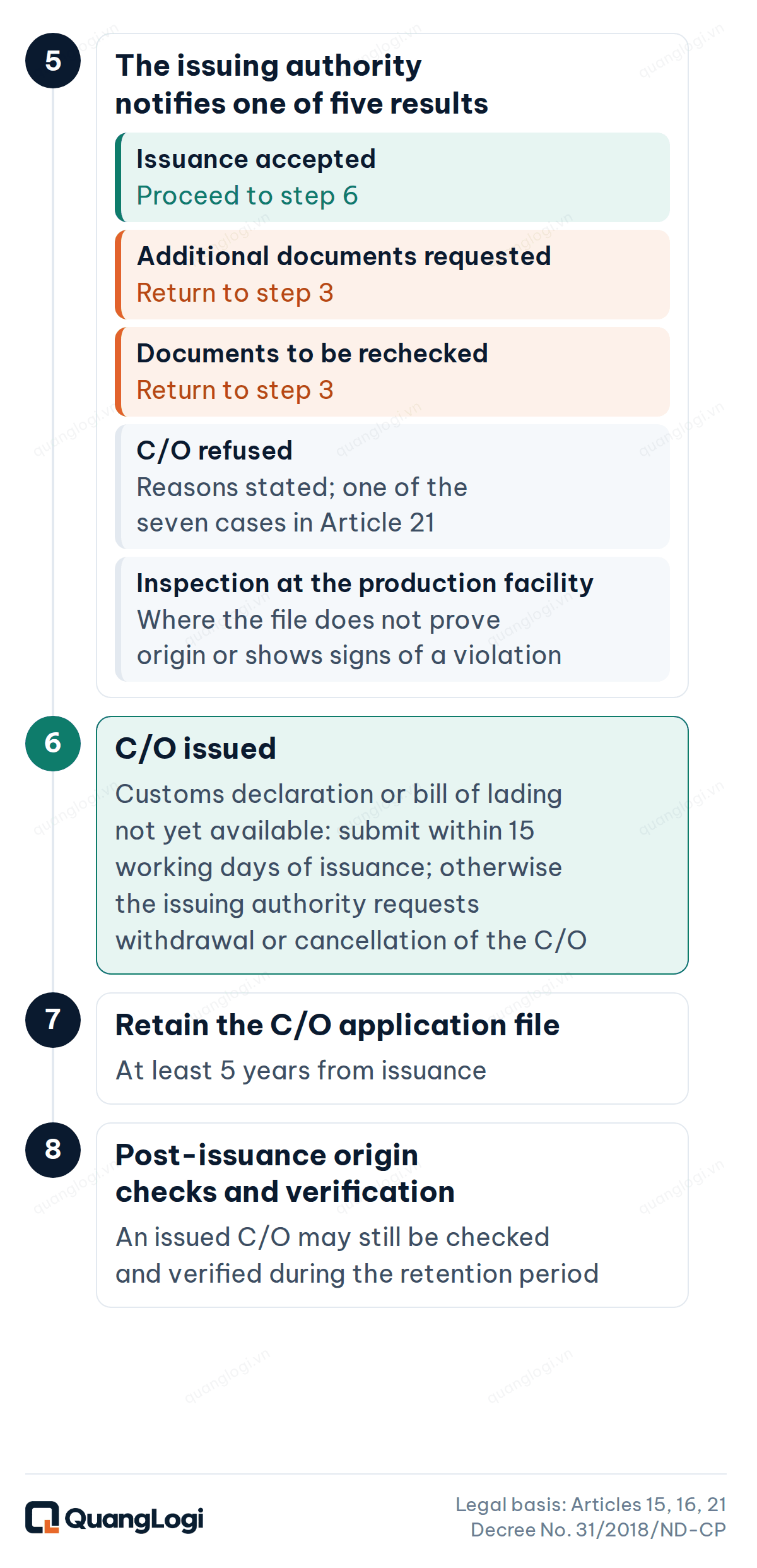
- A trader keeps the C/O application in written form for at least 5 years from the date the C/O is issued (Clause 3, Article 30 of Decree 31/2018/ND-CP); a C/O that has been issued can still be verified under Article 28 within that period.
The C/O issuing authority has changed, and from 1 August 2026 there are two authorities
The Vietnam Chamber of Commerce and Industry has not issued any type of C/O since 5 May 2025. The issuing authorities are now the Agency of Foreign Trade (Ministry of Industry and Trade) for the 12 C/O forms listed in Form No. 17, and Provincial People's Committees for the 21 entries in Form No. 18; both are in Part II of the Appendix to Circular 26/2026/TT-BCT. Form E for China is on the provincial list only. Applications are filed on two different systems, depending on the C/O form: the Electronic Certificate of Origin Management and Issuance System (eCoSys) at ecosys.gov.vn, and the Electronic Certificate of Origin Management and Issuance System of the Ministry of Industry and Trade at co.moit.gov.vn.
Legal basis: Decision 1103/QD-BCT of 21 April 2025; Article 19 of Circular 26/2026/TT-BCT of 20 May 2026 (in force from 29 May 2026), which amends Clause 1, Clause 2 and Clause 3, Article 4 of Circular 40/2025/TT-BCT. By exception, Clause 3, Article 19, on replacing Appendix I with Form No. 17, applies from 1 August 2026 under Article 27.

If you have a specific consignment that needs checking, you can send me three pieces of information: the HS code of the finished product, the list of imported materials with their HS codes, and the destination market. I will tell you whether the goods are likely to qualify as originating in Vietnam, and under which C/O form.
What I do here is origin documentation and customs procedures work, within the scope of the professional certificates I hold; it is not legal advice on a specific matter.
1. Four changes in 2025 and 2026 that make older guides unusable
Four changes in the two years 2025 and 2026 mean that the procedural part of most guides written before May 2025 can no longer be used. The changes concern the issuing authority, the power to issue, the checking procedure and the procedure for a retrospectively issued C/O. When you consult a guide found online, check the following four points to see whether that guide has been updated.
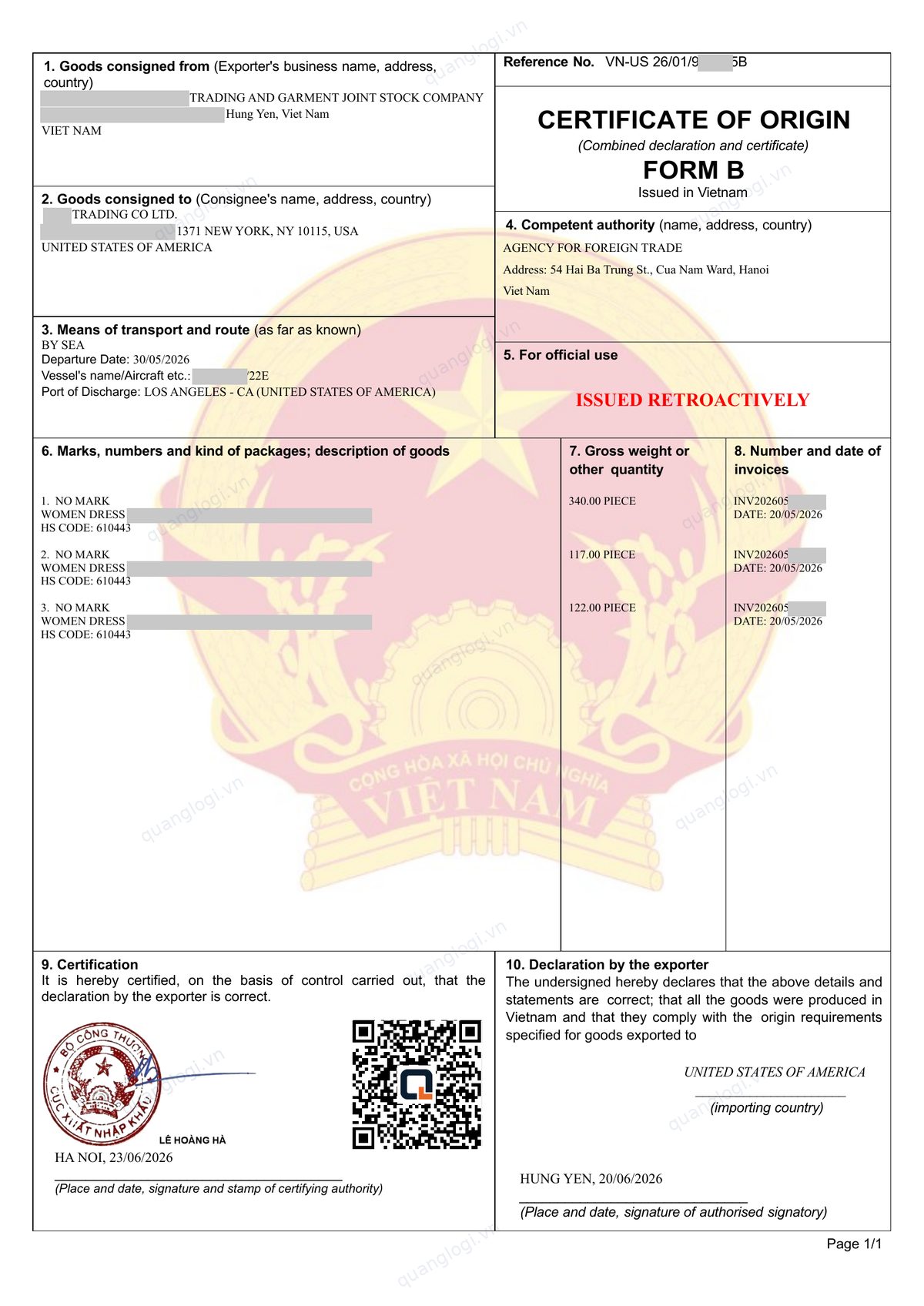
Change 1. The Vietnam Chamber of Commerce and Industry no longer issues C/Os. Decision 1103/QD-BCT of 21 April 2025 withdrew in full the power delegated to the Vietnam Chamber of Commerce and Industry to issue C/Os and certificates of non-manipulation and to assign REX numbers. From 5 May 2025, the Chamber stopped issuing all types of C/O, including Form B, which most companies used to apply for there. C/Os that the Chamber issued before 5 May 2025 remain valid, and the Chamber continues to answer verification requests for them under Clause 4, Article 7 of Circular 40/2025/TT-BCT.
Change 2. The power to issue has been reallocated. Decree 146/2025/ND-CP, in force from 1 July 2025, reallocated the power to issue C/Os. The issuance procedures and the arrangements for self-certification of origin are set out in Circular 40/2025/TT-BCT, in force from the same date. Clause 3, Article 2 of Circular 12/2026/TT-BCT, in force from 1 May 2026, abolished the arrangement under which intermediary organisations were assigned to issue C/Os; since then, the issuing authority at provincial level has been the Provincial People's Committee itself.
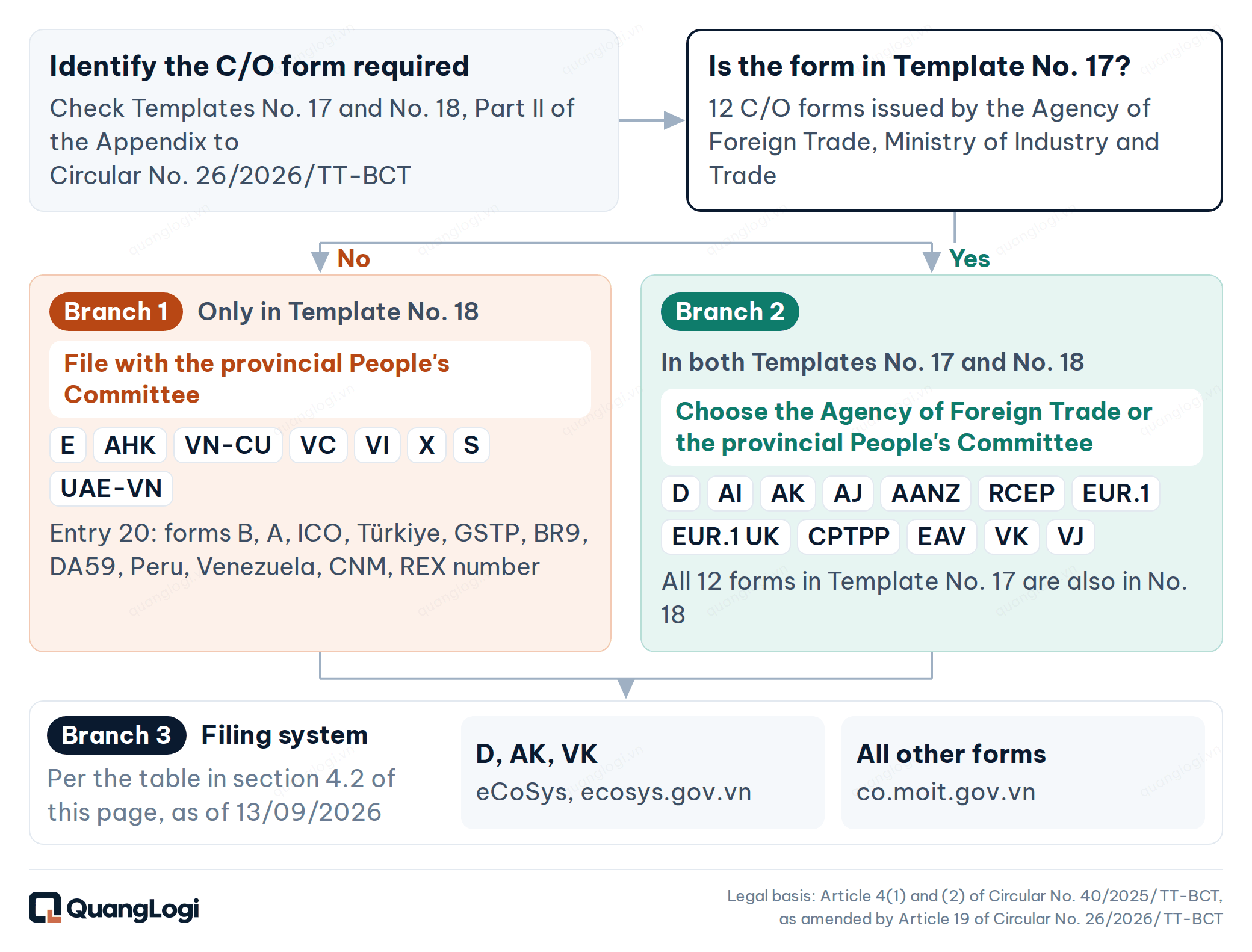
Change 3. From 1 August 2026, the power to issue C/Os is reallocated between two authorities. Article 19 of Circular 26/2026/TT-BCT replaces the two appendices to Circular 40/2025/TT-BCT with Form No. 17 and Form No. 18 in Part II of the Appendix to Circular 26/2026/TT-BCT. The Agency of Foreign Trade (Ministry of Industry and Trade) issues the 12 forms listed in Form No. 17. Provincial People's Committees issue what is listed in the 21 entries of Form No. 18.
These two lists are not mutually exclusive. All 12 forms on the Agency of Foreign Trade's list are also on the Provincial People's Committees' list, so for those 12 forms the company may choose where to submit its application.
| GROUP | C/O FORM | AGENCY OF FOREIGN TRADE | PROVINCIAL PEOPLE'S COMMITTEES |
|---|---|---|---|
| On both lists | D, AI, AK, AJ, AANZ, RCEP, EUR.1, EUR.1 UK, CPTPP, EAV, VK, VJ | Yes | Yes |
| Forms under agreements, on the provincial list only | E, AHK, VC, VI, VN-CU, S, X, UAE-VN | No | Yes |
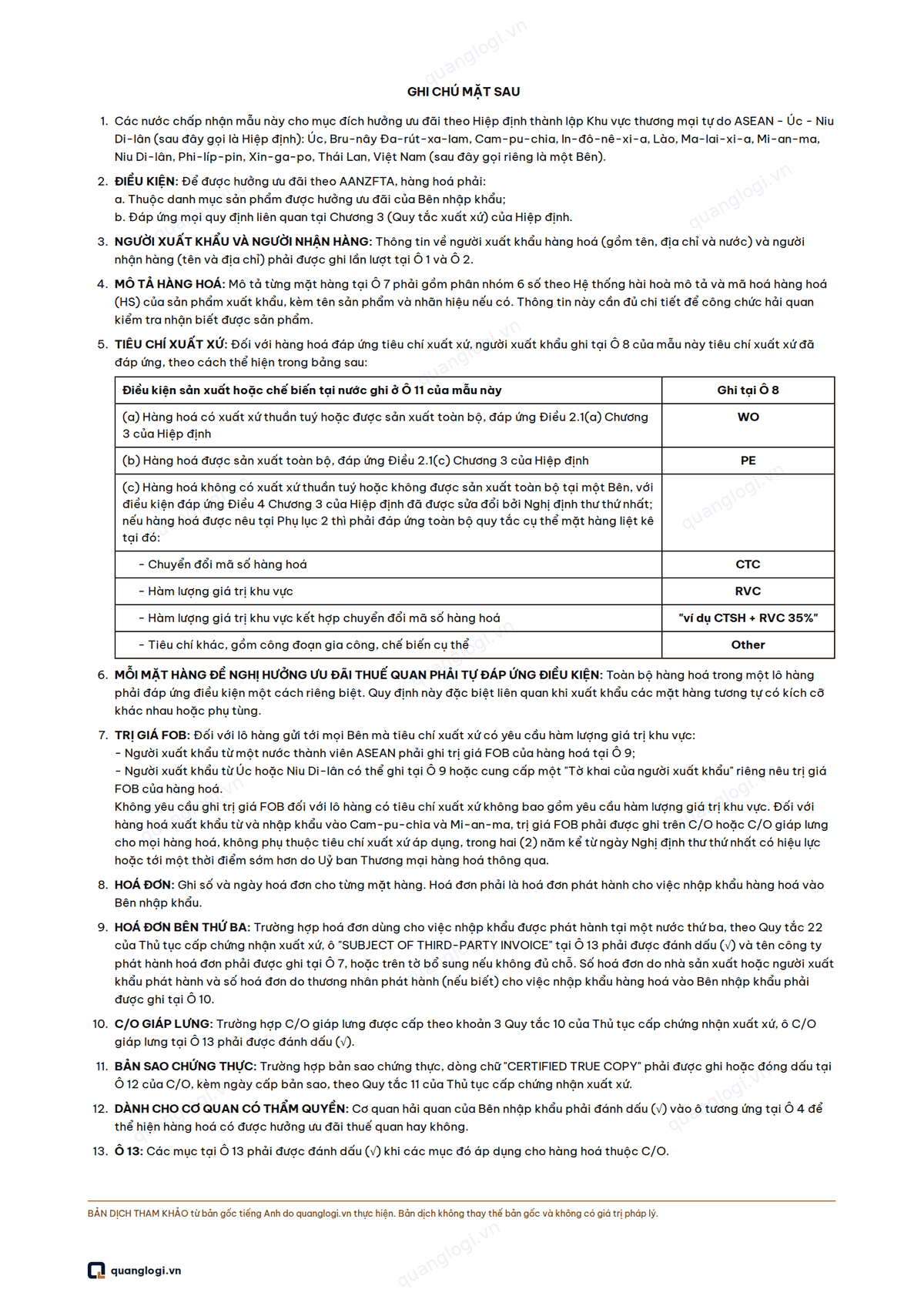
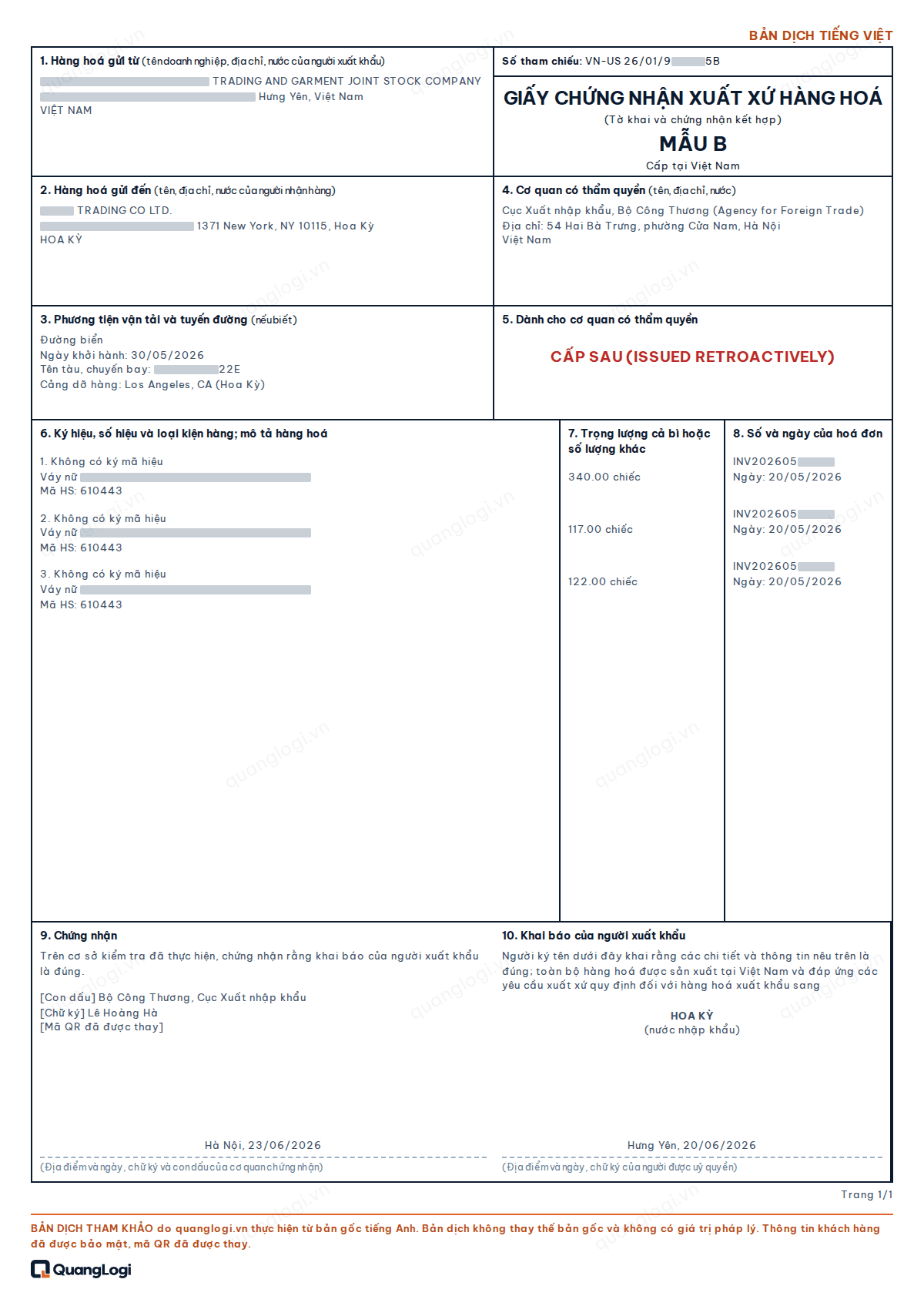
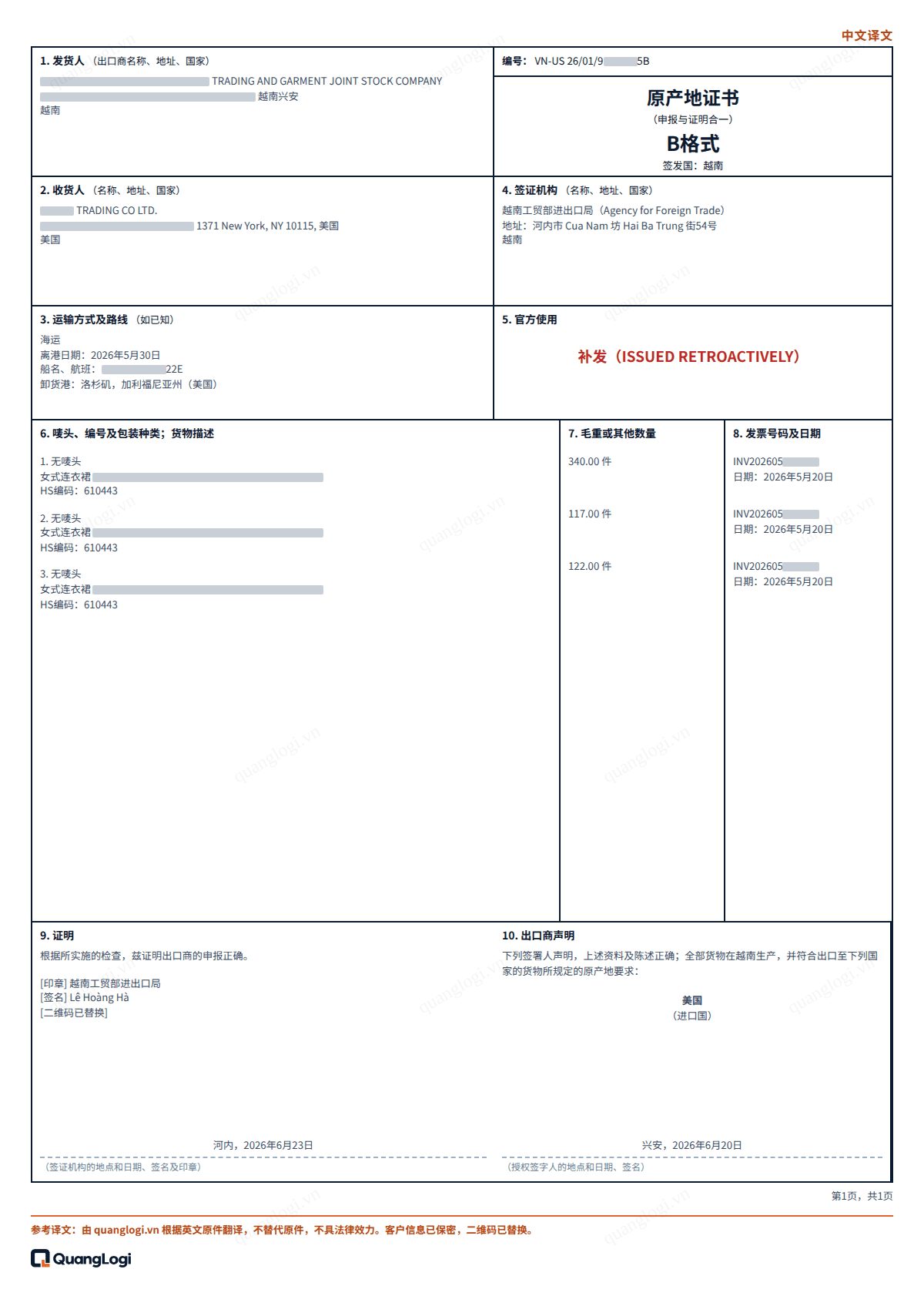
| Non-preferential forms and specialised forms | B, A, ICO, Türkiye, GSTP, BR9, DA59, Peru, Venezuela, CNM, REX number | No | Yes |
What this means for the documentation: there is no C/O form that only the Agency of Foreign Trade can issue, whereas there are 19 types that only Provincial People's Committees issue. The reading that the Ministry of Industry and Trade issues one group of forms and Provincial People's Committees issue the remaining group is incorrect.
For goods going to China, the application must be submitted at provincial level
Form E under the ASEAN-China agreement is not on the list of the Agency of Foreign Trade. A company exporting to China, the largest market for Vietnamese goods, submits its application to the Provincial People's Committee. The forms for Hong Kong, Chile, Israel, Cuba, Laos, Cambodia and the United Arab Emirates are also issued at provincial level only.
Change 4. The customs authority's checking procedure has changed. Decision 467/QD-CHQ of 29 April 2025 replaces the old procedure and applies risk management to checking and determining the origin of exported and imported goods.
Appendix III, Section 1, Point Đ, Clause 5 of Resolution 19/2026/NQ-CP provides that the administrative procedure for retrospective issuance of a C/O under Article 15 and Article 17 of Decree 31/2018/ND-CP is not to be carried out while the resolution is in force. However, as at 15 September 2026, procedure 1.001380 was still published on the Ministry of Industry and Trade Public Service Portal. The two sources are not yet consistent on how this operates in practice, so you should not assume either that applications for a retrospectively issued C/O are still accepted or that they have been stopped altogether. You need to check each case directly with the authority receiving the application.
2. Four questions that must be answered before signing a contract
Whether goods can qualify as originating in Vietnam is decided when the company chooses its materials supplier and sets up its production process, not when the application is prepared. This section is for the person who signs the export contract and the person who makes the investment decision.
The C/O clause in an export contract is a commitment with a cost. The buyer agrees to the contract price because it has factored in the preferential rate of import duty in its own country, on condition that the exporter can provide a valid C/O. If there is no C/O at the time of delivery, or there is one but the customs authority of the importing country rejects it, the seller usually has to bear the difference in duty because it is in breach of contract. Once the goods have been produced, there is very little that can be done to change the outcome of the origin assessment.
Question 1. Which C/O form the buyer wants, and which agreement that form belongs to
The same market may be covered by two or more agreements. Under each agreement, the origin criterion and the preferential rate of duty for the same HS code may differ, so you need to establish which C/O form the buyer needs, and under which agreement. The table matching markets with C/O forms is in section 4.
Question 2. What the HS code of the finished product is, and what the criterion for that code is under the agreement
Each agreement has general rules of origin and a List of Product-Specific Rules, in which the rules are listed by the HS code of the exported product. You need to determine whether the product is subject to the agreement's general rule or has its own criterion in the list. This factor determines everything that follows.
Question 3. What the production process is, where the materials are imported from, and what their HS codes are
If the criterion is a change in tariff classification at chapter level and the materials are classified in the same chapter as the finished product, the goods do not meet the criterion with those materials, however much processing is carried out. Materials that are purchased domestically but were imported and resold by another party are still non-originating materials, unless there is a declaration of origin by the supplier, accompanied by supporting evidence.
Question 4. Whether the factory can provide all the documents needed as proof
The documents needed are the import declarations for the materials, the purchase invoices, the stock records, the statement of exported goods meeting the origin criteria and the production-process description. A factory that meets the criterion in fact but has no valid documentation to prove it will still not be issued with a C/O.
3. Whether the goods you produce in Vietnam qualify as originating in Vietnam
A product made from imported materials belongs to the category of goods not wholly obtained under Article 8 of Decree 31/2018/ND-CP, and is regarded as having Vietnamese origin when it meets the origin criterion in the List of Product-Specific Rules. For this category, the agreements use three types of criterion, which may be applied separately or in combination.
| TYPE OF CRITERION | WHAT IT MEANS | WHAT TO PREPARE |
|---|---|---|
| Change in tariff classification | The HS code of the finished product must differ from the HS code of the non-originating materials, at chapter (2 digits), heading (4 digits) or subheading (6 digits) level | The exact HS codes of both the materials and the finished product |
| Value content | The share of value created in Vietnam must reach a minimum percentage, calculated using the formula of each agreement | The value of the imported materials and of the materials purchased domestically, and the ex-works price or FOB value |
| Specific working or processing operation | A particular operation must be carried out in Vietnam; this criterion is common for textiles and clothing, and for chemicals | A production-process description that matches what the company actually does |
Three accompanying concepts need to be considered before concluding whether a given plan meets the criterion or not, because they can turn a plan that seems not to meet the criterion into one that does, or the reverse.
Simple working or processing operations. Article 9 of Decree 31/2018/ND-CP lists operations such as preservation, sorting, change of packaging, labelling, simple mixing and simple assembly. These operations are not taken into account when origin is determined, however many of them are carried out and however they are combined.
Cumulation. Materials originating in another party to the same agreement are treated as Vietnamese originating materials under that agreement's cumulation rule. For this reason, you must know whether the materials supplier is located in a party to the agreement or outside it before confirming the purchase order.
The de minimis rule must be checked agreement by agreement. Do not extrapolate from Article 11 of Decree 31/2018/ND-CP, or from the rule of one FTA, to all FTAs. For RCEP, the EVFTA and every other agreement, reach a conclusion only after checking the correct provision and the applicable product-specific rules.
Underlying legal basis: Decree 31/2018/ND-CP of 8 March 2018, detailing the Law on Foreign Trade Management with regard to origin of goods, in force. The List of Product-Specific Rules of each agreement is in the separate implementing circular for that agreement.
Read next: Conditions for goods to be of Vietnamese origin
4. Choosing the C/O form by destination market, and which system to file on
The C/O form is chosen according to the destination market and the agreement that the buyer uses to claim preferential treatment, and each form is tied to an implementing circular of the Ministry of Industry and Trade that contains the List of Product-Specific Rules of that agreement.
4.1. Markets, C/O forms and implementing instruments
Hover over a market name to show the list of member countries; click to open the window with the full list. (font size 0.85em)
| MARKET | AGREEMENT | C/O FORM | VIETNAM'S IMPLEMENTING INSTRUMENT |
|---|---|---|---|
| ATIGA | Form D | Circular 22/2016/TT-BCT of 3 October 2016, amended several times. List of Product-Specific Rules under Circular 03/2023/TT-BCT | |
| ACFTA | Form E | Circular 12/2019/TT-BCT of 30 July 2019 | |
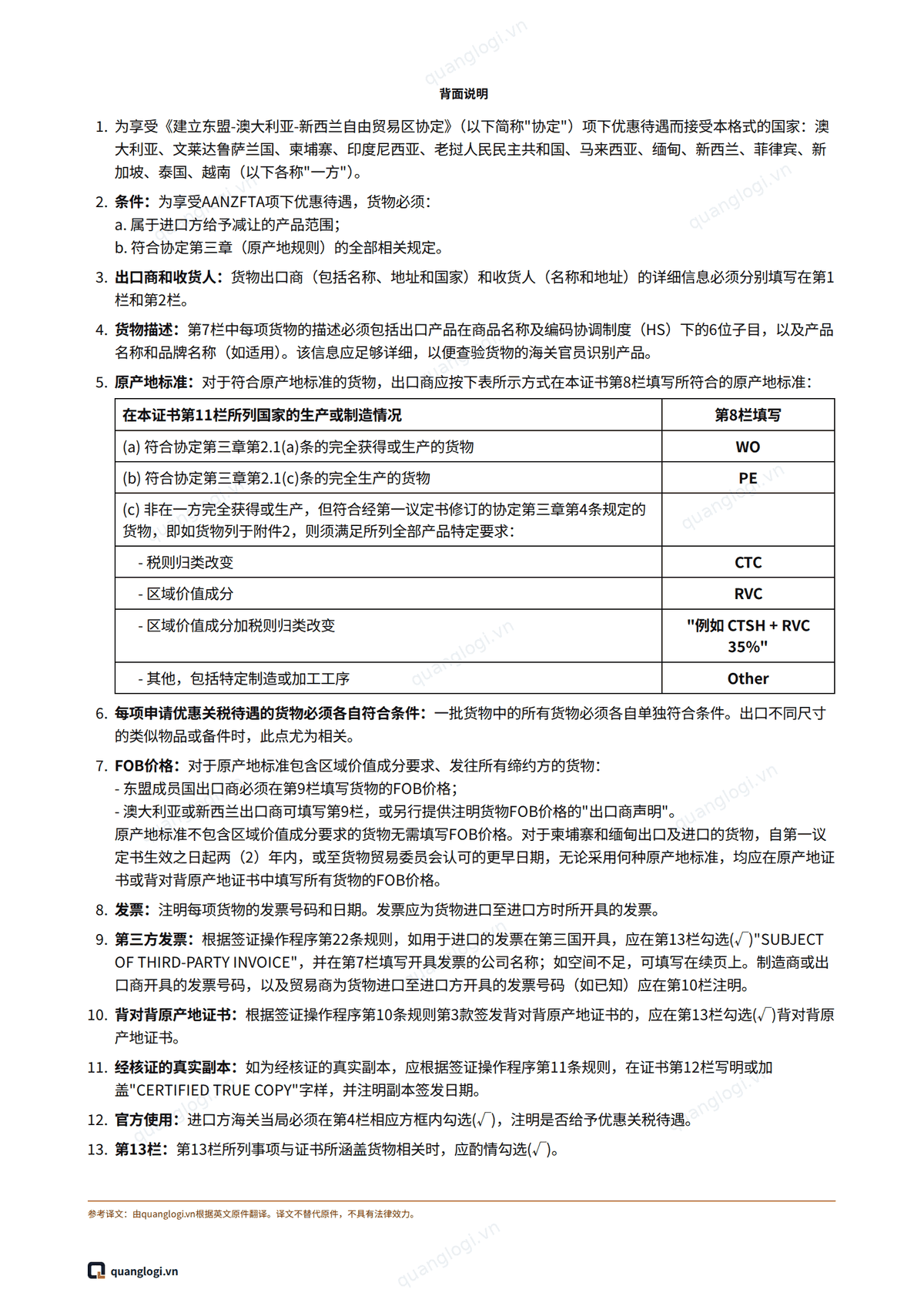
| AKFTA or VKFTA | Form AK or Form VK | AKFTA: Circular 49/2025/TT-BCT of 9 September 2025, in force from 1 May 2026, replacing Circular 20/2014/TT-BCT; text to consult: Consolidated Text 18/VBHN-BCT of 2026. VKFTA: Circular 40/2015/TT-BCT of 18 November 2015, in force from 20 December 2015 under Circular 48/2015/TT-BCT; product-specific rules under Circular 09/2022/TT-BCT | |
| AJCEP or VJEPA | Form AJ or Form VJ | AJCEP: Circular 37/2022/TT-BCT of 23 December 2022. VJEPA: Circular 10/2009/TT-BCT of 18 May 2009 and its amending instruments; text to consult: Consolidated Text 09/VBHN-BCT of 2024 | |
| AIFTA | Form AI | Circular 15/2010/TT-BCT of 15 April 2010 | |
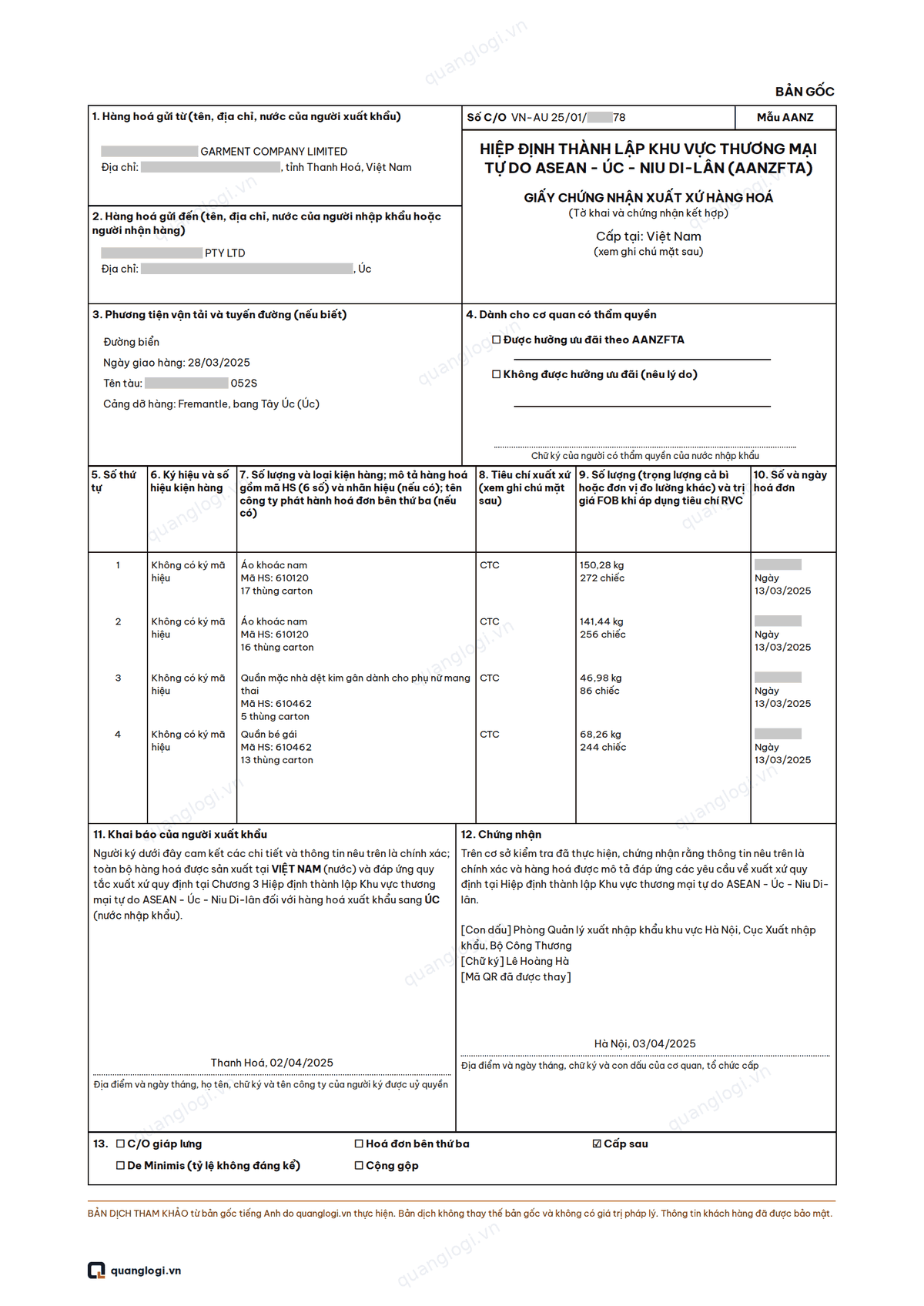
| AANZFTA | Form AANZ | Circular 44/2025/TT-BCT of 7 July 2025, in force from 22 August 2025, replacing Circular 31/2015/TT-BCT; text to consult: Consolidated Text 17/VBHN-BCT of 2026 | |
| RCEP | Form RCEP | Circular 05/2022/TT-BCT of 18 February 2022, amended by Circular 32/2022/TT-BCT | |
| CPTPP | Form CPTPP | Circular 03/2019/TT-BCT of 22 January 2019, amended by Circular 06/2020/TT-BCT; text to consult: Consolidated Text 44/VBHN-BCT of 2020 | |
| EVFTA | Form EUR.1 or an origin self-certification document, depending on the value of the consignment | Circular 14/2026/TT-BCT of 25 March 2026, in force from 10 May 2026, replacing Circular 11/2020/TT-BCT and Circular 41/2022/TT-BCT | |
| UKVFTA | Form EUR.1 UK | Circular 02/2021/TT-BCT of 11 June 2021 | |
| VN-EAEU FTA | Form EAV | Circular 21/2016/TT-BCT of 20 September 2016, amended by Circular 01/2024/TT-BCT; text to consult: Consolidated Text 06/VBHN-BCT of 2024 | |
| AHKFTA | Form AHK | Circular 21/2019/TT-BCT of 8 November 2019 | |
| VCFTA | Form VC | Circular 31/2013/TT-BCT of 15 November 2013, amended by Circular 05/2015/TT-BCT | |
| VIFTA | Form VI | Circular 11/2024/TT-BCT of 1 August 2024 | |
| VN-UAE CEPA | Form UAE-VN | Circular 24/2026/TT-BCT of 5 May 2026, in force from the same date; Article 20 of Circular 26/2026/TT-BCT provides that the issuing authority is the Provincial People's Committee; text to consult: Consolidated Text 49/VBHN-BCT of 2026 | |
| Vietnam and Laos | Form S | Circular 04/2010/TT-BCT of 25 January 2010 and its amending instruments; text to consult: Consolidated Text 11/VBHN-BCT of 2024 | |
| Vietnam and Cambodia | Form X | Circular 17/2011/TT-BCT of 14 April 2011, in force from 1 June 2011, corrected by Decision 7360/QD-BCT of 4 December 2012 | |
| Vietnam and Cuba | Form VN-CU | Circular 08/2020/TT-BCT of 8 April 2020 | |
| Markets without a preferential agreement | Not applicable | Form B | Circular 05/2018/TT-BCT of 3 April 2018, non-preferential rules of origin; text to consult: Consolidated Text 21/VBHN-BCT of 2025 |
The three rows for Laos, Cambodia and Cuba are based on bilateral trade arrangements, not free trade agreements, so the Agreement column for these three rows gives the name of the country.
Timor-Leste has been the 11th member of ASEAN since 26 October 2025. As regards ATIGA specifically, the two sides have only concluded market access negotiations, at the fourth meeting of the Special Coordinating Committee on 20 and 21 October 2025 in Jakarta. Concluding negotiations does not yet amount to accession. As at 13 September 2026, no official announcement had confirmed that ATIGA is in force for Timor-Leste or that Form D can be used for this market, so Timor-Leste has not been included in the table above.
Seven specialised forms not tied to a free trade agreement
| FORM | USED FOR | NOTES |
|---|---|---|
| Form A | Countries that grant Vietnam preferences under the Generalised System of Preferences (GSP) | A unilateral preference scheme under Article 5 of Decree 31/2018/ND-CP, not an agreement |
| Form GSTP | Global System of Trade Preferences among Developing Countries | |
| Form ICO | Exported coffee | Under the rules of the International Coffee Organization |
| Form BR9 | Brazil, only for beverages, wine, vinegar and products of grapes and wine | Other goods going to Brazil use Form B |
| Form DA59 | South Africa | Carries no tariff preference; equivalent to Form B |
| Form P | Peru | Carries no tariff preference; equivalent to Form B |
| Form TR | Türkiye | Carries no tariff preference; equivalent to Form B |
Entry 20 of Form No. 18 contains two further types, the Venezuela form and the certificate of non-manipulation (CNM), together with the REX number.
The correct sequence is to choose the market and the agreement first, check the criterion next, and only then consider the actual situation at the factory.
The situation I meet most often is one where I help a company choose the C/O form that gives the greatest tariff preference when several forms under several agreements are available for the same destination market. The three largest markets for Vietnamese goods among those covered by agreements are all in this situation. China has two options: the ACFTA with Form E, or RCEP with Form RCEP. Japan has four options: the AJCEP with Form AJ, the VJEPA with Form VJ, RCEP with Form RCEP, or the CPTPP with Form CPTPP. South Korea has three options: the AKFTA with Form AK, the VKFTA with Form VK, or RCEP with Form RCEP. For the same HS code, each agreement has its own origin criterion and its own preferential rate of duty, so the form that is easiest to qualify for is not necessarily the form that gives the greatest duty advantage.
4.2. Two filing systems, and which form goes where
C/O applications are currently filed at one of two addresses, depending on the C/O form, and going to the wrong system is where most time is lost at the submission stage. As at 13 September 2026, the C/O forms were allocated as follows.
| SYSTEM | ADDRESS | C/O FORMS |
|---|---|---|
| Electronic Certificate of Origin Management and Issuance System (eCoSys) | ecosys.gov.vn | D, AK, VK |
| Electronic Certificate of Origin Management and Issuance System of the Ministry of Industry and Trade | co.moit.gov.vn | EUR.1, AANZ, AJ, AI, CPTPP, EAV, RCEP, VJ, EUR.1 UK, AHK, B, E, S, VC, VI, VN-CU, X, A, CNM, DA59, GSTP, ICO, P, TR, UAE-VN |


A company exporting to ASEAN or South Korea using Forms D, AK and VK still files on eCoSys, because the electronic C/O data for these forms is transmitted to the National Single Window Portal. The remaining forms are filed on the Ministry of Industry and Trade's system at co.moit.gov.vn. A company dealing with both groups of markets must maintain accounts on both systems.
Read next: Origin criteria by FTA and C/O form
If you have not yet determined which C/O form your consignment should use, you can send me the HS code of the finished product and the importing country. I will tell you which form can be used, the criterion for that form, and which system the application is filed on.
What I do here is origin documentation and customs procedures work, within the scope of the professional certificates I hold; it is not legal advice on a specific matter.
5. What the supporting evidence consists of
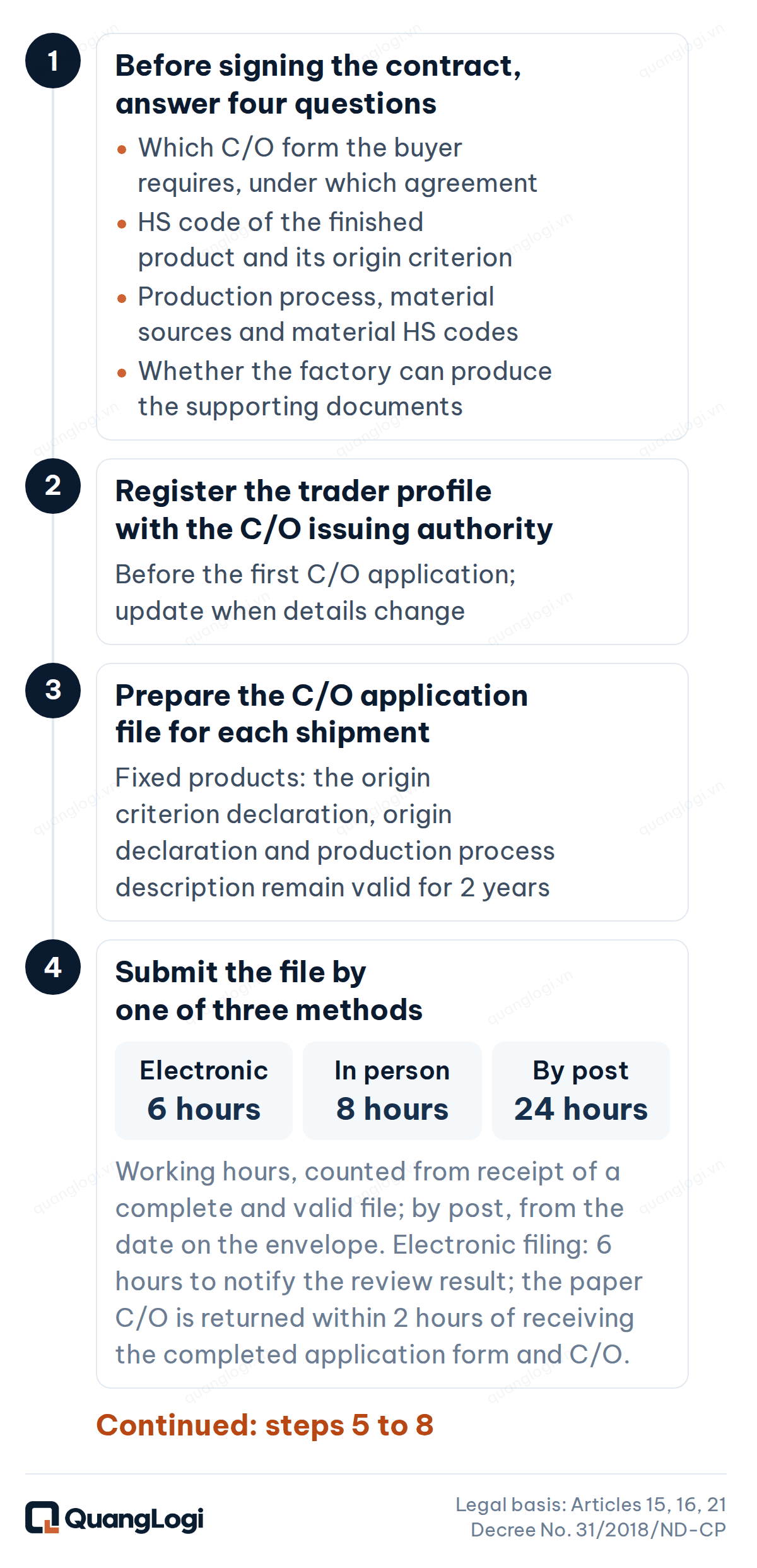
The documents in the C/O application for each consignment are set out in Clause 1, Article 15 of Decree 31/2018/ND-CP, and they fall into three groups according to their purpose: evidence of inputs, evidence of production and evidence of outputs.
| GROUP | DOCUMENT | PURPOSE |
|---|---|---|
| Input | Import declarations for all imported materials | Shows the source and the value of the non-originating materials (an additional document under Point i, Clause 1, Article 15, but the one most often requested) |
| Input | VAT invoice for materials purchased domestically | Applies to the portion of the materials not imported directly |
| Input | Declaration of origin by the domestic manufacturer or materials supplier under Appendix X to Circular 05/2018/TT-BCT, accompanied by that supplier's supporting evidence of origin | Provides the basis for counting the materials purchased domestically as originating (Point g, Clause 1, Article 15) |
| Production | Statement of exported goods meeting the origin criteria, using the templates in Appendices II to IX to Circular 05/2018/TT-BCT | Shows the types of materials used, the quantity of each type per unit of product, the value of the input materials, and how these materials meet the origin criterion (Point e, Clause 1, Article 15) |
| Production | Production-process description | Shows that the operations carried out in Vietnam are not among the simple working or processing operations in Article 9 (Point h, Clause 1, Article 15) |
| Output | Commercial invoice and bill of lading, with the contract and packing list when requested | Gives the details of the export consignment (Point d and Point đ, Clause 1, Article 15) |
| Output | Printout of the cleared export declaration | Confirms that the consignment has actually been exported (Point c, Clause 1, Article 15) |
The application is filed on one of the two systems described in section 4.2, depending on the C/O form.
The document that takes the most time and most often runs into problems is the statement of exported goods meeting the origin criteria. The statement submitted in the application must reconcile on four points at once: the quantity of materials brought in, as shown on the import declarations and the VAT invoices; the quantity of finished goods exported; the production process described in the application; and the origin criterion prescribed for the HS code of the finished product. A single point that does not reconcile and cannot be explained is a ground for refusing to issue the C/O under Clause 3, Article 21 of Decree 31/2018/ND-CP, and after a C/O has been issued the application is still subject to post-issuance verification later.

Read next: C/O application for goods produced in VietnamRead next: Input materials, material usage per unit and production process when applying for a C/O
6. Who does the work, and how long it takes
A company can submit the application itself or engage a customs broker to assist. What matters is not who submits the application but whether the company can put together an application that reconciles on all four points and is sound enough to stand up to both the review for C/O issuance and post-issuance verification later.
Time limits under the regulations. Article 16 of Decree 31/2018/ND-CP sets the time limit for issuing a C/O at 6 working hours from receipt of a complete and valid electronic application, 8 working hours when the application is submitted in person, and 24 working hours when it is submitted by post. Every time limit runs from when the application is complete and valid, not from when it is first submitted.
Time in practice. When the company provides all the information from the outset, preparing the application usually takes one working day. The next working day is spent filing on the system that corresponds to the C/O form and then waiting for approval. If one import declaration for the materials or one purchase invoice is missing, the clock restarts from the time the application is completed; if that time falls at the weekend, the application is normally approved at the start of the following week.
A first application is different from later ones. A company applying for a C/O for the first time must, in addition to preparing the whole application from scratch, complete trader-profile registration with the issuing authority under Article 13 of Decree 31/2018/ND-CP. From 1 August 2026, the company needs to determine which list its C/O form is on. For the 12 forms that appear in both Form No. 17 and Form No. 18, the company may choose to submit to the Agency of Foreign Trade or to the Provincial People's Committee. Applications for the forms that appear only in Form No. 18, including Form E for China, can be submitted at provincial level only. The first application always takes the most time and is checked most closely. For a fixed product, the documents on the origin criterion, the declaration by the supplier and the production process are valid for two years under Clause 2, Article 15, so later applications contain only the documents for each consignment.
Appendix III, Section 1, Point Đ, Clause 5 of Resolution 19/2026/NQ-CP provides that the administrative procedure for retrospective issuance of a C/O under Article 15 and Article 17 of Decree 31/2018/ND-CP is not to be carried out while the resolution is in force. However, as at 15 September 2026, procedure 1.001380 was still published on the Ministry of Industry and Trade Public Service Portal. The two sources are not yet consistent on how this operates in practice, so you should not assume either that applications for a retrospectively issued C/O are still accepted or that they have been stopped altogether. You need to check each case directly with the authority receiving the application. Details are on the page "C/O application for goods produced in Vietnam".


7. Post-issuance verification and record retention
The obligation to prove origin does not end when a C/O is issued. The customs authority of the importing country has the right to request origin verification after clearance of the consignment. On the Vietnamese side, checks and verification are carried out under Article 28 of Decree 31/2018/ND-CP, and the customs authority checks and determines origin under the procedure in Decision 467/QD-CHQ of 29 April 2025, which applies risk management.
What is checked is not the C/O itself but all the documents behind it.
| DOCUMENT CHECKED | WHAT IS CHECKED |
|---|---|
| Import declaration for the materials | Quantity and value of the non-originating materials actually imported |
| VAT invoice for materials purchased domestically | The portion of the materials not imported directly |
| Stock records, accounting books and records | Whether the quantities of materials received into stock and taken out of stock agree with the application as submitted |
| Statement of exported goods meeting the origin criteria | Whether the figures submitted agree with the actual material usage per unit |
| Internal table of material usage per unit | The basis for the figure for material usage per unit in the statement |
| Production-process description | Whether the operations in Vietnam are as described and whether they fall outside the scope of Article 9 |
| Material deduction ledger for each C/O issued | Whether the same quantity of materials has been used for more than one consignment for which a C/O was issued |
Clause 5, Article 30 of Decree 31/2018/ND-CP provides that documentation, documents, information and records used for origin verification are kept confidential. When a competent domestic or international authority asks for them to be disclosed, the trader and the C/O issuing authority or organisation must report to the Ministry of Industry and Trade before disclosing them. This provision does not provide that every verification request or every reply must pass through the C/O issuing authority.
Retention periods under Article 30 of Decree 31/2018/ND-CP:
| PARTY | MINIMUM PERIOD | PERIOD RUNS FROM | METHOD |
|---|---|---|---|
| Trader applying for a C/O | 5 years | Date the C/O is issued | In written form |
| Self-certifying trader | 5 years | Date the origin self-certification document is made out | In written form |
| C/O issuing authority or organisation | 5 years | Date of issuance | Written or electronic |
| Customs authority | 5 years | Date of registration of the customs declaration | Written or electronic |
Keeping records so that they can be retrieved, cross-checked and produced
Clause 3, Article 30 of Decree 31/2018/ND-CP requires a trader applying for a C/O to keep the C/O application and the related documents in written form for at least 5 years from the date the C/O is issued. This provision alone is not a sufficient basis for concluding that every method of electronic storage is invalid. As a matter of records management, you should maintain a set of records that can be retrieved, cross-checked and produced in full when a verification request is made.
Read next: Substantiating origin, C/O record retention and post-issuance verification
8. Seven common errors when applying for a C/O
The seven errors below recur most often in C/O applications, and most of them stem from a decision taken before the application was prepared.
- Declaring the wrong HS code for the finished product, so that the wrong origin criterion is identified.
- Submitting a statement of exported goods meeting the origin criteria that does not match the HS code or the material usage per unit of the consignment covered by the application, usually because the statement was copied from an earlier consignment.
- Having evidence for a smaller quantity of materials than the quantity declared as used: the quantity of goods exported multiplied by the material usage per unit in the statement exceeds the quantity of materials on the import declarations and the purchase invoices.
- Assuming that materials purchased domestically are Vietnamese originating materials, without a declaration of origin by the supplier under Appendix X to Circular 05/2018/TT-BCT.
- Showing an exporter's name, importer's name, description of the goods, unit of measurement or quantity on the C/O that differs from the commercial invoice or the bill of lading.
- Applying the origin criterion of one C/O form to another C/O form by mistake.
- Not having completed trader-profile registration with the authority that issues the C/O form needed, and starting the additional registration only when a consignment arises that needs a form issued only by Provincial People's Committees (Forms E, B, S and X).
The early signs of each error, and what to do when issuance is refused under Article 21 of Decree 31/2018/ND-CP, are on the page "Common errors when applying for a C/O and how to deal with them".
Read next: Common errors when applying for a C/O and how to deal with them
9. Current legal basis
| INSTRUMENT | DATE OF ISSUANCE | EFFECTIVE DATE, STATUS | RELEVANT PROVISIONS |
|---|---|---|---|
| Decree 31/2018/ND-CP, "Detailing the Law on Foreign Trade Management with regard to origin of goods" | 8 March 2018 | 8 March 2018, in force; under Resolution 19/2026/NQ-CP, three administrative procedures in Article 15 and Article 17 are not to be carried out | Articles 4 and 5 (preferential rules of origin); Articles 6 to 12 (non-preferential rules of origin); Article 13 (trader profile); Articles 15 and 16 (application and time limit for issuing a C/O); Article 21 (refusal to issue); Article 28 (checks and verification); Article 30 (record retention) |
| Resolution 19/2026/NQ-CP | 29 April 2026 | 29 April 2026, ceases to have effect on 1 March 2027 (Clause 3, Article 8) | Appendix III, Section 1, Point Đ, Clauses 5, 6 and 7: the procedures for retrospective issuance of a C/O, for C/Os for goods sent to a bonded warehouse, and for C/Os for goods exported to or imported from export processing enterprises and non-tariff zones are not to be carried out. Does not amend the rules of origin |
| Circular 05/2018/TT-BCT, "Providing for origin of goods". Text to consult: Consolidated Text 21/VBHN-BCT of 2025 | 3 April 2018 | 3 April 2018, in force | Non-preferential rules of origin; Article 7 (declaration and undertaking of origin); Appendices II to IX (statement template for each origin criterion); Appendix X (declaration of origin by the domestic manufacturer or materials supplier) |
| Decision 1103/QD-BCT | 21 April 2025 | Applies from 5 May 2025 | Withdraws the power to issue C/Os delegated to the Vietnam Chamber of Commerce and Industry |
| Decision 467/QD-CHQ | 29 April 2025 | 29 April 2025 | The customs authority's procedure for checking and determining the origin of exported and imported goods; an administrative instrument, cited for reference only |
| Decree 146/2025/ND-CP | 12 June 2025 | 1 July 2025, in force | Delegation and decentralisation of powers in the field of industry and trade, including the power to issue C/Os |
| Circular 40/2025/TT-BCT | 22 June 2025 | 1 July 2025, in force, amended by the two circulars below | Article 4 (power to issue); Article 5 (conditions for issuing a C/O); Clause 4, Article 7 (verification of C/Os after the issuing body has ceased to issue) |
| Circular 12/2026/TT-BCT | 9 March 2026 | 1 May 2026, in force | Clause 3, Article 2 abolishes the arrangement in Circular 40/2025/TT-BCT under which intermediary organisations were assigned to issue C/Os |
| Circular 26/2026/TT-BCT | 20 May 2026 | 29 May 2026, except that Clause 3, Article 19 applies from 1 August 2026 under Article 27; in force | Article 19 amends Article 4 of Circular 40/2025/TT-BCT and replaces two appendices with Form No. 17 and Form No. 18; Article 20 (issuing authority for Form UAE-VN) |
Note on status: the status of the instruments was checked on 12 September 2026 against the register for tracking instruments; Decree 31/2018/ND-CP and Resolution 19/2026/NQ-CP were checked against the full text on 13 September 2026; the three circulars, Circular 40/2025/TT-BCT, 12/2026/TT-BCT and 26/2026/TT-BCT, were checked against the full text on 12 September 2026. The product-specific rules of each agreement are in a separate circular; the fourth column of table 4.1 cites the correct circular and the text to consult for each agreement.
10. Read next, in order
The seven links below use the URL pattern nested under the parent category, which matches the canonical tag of each page.
Before signing a contract
- Conditions for goods to be of Vietnamese origin. Wholly obtained, substantial transformation, and the simple working or processing operations that are not taken into account.
- Origin criteria by FTA and C/O form. The same goods may qualify as originating under one agreement but not under another.
When preparing for production
- Input materials, material usage per unit and production process when applying for a C/O. The three groups of documents evidencing the origin criterion, and the four-way cross-check.
When preparing the application
- C/O application for goods produced in Vietnam. From first-time trader-profile registration to the application for each consignment, and the issuing authority for each C/O form from 1 August 2026.
- Customs documentation and procedures for exports. The export declaration and where it connects with the C/O application.
After the goods have been dispatched
- Substantiating origin, C/O record retention and post-issuance verification. The documents that must be kept and how to respond to a verification.
- Common errors when applying for a C/O and how to deal with them. The errors repeated most often in real applications.
11. Author

Hoàng Ngọc Quang (QuangLogi)
Registered customs-broker staff member assigned an identification number by Vietnam Customs under Official Letter No. 249/GSQL-TH dated 20 February 2025.
Customs declaration professional certificate No. 165/2018/KHQ-HN.
Vice Director of GIANG TO VIEN DUONG INTERNATIONAL TRANSPORT Co., Ltd. (Luchi Vietnam).
Member of the Vietnam Association for Logistics Manpower Development (VALOMA) under Admission Decision No. 1003/QD-BCH.
Trained as a lawyer in Course IX of the lawyer training programme for international integration at the Judicial Academy.
More than ten years handling documents and customs procedures on the China-Vietnam-Cambodia corridor, including C/O applications for goods exported from Vietnam and C/O files for goods imported from China.
About the author
I write as someone who prepares these applications myself. Any case and client details in the examples have been anonymised.